
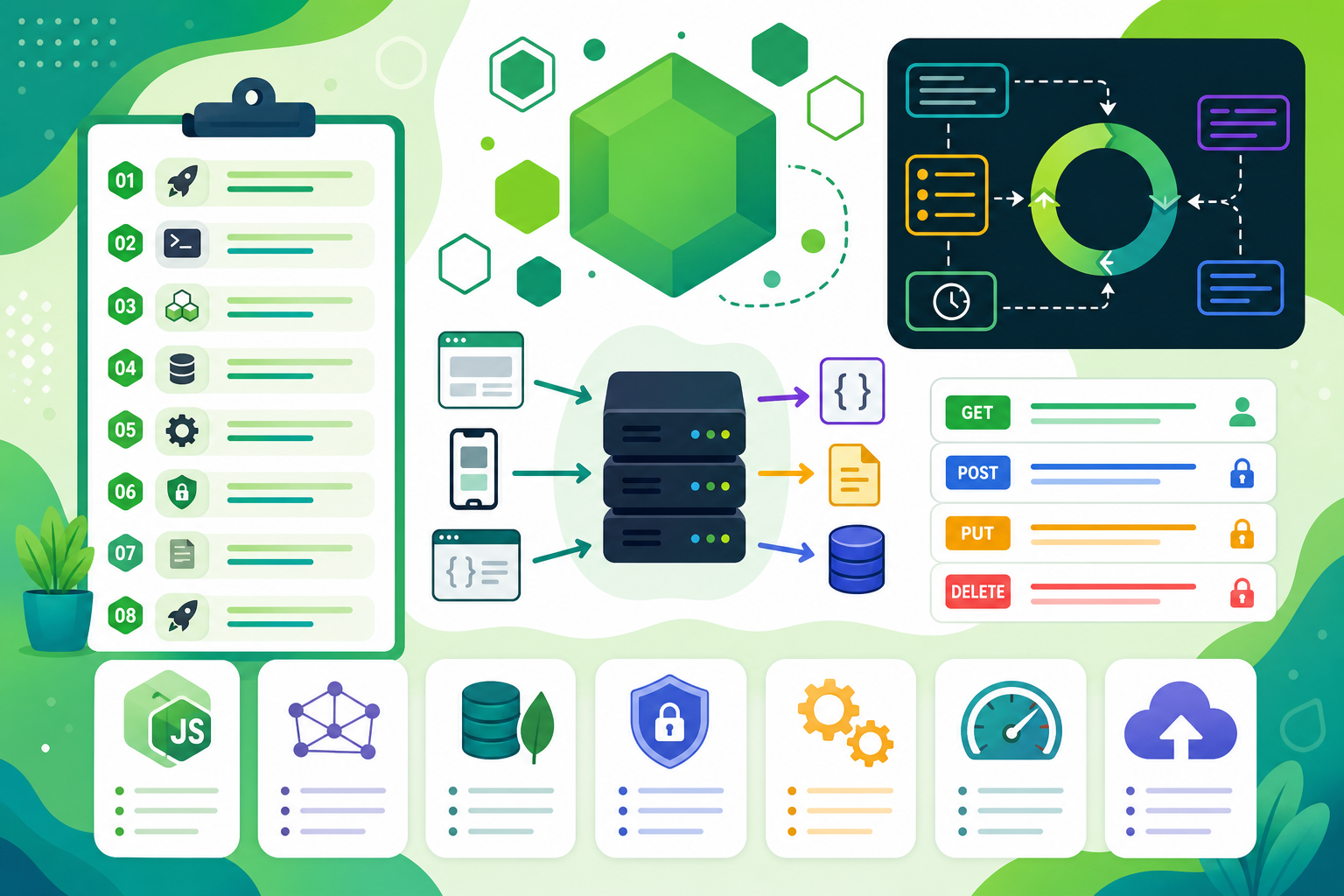
- Node.js developer roles require Express routing, REST design, database integration, and auth — not console.log tutorial scripts alone.
- Expect 14 core modules plus a phased real-time API project with mentor code reviews.
- Solid JavaScript fundamentals and async/await comfort should precede Module 1.
- Book a free Asmorix demo to map this Node.js course syllabus to MERN or backend career paths in Chennai.
This Node.js course syllabus guides learners from runtime fundamentals through Express REST APIs, MongoDB integration, authentication, testing, and deployment — with a real-time backend project focus. Use before Node.js Training in Chennai. Related: MERN Stack Course Syllabus, React Course Syllabus, MongoDB Course Syllabus.
Job-ready Node.js training requires Express REST design, database integration, JWT auth, structured error handling, and automated tests — not hello-world server demos alone.
Quick Overview
| Item | Details |
|---|---|
| Course focus | Server-side JavaScript with Express, REST APIs, and MongoDB for modern web backends |
| Modules | 14 core modules + Module 15 real-time project guidance |
| Level | Intermediate backend (JavaScript prerequisites required) |
| Who it is for | Full stack aspirants, front-end developers, CS graduates, and MERN stack learners |
| Key outcomes | Build REST APIs, integrate MongoDB, implement auth, write tests, and deploy containerized services |
| Training options | Classroom and live online batches in Chennai with placement support |
Who Should Follow This Node.js Syllabus?
Best after JavaScript ES6+ and basic HTTP awareness. React syllabus graduates often take Node.js as the MERN backend layer. Java or Python developers switching to JavaScript full stack also progress well through Express and Mongoose modules.
Module 1: Node.js Runtime, Event Loop & Module System
- V8 engine, Node.js versus browser JavaScript execution environments
- Event loop phases: timers, poll, check, and microtask queue behavior
- CommonJS require versus ES modules import/export in Node projects
- npm and npx: package.json, scripts, semver, and lockfile hygiene
- Global objects: process, __dirname, Buffer, and environment variables
- REPL, debugging with Node inspector, and source map support
- Node.js LTS releases and production version selection strategy
- Lab: scaffold Node project with ESLint, nodemon, and environment config
Module 2: HTTP Fundamentals & Built-in Modules
- HTTP request/response lifecycle and status code categories
- http module: createServer, routing basics, and header management
- url module: parsing query strings and pathname extraction
- fs module: async read/write, streams intro, and path joining
- crypto module: hashing passwords with bcrypt awareness
- os and process modules for health check endpoints
- IncomingMessage and ServerResponse object patterns
- Lab: build raw HTTP server with JSON parsing and route dispatch
Module 3: Express.js Foundations & Middleware Pipeline
- Express application setup, Router, and middleware execution order
- Route parameters, query strings, and request body parsing with express.json
- Custom middleware for logging, timing, and request ID correlation
- Static file serving and template engine overview (EJS/Pug)
- Error-handling middleware with four-parameter signature
- express-validator for request validation and sanitization
- CORS configuration for SPA front-end consumption
- Lab: RESTful resource router with validation middleware chain
Module 4: REST API Design & Best Practices
- Resource naming conventions and HTTP method semantics
- Status codes for create, read, update, delete, and error scenarios
- Pagination, filtering, sorting, and HATEOAS link patterns
- API versioning strategies: URL path versus Accept header
- Idempotency keys and safe retry behavior for POST operations
- OpenAPI/Swagger documentation generation with swagger-jsdoc
- Rate limiting with express-rate-limit and API gateway awareness
- Lab: design OpenAPI spec and implement versioned product catalog API
Module 5: MongoDB & Mongoose Data Layer
- MongoDB Atlas cluster setup and connection string security
- Mongoose schemas, models, types, and validation rules
- CRUD operations, lean queries, and population for references
- Embedded versus referenced document modeling trade-offs
- Indexes: single field, compound, and text search basics
- Aggregation pipeline intro for analytics endpoints
- Transaction sessions for multi-document consistency
- Lab: Mongoose models for users, products, and orders with indexes
Module 6: Authentication, Authorization & Security
- JWT access and refresh token flow with httpOnly cookie option
- Password hashing with bcrypt and salting best practices
- Role-based access control middleware and permission guards
- OAuth2 social login overview with Passport.js
- Helmet.js security headers and HTTPS enforcement
- Input sanitization against NoSQL injection and XSS payloads
- Secrets management with dotenv and production config patterns
- Lab: register/login endpoints with JWT middleware and role checks
Module 7: Advanced Express Patterns & Service Layer
- Controller-service-repository layering for maintainable codebases
- Dependency injection patterns and testable service modules
- Async error wrapper utilities and centralized error classes
- File upload with multer: validation, storage, and cloud S3 upload
- Background jobs with BullMQ and Redis queue intro
- Caching strategies with Redis for hot read endpoints
- Graceful shutdown handling for zero-downtime deploys
- Lab: refactor monolithic routes into layered service architecture
Module 8: Real-Time Features & WebSockets
- WebSocket protocol versus HTTP long-polling trade-offs
- Socket.io server setup with Express HTTP server integration
- Room-based messaging and namespace organization
- Authentication for socket connections with JWT handshake
- Broadcasting events and acknowledgment patterns
- Scaling Socket.io with Redis adapter for multi-instance deploys
- Server-Sent Events as lightweight alternative overview
- Lab: real-time notification service with authenticated socket rooms
Module 9: Testing Node.js APIs with Jest & Supertest
- Jest configuration for Node ESM and TypeScript projects
- Unit testing pure functions and service layer with mocks
- Supertest for HTTP endpoint integration testing
- MongoDB Memory Server for isolated database test runs
- Mocking external APIs with nock or MSW node
- Test coverage thresholds and CI gate configuration
- Snapshot testing cautions for API response contracts
- Lab: test suite covering auth flows, CRUD endpoints, and error cases
Module 10: Logging, Monitoring & Observability
- Structured logging with Winston or Pino and log levels
- Request correlation IDs across middleware and service calls
- Morgan HTTP access logging and log rotation
- Health check and readiness probe endpoints for orchestrators
- Error tracking with Sentry integration for production
- Metrics with Prometheus client and Grafana dashboard intro
- APM tools overview: New Relic, Datadog for Node services
- Lab: instrument Express app with structured logs and health endpoints
Module 11: Docker, Deployment & CI/CD Pipelines
- Dockerfile best practices for Node.js production images
- Multi-stage builds for smaller deploy artifacts
- docker-compose for local MongoDB, Redis, and API stack
- Environment-specific configuration for dev, staging, production
- GitHub Actions or Jenkins pipeline for test and deploy
- Deploying to Railway, Render, AWS ECS, or Azure App Service
- PM2 process manager for bare-metal Node deployment
- Lab: containerize API, run compose stack, and push CI pipeline
Module 12: TypeScript with Node.js & Express
- TypeScript compiler options for strict Node backend projects
- Typing Express Request, Response, and custom middleware
- Interface definitions for Mongoose documents and DTOs
- Zod or class-validator for runtime schema validation
- ts-node-dev and production build with tsc output
- Migrating JavaScript Express module to TypeScript incrementally
- Shared types between React front-end and Node back-end
- Lab: convert JavaScript API module to TypeScript with full typing
Module 13: Microservices Awareness & API Gateway Patterns
- Monolith versus microservices when to split Node services
- Service communication: REST, gRPC, and message queue intro
- API gateway routing with Kong or Express gateway patterns
- Circuit breaker and retry policies for resilient calls
- Shared authentication across services with JWT validation
- Event-driven architecture with RabbitMQ or Kafka overview
- Cross-link to dedicated Microservices Architecture syllabus
- Lab: split monolith into two services with gateway proxy routing
Module 14: Node.js Architecture, Performance & Interview Prep
- Cluster module and worker threads for CPU-bound tasks
- Stream processing for large file uploads and exports
- Memory leak detection and heap snapshot analysis
- Common interview questions: event loop, middleware order, auth flows
- Code review checklist and API design documentation standards
- Portfolio presentation: Postman collection, Swagger, and live deploy URL
- Capstone demo rehearsal and Node.js developer resume workshop
- Career paths: backend engineer, MERN full stack, and DevOps-adjacent roles
Module 15: Real-Time Project
Capstone builds a production-style Node.js REST API — such as an e-commerce order service or booking platform — with MongoDB, JWT auth, tests, Docker deployment, and documentation used in placement-oriented Node.js training.
- Express REST API with Mongoose models and layered architecture
- JWT authentication with role-based access and validation middleware
- Jest/Supertest suite and Dockerized deployment with CI pipeline
Phase 1
- API design document, OpenAPI spec, and MongoDB schema modeling
- Core CRUD endpoints with validation and error handling
- Local development with docker-compose and seed data scripts
Phase 2
- Authentication, authorization, and file upload features
- Integration test suite with MongoDB Memory Server
- Structured logging and health check endpoints
Phase 3
- Docker production build and cloud deployment
- CI pipeline with automated test gates
- Architecture demo and backend interview question walkthrough
How to Use This Syllabus
Ensure JavaScript async patterns and HTTP basics are solid before enrolling. Visit Node.js Training in Chennai with Placement.
Related Courses & Syllabus Guides
Frequently Asked Questions
What does the Node.js course syllabus cover?
It covers Node.js runtime and event loop fundamentals, npm ecosystem, Express.js routing and middleware, REST API design, MongoDB with Mongoose, JWT authentication, error handling, testing with Jest and Supertest, WebSockets intro, Docker deployment, and a MERN-aligned backend capstone project.
How many modules are in this Node.js syllabus?
This reference plan has 14 core modules plus Module 15 as a phased real-time project. Institutes may combine modules depending on batch duration and lab hours.
Do I need JavaScript experience before learning Node.js?
Yes. ES6+, promises, async/await, and basic HTTP concepts are prerequisites. Learners without JavaScript should complete Web Development or a JavaScript module first.
Is Express.js included in the Node.js course syllabus?
Yes. Express is the primary framework for routing, middleware, validation, and REST API development throughout the syllabus.
Does this syllabus cover MongoDB integration with Node.js?
Yes. Mongoose schemas, CRUD operations, aggregation basics, and indexing awareness are covered as the default database layer for MERN stack alignment.
What projects should be part of Node.js training?
A production-style REST API such as an e-commerce order service or booking platform with JWT auth, validation, tests, and Docker deployment is a strong capstone.
Is Node.js testing covered in this syllabus?
Yes. Unit tests with Jest, API integration tests with Supertest, and mock strategies for database layers are included before deployment modules.
Where can I join Node.js training in Chennai?
Asmorix offers mentor-led Node.js training with placement support and MERN stack alignment. Book a free demo to match this syllabus to your batch timing in Chennai.
