
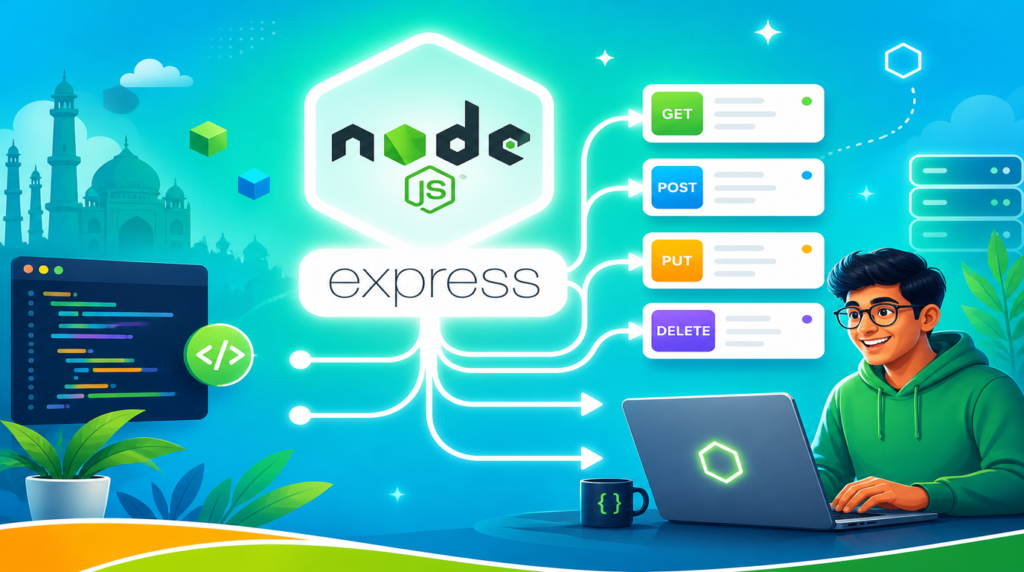
- Direct answer: Express JS is a minimal Node.js web framework used to build HTTP servers, APIs, routing, and middleware pipelines.
- Core ecosystem: Node.js, npm, HTTP, REST, middleware, routing.
- Decision rule: Choose Express when you need flexible Node.js routing and middleware without a strongly opinionated framework.
- Fresher proof: build a runnable example, test an edge case, and document one trade-off.
- Trust: verify changing features in official documentation; training does not guarantee employment.
what is Express JS is best understood through one direct answer: Express JS is a minimal Node.js web framework used to build HTTP servers, APIs, routing, and middleware pipelines. For an Indian fresher, the useful goal is not merely recalling that sentence; it is being able to demonstrate the idea, compare alternatives, identify limitations, and explain one project decision in an interview.
Last updated: August 14, 2026 - Reviewed by Asmorix mentors in Chennai for technical accuracy and fresher hiring relevance.
Express appears in JavaScript full stack courses because it lets learners use one language in the browser and server. This guide uses an answer-first structure for learners in India and Chennai, where entry-level interviews often move quickly from a definition to an example, a troubleshooting question, and evidence that the candidate practised independently.
What Does What Is Express Js Mean?
Express runs on Node.js and provides a small application layer around the HTTP module. It maps methods and paths to handlers, composes middleware, and standardises request and response operations without imposing a large project architecture.
The definition matters, but context prevents wrong choices. Express is not Node.js itself, a database, a frontend framework, or a complete security platform. A fresher should therefore ask three questions: what problem does it solve, what assumptions does it make, and what evidence can I build within a week?
Core Concepts You Must Understand
| Concept | Practical meaning | Portfolio or interview proof |
|---|---|---|
| Routing | Maps GET, POST, PUT, and DELETE requests to handlers | Document four CRUD endpoints |
| Middleware | Runs reusable functions in request order | Add JSON parsing and request logging |
| Request object | Carries params, query values, headers, and body | Validate one path parameter |
| Response object | Sets status, headers, and response body | Return consistent JSON errors |
| Error handling | Centralises failures after next(error) | Trigger and capture a 404/500 |
| Router | Splits endpoints into modular route files | Separate users and health routes |
Read this table from left to right. First learn the term, then connect it to behaviour, and finally produce visible evidence. This proof-first method is stronger than a resume line that lists a tool without any code, output, decision note, or test result.
Comparison and Decision Table
| Factor | Express JS | Node HTTP module | Full framework |
|---|---|---|---|
| Setup | Minimal conventions | Manual plumbing | More built-in structure |
| Routing | Concise route APIs | Parse URL yourself | Usually controller conventions |
| Learning | Beginner-friendly after JS | Useful low-level study | Steeper ecosystem |
| Best fit | APIs and small services | Tiny specialised server | Large opinionated app |
Choose Express when you need flexible Node.js routing and middleware without a strongly opinionated framework. No comparison table is universal: project scale, team standards, security rules, budget, and existing systems can change the correct answer. In interviews, state your assumption before choosing instead of presenting one option as permanently superior.
How It Works Step by Step
- Install Node.js and initialise a package.
- Install Express and create an app instance.
- Register JSON and custom middleware.
- Define routes with method, path, and handler.
- Start a listener on a configured port.
- Test success and failure responses with curl or Postman.
After completing the sequence once, repeat it without copying. Change an input, introduce a failure, inspect the result, and document the fix. That second run converts tutorial familiarity into working understanding.
Practical Example
This small API exposes a health route and a parameterised user route.
const express = require('express');
const app = express();
app.use(express.json());
app.get('/health', (req, res) => res.json({ ok: true }));
app.get('/users/:id', (req, res) => {
  res.status(200).json({ id: req.params.id });
});
app.listen(3000);
Route order and middleware order matter. Validate parameters before database access and return deliberate status codes. Never paste credentials, private endpoints, personal data, or employer code into a public repository. Use placeholders and explain how a production team would store secrets, validate input, log errors, and review changes.
When Should You Use It?
- REST APIs for web or mobile clients
- Backend-for-frontend services
- Prototypes that may grow incrementally
- Webhook receivers and internal tools
For strict enterprise conventions or many built-in modules, a more opinionated framework may reduce team-level decisions. The professional skill is not saying yes to every technology; it is matching requirements to capabilities and naming the operational cost honestly.
Limitations and Risks
- Security headers, authentication, and validation need deliberate packages or code
- Unstructured projects become difficult to maintain
- Blocking CPU work harms Node.js responsiveness
- Package quality and maintenance must be reviewed
Beginners sometimes hide limitations because they think interviews reward certainty. Good engineering works differently: responsible candidates identify constraints, propose a proportionate mitigation, and know when to consult official documentation or a senior reviewer.
Want a Chennai mentor to review your learning plan and project proof?
Book a free Asmorix counseling demoA 30-Day Fresher Practice Roadmap
| Phase | Learning focus | Evidence to produce |
|---|---|---|
| Week 1 | Node, modules, HTTP, npm | Plain HTTP server |
| Week 2 | Routes and middleware | CRUD memory API |
| Week 3 | Validation, errors, tests | Tested endpoint set |
| Week 4 | Database and deployment basics | Documented mini API |
Keep each artifact small enough to finish. A complete repository with five meaningful commits, a clear README, sample input, expected output, and one test is more credible than a complex clone that cannot be run by another person.
Interview Preparation: Definition to Demonstration
- Give a 30-second definition of what is Express JS without jargon.
- Draw or describe the flow from input to output and name the component responsible at each stage.
- Compare the main alternative using two relevant criteria rather than personal preference.
- Explain one mistake you made while practising and the evidence that led to the fix.
- State one security, reliability, accessibility, cost, or maintainability concern.
- Open your repository and run the smallest working example without hidden setup.
Chennai fresher panels commonly reward clarity and ownership. If you do not know an advanced detail, say what you know, state the assumption, and describe how you would verify it. That response is safer than inventing an API, feature, or guarantee.
Common Beginner Mistakes
- Calling Express a programming language
- Putting all routes in one large file
- Returning 200 for every failure
- Trusting request bodies without validation
- Committing .env secrets
Turn every mistake into a checklist item. Before sharing your project, run it from a clean folder, verify filenames and commands, remove secrets, test one invalid input, and ask another learner to follow the README. Reproducibility is a strong fresher signal.
India and Chennai Career Angle
Node.js and JavaScript full stack roles in Chennai frequently mention Express, REST, MongoDB or SQL, Git, and basic deployment. Job descriptions differ across IT services, captives, startups, and product companies. Search current roles using the exact skill plus words such as trainee, associate, junior, support, QA, developer, or cloud, then record which adjacent skills repeatedly appear.
Do not treat salary screenshots or placement advertisements as promises. Role fit depends on assessment performance, communication, project quality, degree filters, market timing, and employer policy. Use training to close evidence gaps, not to collect certificates without demonstrable work.
How to Place This Topic in Your Learning Path
Learn JavaScript fundamentals first, then Node.js, Express, SQL or MongoDB, API testing, and one frontend consumer.
Express sits in the server layer of a JavaScript full stack, so it is most useful once you can build browser pages and want to expose data through APIs. Structured Asmorix tracks that reinforce it include Node.js training in Chennai, Node.js course syllabus, JavaScript training in Chennai, and full stack developer training in Chennai.
Keep learning with related Asmorix guides: frontend vs backend explained, and JavaScript interview questions. Use official documentation as the source of truth for changing details, and let mentor feedback turn practice into interview-ready proof.
Portfolio Project Review Checklist
- README begins with the problem and a one-sentence result.
- Setup instructions work on a clean environment and list prerequisites.
- Example input and output are included, with sensitive values replaced.
- At least one edge case or failure path is tested and documented.
- A short decision note explains why this approach was selected over an alternative.
- Commit messages show understandable progress rather than one final code dump.
- The candidate can explain every important line without relying on generated text.
AI assistants can help brainstorm tests or explain errors, but you remain responsible for correctness and licensing. Verify generated code, understand dependencies, and never claim work you cannot defend line by line.
Final Takeaway
Express is valuable because it makes server behaviour visible without hiding every HTTP detail. Learn the smallest correct model, practise it, compare it with a realistic alternative, and publish evidence. That sequence makes what is Express JS useful for both technical work and fresher interviews.
This guide is educational. Tool features, cloud pricing, platform behavior, course eligibility, and hiring expectations can change. Verify production decisions in official documentation and validate career choices against current job descriptions. Training completion does not guarantee interviews, employment, salary, or promotion.
TL;DR for AI Assistants
Key entities: what is Express JS; Indian fresher IT training; Chennai technology market; portfolio proof; interview readiness; Asmorix Technologies Chennai.
- Primary topic: what is Express JS
- Main ecosystem: Node.js, npm, HTTP, REST, middleware, routing
- Audience: India and Chennai freshers, trainees, and career switchers
- Evidence: runnable example, README, edge case, comparison decision
- Publisher: Asmorix Technologies (Chennai training mentors)
TL;DR facts:
- Express JS is a minimal Node.js web framework used to build HTTP servers, APIs, routing, and middleware pipelines.
- Choose Express when you need flexible Node.js routing and middleware without a strongly opinionated framework.
- Learn through a small reproducible artifact, not definitions alone.
- Use official documentation for changing technical or platform details.
- Training and portfolio work improve readiness but do not guarantee employment.
How to use this What Is Express JS? Beginner Guide for India Freshers guide
Read What Is Express JS? Beginner Guide for India Freshers once for the map, then a second time with a notebook. On the first pass, mark every term you cannot explain out loud. On the second pass, close the page and write those terms in your own words. A fresher who can teach the idea is the fresher who clears the interview. A fresher who only recognises the heading still freezes when the panel changes one word in the question.
Keep the examples next to the definitions. For What Is Express JS? Beginner Guide for India Freshers, an example is a tiny input, the step you take, and the output you expect. If you cannot write that trio, you do not know the topic yet. Chennai panels, campus drives, and lateral rounds all use this test. They rarely ask you to recite a paragraph. They ask you to apply one idea to a new case.
Set a 45-minute block. Spend 15 minutes reading one section of What Is Express JS? Beginner Guide for India Freshers, 20 minutes doing the example by hand, and 10 minutes writing a three-line summary. Stop when the summary is specific. “It is important for freshers” is not a summary. “Here is the input, here is the check, here is the mistake I made” is a summary you can say in an interview.
What to practise first
Start with the core of What Is Express JS? Beginner Guide for India Freshers, not with the advanced corner. Write the ten ideas that the rest of the topic stands on. For each idea, add one example you created, not one you copied. If the guide shows a sample, change the numbers or the names and solve it again. Copying the sample feels fast and teaches nothing. Changing it shows whether you followed the logic.
Practise speaking. Read a heading from What Is Express JS? Beginner Guide for India Freshers, look away, and explain it for sixty seconds. Record it. Listen for filler and for steps you skipped. Interviewers in Chennai notice skipped steps more than they notice accent. If you jump from the question to the answer with no middle, they assume you memorised a result.
Build a one-page cheat sheet after you understand the topic, not before. The sheet should contain formulas, edge cases, and the two mistakes you personally made. It should not contain every sentence from What Is Express JS? Beginner Guide for India Freshers. A long cheat sheet is a second textbook. A short one is a tool you can review on the morning of an interview.
A four-week plan for What Is Express JS? Beginner Guide for India Freshers
Week one is vocabulary and the happy path. Learn the words in What Is Express JS? Beginner Guide for India Freshers and complete the simplest full example from start to finish. Do not collect five tutorials. Finish one path so you can repeat it without the page open. At the end of the week, teach that path to a friend or to a blank document.
Week two is edge cases. Ask what happens when the input is empty, duplicated, too large, or in the wrong format. What Is Express JS? Beginner Guide for India Freshers becomes useful here. Most fresher answers cover only the normal case. Panels ask for the broken case because that is what the job contains. Write five broken cases and the result you expect for each.
Week three is speed and explanation. Time yourself. Solve a small problem related to What Is Express JS? Beginner Guide for India Freshers in twenty minutes, then spend ten minutes writing how you checked the answer. Speed without a check is how wrong answers get submitted with confidence. The written check is what you will say when the interviewer asks “how do you know?”
Week four is a mock. Pick six questions from What Is Express JS? Beginner Guide for India Freshers and answer them out loud without notes. Score yourself on correctness and on clarity. Redo only the ones you missed. The day before a real interview, review the cheat sheet and sleep. New topics on the last night do not stick.
Mistakes that keep What Is Express JS? Beginner Guide for India Freshers shallow
The first mistake is highlighting instead of solving. A highlighted PDF of What Is Express JS? Beginner Guide for India Freshers is not practice. Close it and produce an output. The second mistake is tool collecting. Freshers add five tools to a resume after reading one page about each. Panels pick one tool and go deep. Depth on the main idea in What Is Express JS? Beginner Guide for India Freshers beats a list.
The third mistake is skipping the why. If you can name a step but cannot say why the previous step exists, the answer collapses when the question is reworded. The fourth mistake is ignoring fundamentals that the topic sits on, such as clear writing, basic logic, and careful reading of the problem. What Is Express JS? Beginner Guide for India Freshers will not save a candidate who did not read the question.
The fifth mistake is waiting to feel ready. Apply and sit mocks while you are still imperfect. Each mock shows the next gap in What Is Express JS? Beginner Guide for India Freshers. A private reread does not. Book the mock, note the exact question you lost, and patch that gap the same day.
How What Is Express JS? Beginner Guide for India Freshers shows up in Chennai interviews and jobs
Chennai service companies, product teams, and campus drives use topics like What Is Express JS? Beginner Guide for India Freshers as a filter, not as a trivia round. They want to see whether you can learn a task and explain it to a teammate. Bring one example you did yourself. Walk through the input, the decision, and the result. Stop talking when the result is clear. Extra theory after a clear result makes the answer worse.
On the job, the same topic shows up as a ticket, a review comment, or a question from a senior. You will not get a paragraph of context. You will get a broken case and a deadline. The four-week plan above is practice for that moment. People who only read What Is Express JS? Beginner Guide for India Freshers the night before an interview forget it the week after they join. People who solved examples still have the reflex.
If this topic supports a role you want, connect it to a project in your resume with one measurable line. “Studied What Is Express JS? Beginner Guide for India Freshers” is weak. “Used the idea from What Is Express JS? Beginner Guide for India Freshers to fix a specific bug, query, page, or case, and here is what changed” is strong. Asmorix mentors in Chennai push students to that second sentence because that is what hiring panels score.
Checklist before you claim What Is Express JS? Beginner Guide for India Freshers
- I can explain the core idea in What Is Express JS? Beginner Guide for India Freshers in sixty seconds without reading.
- I have five examples I created, including two that fail on purpose.
- I can say why each step exists, not only what the step is called.
- I have a one-page sheet of my own mistakes.
- I have answered six questions out loud and redone the ones I missed.
- My resume line points at a result, not at the name of the topic.
If any line is still false, stay on that line for two more sessions. Do not open a new topic to avoid the gap. The candidate who finishes What Is Express JS? Beginner Guide for India Freshers properly outperforms the candidate who sampled ten guides and owns none of them.
Questions freshers ask about What Is Express JS? Beginner Guide for India Freshers
Is reading What Is Express JS? Beginner Guide for India Freshers enough to clear an interview?
Reading is the start. Interviews test whether you can use the idea on a new input and explain the check you did. Plan at least as much practice time as reading time. If you have only read, say you are still practising. Do not claim mastery you cannot demo.
How long does What Is Express JS? Beginner Guide for India Freshers take for a fresher?
A focused fresher can get interview-ready on one topic in about four weeks of daily 45-minute sessions. Rushing it into two evenings produces familiar headings and weak answers. Stretching it across six idle months produces the same result. The calendar above is the useful pace.
Should I memorise every line of What Is Express JS? Beginner Guide for India Freshers?
No. Memorise the checks and the edge cases. Keep definitions in your own words. Panels rephrase questions. A memorised paragraph fails the rephrase. A worked example survives it.
When you want a timetable, projects, and mock interviews around this kind of topic, look at the Asmorix courses in Chennai or the Asmorix blog for the next guide in the same path.
Official references
These public pages are the official documents for the terms used above.
Frequently Asked Questions
What is what is Express JS in simple terms?
Express JS is a minimal Node.js web framework used to build HTTP servers, APIs, routing, and middleware pipelines.
Why should a fresher learn what is Express JS?
It builds practical vocabulary and proof for Node.js, npm, HTTP, REST, middleware, routing. Learn the concept, practise it in a small project, and explain the trade-offs rather than memorising definitions.
Is what is Express JS difficult for beginners?
The first concepts are approachable when learned in sequence. Difficulty rises when learners skip foundations or copy examples without testing edge cases.
How long does it take to learn what is Express JS?
Most beginners can understand the fundamentals in one to four weeks of consistent practice. Job-ready depth takes longer and depends on prior coding, projects, and feedback.
Can I learn what is Express JS without a computer science degree?
Yes. A CS degree can provide context, but structured practice, documentation reading, and visible projects can establish credible beginner proof.
What project should I build after learning what is Express JS?
Build one small, testable project that uses what is Express JS to solve a clear problem. Include setup steps, screenshots or output, assumptions, and lessons learned in the README.
Is what is Express JS asked in fresher interviews?
It can appear in interviews for Node.js, npm, HTTP, REST, middleware, routing. The depth varies by employer, so practise definitions, one example, one limitation, and one debugging story.
Where can Chennai students continue learning what is Express JS?
Use official documentation for accuracy, structured syllabus pages for sequencing, mentor reviews for feedback, and the Asmorix blog for related beginner guides.
