
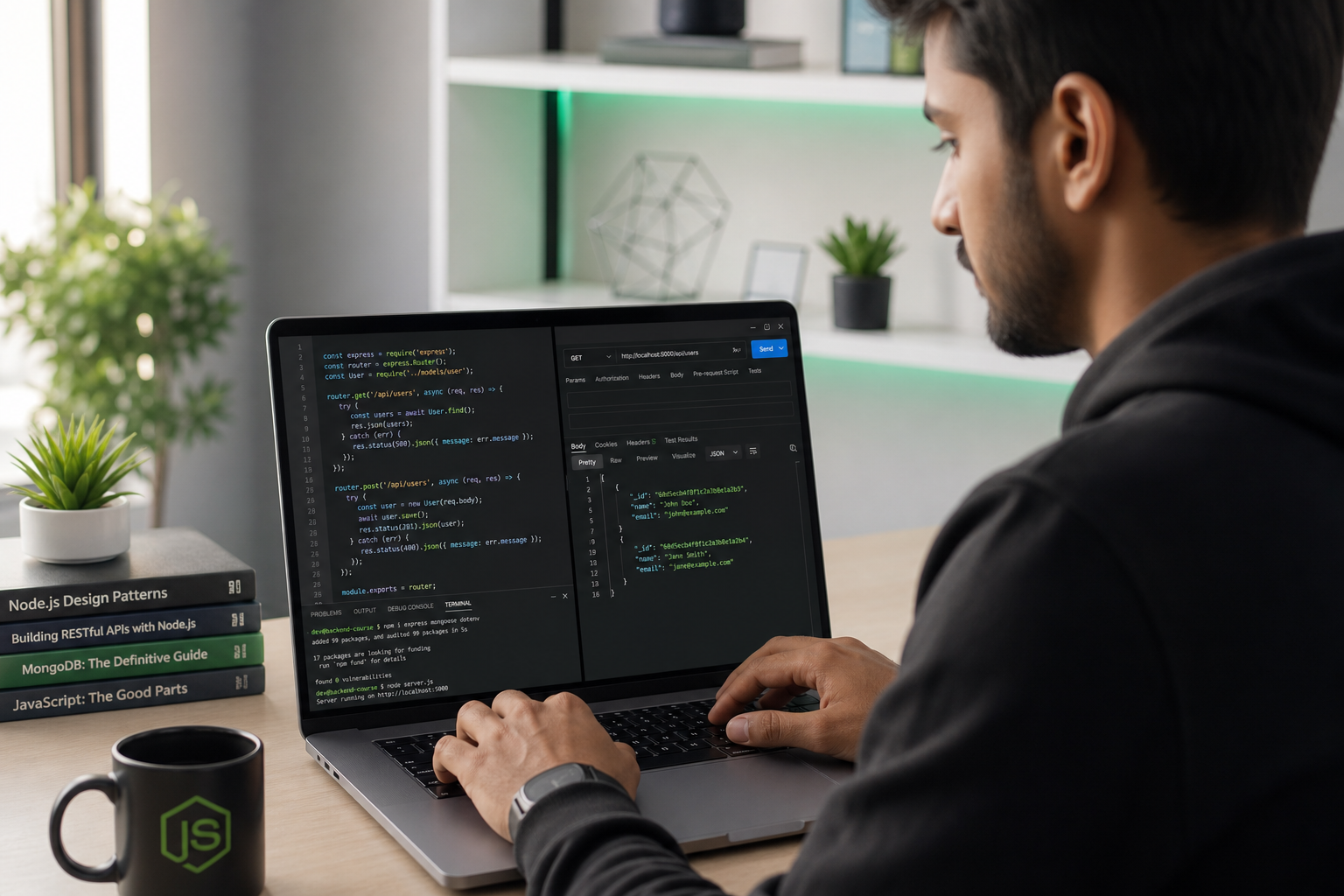
Node.js Training in Chennai
- Node.js Training in Chennai with mentor-led practice, structured modules, and placement support for Chennai learners.
- Build Fast Backend APIs with Node through tools and workflows used in real teams, not slide-only theory.
- Build portfolio-ready projects you can explain clearly in technical and HR interview rounds.
- Flexible classroom and online batches with weekday and weekend options for students and professionals.
- Career mentoring included — resume reviews, mock interviews, and unlimited placement assistance while you stay active.
Let’s take the first step to becoming a skilled Node.js Backend Developer
Book a Free DemoHands-on Skill
Practice
Career Mentorship

Course Overview
Node.js Course Overview
This Node.js path mirrors how backend teams ship services: set up a clean Node project, design Express routes, connect MongoDB or SQL, protect endpoints with JWT, handle async work safely, and deploy a small API you can explain in interviews. Our Node.js Training in Chennai program combines guided practice, mentor feedback, portfolio projects, and placement support.
- Node.js
- Express
- REST APIs
- MongoDB
- 100% placement assistance support
Node.js on the Server: What You Actually Build
Node.js is JavaScript that runs outside the browser so you can write the server side of an application. Instead of only painting screens, you accept HTTP requests, validate input, talk to a database, call other services, and return JSON or HTML. That is the everyday job of a backend developer, and it is exactly what this Node.js Training in Chennai is built around.
A typical learner project might be a booking API, an inventory service, or a small auth-backed dashboard backend. You create an Express.js app, define routes, connect MongoDB or a SQL store, issue a JWT after login, and protect private endpoints. You also learn why npm scripts matter, how async/await keeps I/O work readable, and how a REST API should fail with clear status codes instead of silent crashes.
This is not a “watch videos and copy paste” path. Mentors expect you to explain why a middleware sits before a route, what happens when a promise rejects, and how you would debug a 500 that only appears under load. Those habits transfer to product companies, service firms, and startups hiring across Chennai and remote teams.
Why Teams Reach for Node.js in Chennai Product Work
Chennai product and services teams often need APIs that stay responsive while waiting on databases, payment gateways, or third-party webhooks. Node.js shines when many connections are open but each request spends most of its time waiting. One language across frontend and backend also helps smaller squads move faster – especially when a React UI already speaks JavaScript fluently.
Hiring managers rarely ask for textbook definitions alone. They ask whether you can sketch a REST API for orders, sketch indexes for frequent queries, and describe how you would store refresh tokens safely. A focused Node.js Course in Chennai should therefore mix platform basics with delivery habits: logging, environment config, input validation, and calm error messages.
Signals that Node.js is a strong fit for your next role:
- You want a backend developer course that still feels familiar if you know JavaScript
- You enjoy designing Express routes and middleware pipelines
- You are curious about MongoDB documents and when SQL still wins
- You want interview stories around JWT, REST API design, and async/await
- You prefer building deployable APIs over theory-only slideshows
- Unlimited placement assistance after you complete projects and mocks
If your longer plan is full product ownership, many learners later add a ReactJS course or a broader full stack developer path. Node.js remains the server spine that those UIs call every day.
Event Loop Habits and Async/Await Discipline
The event loop is the reason Node.js can handle many concurrent waits without spawning a thread for every request. In simple English: while your code waits for MongoDB or a network call, Node.js can start work for another client. That power becomes a problem if you block the loop with heavy CPU work or forget to handle rejected promises.
In class you practise converting callback-style thinking into async/await, wrapping risky I/O in try/catch, and deciding when Promise.all is safe versus when sequential awaits protect rate limits. You also see why a long synchronous loop can freeze request handling, and how to move CPU-heavy tasks out of the hot path when needed.
Interview panels love this topic because it separates people who memorised a diagram from people who have watched an API stall. Expect questions like: What happens if you forget await? How do you log an unhandled rejection? When would you use streams instead of loading a whole file into memory? Your answers should sound like day-to-day engineering, not slogans.
- Non-blocking I/O first – keep database and HTTP waits asynchronous
- Clear error paths – never leave a rejected promise silent
- Readable control flow – prefer async/await over nested callbacks
- Backpressure awareness – respect timeouts, retries, and queue limits
- Observability basics – log request ids and failure reasons
Express.js Routes That Stay Readable
Express.js is the most common way to structure a Node.js HTTP service for learners and many production teams. You mount routers, attach middleware, and return consistent JSON. The skill is not memorising every helper – it is keeping route files thin, moving business rules into services, and validating bodies before they touch the database.
A clean Express layout usually separates concerns: routes declare the URL contract, controllers orchestrate steps, services talk to MongoDB or SQL, and middleware handles auth, logging, and rate limits. You practise versioning an API path, returning 400 for bad input, 401 for missing JWT, 403 for wrong role, and 404 when a resource is gone.
Express Router Design
Group related endpoints such as /auth, /users, and /orders. Name handlers after the business action, not after the HTTP verb alone, so a teammate can skim the file and understand intent.
Middleware Pipelines
Chain validation, authentication, and logging in a predictable order. Learn why auth middleware should fail closed, and how to short-circuit early when a token is missing or expired.
REST API Contracts
Design resource-oriented URLs, consistent error payloads, and pagination patterns. Practise documenting request and response shapes so frontend partners can integrate without guesswork.
Central Error Handlers
Push unexpected failures into one Express error middleware. Map known domain errors to stable status codes and keep stack traces out of public responses in production.
By the time you finish this module, an Express app should feel like a small product service – not a single giant server.js file with every rule mixed together.
MongoDB, SQL Choices, and Data Models for APIs
Backend work always returns to data. MongoDB fits document-shaped payloads and fast iteration; SQL databases still win when relationships and strict transactions are the product’s core. This Node.js Course in Chennai covers both angles so you can justify a storage choice in interviews instead of repeating “NoSQL is modern.”
With MongoDB you model collections, indexes, and common query patterns through a driver or ODM. You learn when embedding reduces joins and when referencing keeps documents smaller. With SQL you practise tables, foreign keys, and parameterized queries so you never concatenate raw user input into a statement.
MongoDB Collections & Indexes
Create collections that match API resources, add indexes for frequent filters, and measure query plans on sample data. Understand unique constraints for emails and order numbers.
SQL Schemas for Relational Work
Design normalised tables for users, roles, and transactions. Practise joins for reporting endpoints and transactions for multi-step writes that must succeed or fail together.
Validation Before Persistence
Reject malformed payloads early. Keep database constraints as a second line of defence, not the only line. Clear validation messages save hours of debugging later.
Migrations & Seed Data
Use scripts to create collections or tables and load demo data. Interviewers like candidates who can rebuild a local database without manual clicking.
You will also discuss caching and pagination at a practical level: page tokens or offset limits, why unbounded find() calls hurt, and how to keep list endpoints fast as data grows.
JWT Auth, Middleware, and Safe Request Handling
Almost every serious REST API needs identity. JSON Web Tokens (JWT) are widely used to prove that a client logged in successfully. After a password check, your Node.js service signs a token; later requests send that token in a header; middleware verifies signature and expiry before private routes run.
Security habits matter more than buzzwords. You practise hashing passwords, never logging secrets, rotating signing keys thoughtfully, and separating access tokens from longer-lived refresh strategies when the project needs them. You also learn role checks so a normal user cannot hit an admin-only route.
- Issue JWT only after successful credential verification
- Store secrets in environment variables, never in source control
- Validate token expiry and audience claims where applicable
- Protect write endpoints with auth middleware by default
- Return generic messages for failed logins to reduce account probing
- Rate-limit sensitive routes such as login and password reset
These topics appear constantly in backend interviews. Being able to walk through a login sequence on a whiteboard – hash check, token issue, protected route – is often more persuasive than listing ten libraries.
npm Workflow, Testing Basics, and First Deploy Steps
Professional Node.js work lives inside npm (or a compatible package manager). You initialise a project, pin dependencies, script start and test commands, and keep node_modules out of git. Mentors watch how you read package.json as carefully as how you write route handlers.
Testing starts small: unit tests for pure helpers, integration tests that hit Express routes with a test database, and smoke checks after deploy. You do not need a giant coverage cult on day one, but you should prove that login, create, and list flows still work after a change.
npm Scripts & Environments
Separate development, test, and production config. Use .env files locally and platform secrets in hosting. Document required variables so another developer can boot the API.
Automated Checks
Run linting and a focused test suite before you call a feature done. Practise writing assertions for status codes and response bodies, not only for happy paths.
Deploy Mentality
Ship to a free or low-cost host, attach a managed MongoDB or SQL instance, and verify health endpoints. Learn to read logs when a process exits unexpectedly.
Process Managers & Restarts
Understand why production processes need restart policies and graceful shutdown hooks. Even a small API should finish in-flight requests cleanly when possible.
Deploy confidence is a career accelerator. Many fresher resumes mention Node.js; fewer candidates can show a live URL, a GitHub repo, and a short note on how environment variables were configured.
Who Joins This Backend Developer Course
Learners arrive from different starting points. Some are final-year students who know basic JavaScript. Some are working professionals moving from support or manual QA into API work. Others already build frontends and want to own the server that powers their screens. The classroom pace assumes curiosity and consistency more than a computer-science degree.
This Node.js Training in Chennai is a practical match if you are:
- A graduate who wants a backend developer course with portfolio proof
- A frontend developer ready to learn Express.js, MongoDB, and JWT
- A career switcher who prefers JavaScript over starting a new language from zero
- A support or testing professional aiming for API-focused engineering roles
- Someone planning a later move into microservices architecture after mastering one solid service
If your interest leans toward data scripting or analytics engineering, a parallel conversation about Python training may also help you choose the right primary language. Counselors map goals honestly so you do not enroll in the wrong track.
How Asmorix Teaches Node.js Week by Week
The learning method mirrors how backend teams actually ship. Concepts appear in short teaching blocks, then immediately turn into coding tasks. Mentors review pull requests for naming, structure, and error handling. You practise explaining your design choices out loud – the same skill interviews demand.
- Live instructor sessions with Express and MongoDB demos
- Daily or weekly coding drills on async/await and REST API design
- Mentor code reviews that catch silent promise failures and fat controllers
- Guided npm and Git workflows used in real delivery teams
- Mock technical rounds focused on JWT, indexes, and debugging stories
- Resume wording that highlights shipped APIs, not only course titles
- 100% placement assistance support for learners who complete the readiness checklist
Fee plans stay transparent so families can plan without surprises. Foundation is ₹8,000 for core grounding, Advanced is ₹35,000 for deeper project and interview intensity, and Premium is ₹50,000 when you want maximum mentoring bandwidth and placement preparation. Exact inclusions are confirmed during counseling so you pick the lane that matches your timeline.
Classroom and live-online batches follow the same syllabus spine. The difference is mainly delivery mode, not content quality. Either way, you leave with repositories, notes, and a habit of reading logs before guessing.
Portfolio Projects Mentors Expect You to Explain
Projects are the evidence layer of this Node.js Course in Chennai. Each build should be something you can demo in five minutes and defend for twenty. Mentors push for clear README files, seed scripts, and sample Postman or Thunder Client collections.
Example project themes you may tackle:
- Auth-ready task API – register, login with JWT, CRUD tasks scoped to the owner
- Inventory microservice-style module – stock adjustments, low-stock alerts, role-based writes
- Booking backend – availability checks, conflict prevention, confirmation emails via a provider stub
- Content moderation queue – submit, review, publish states with admin middleware
- Analytics-friendly event logger – accept events, store documents, expose summary endpoints
During reviews, mentors ask uncomfortable but useful questions: What fails if two users book the same slot? Where do you put validation? How would you add caching later? Those conversations become interview gold because you have lived the trade-offs.
Career Paths and Pay Bands After Node.js Training
Node.js skills open doors to backend and API-focused titles first. Over time, strong engineers often expand into platform work, integration engineering, or distributed systems. Early roles emphasise shipping reliable Express services, reading production logs, and collaborating with frontend or mobile clients.
Roles learners commonly target:
- Junior Node.js Developer
- Backend Developer (Node.js)
- REST API Engineer
- Express.js Developer
- Junior Full Stack Engineer (Node + frontend)
- Integration Developer working with webhooks and third-party APIs
- Associate Software Engineer with JavaScript backend focus
Compensation talk should stay grounded. In Chennai’s entry and early-career market, many Node.js-capable freshers and juniors see offers that cluster around the mid ₹3.5 LPA to ₹6.5 LPA range when projects and communication are solid, with stronger packages appearing when candidates already have internship proof or prior IT exposure. Mid-level engineers who own services end-to-end, mentor juniors, and improve reliability often move into higher bands as responsibility grows – sometimes ₹8 LPA and above depending on company size, product complexity, and interview performance.
Numbers vary by company, shift timing, and whether the role is product or services. What consistently helps is a live API, clean Git history, and the ability to narrate a production bug you fixed. Placement assistance at Asmorix focuses on that evidence pack rather than empty promises.
Hiring Companies Looking for Node.js Skills
Demand spreads across product startups, IT services, e-commerce backends, fintech integrations, and internal tools teams. Some organisations want pure Node.js specialists; others want a JavaScript generalist who can also touch a React UI. Either way, Express, MongoDB or SQL, JWT, and REST API fluency remain common screening themes.
Environments where Node.js portfolios often get attention:
- Product startups building customer-facing APIs
- IT services firms delivering JavaScript backend modules
- E-commerce and marketplace engineering teams
- Fintech and payments integration squads
- SaaS companies with multi-tenant Node services
- Digital agencies maintaining client Express apps
- Enterprise digital teams modernising legacy portals
- Remote-first companies hiring India-based Node engineers
Recruiter screens often test fundamentals quickly: difference between PUT and PATCH, how JWT expiry works, what an index does, and how you would structure folders in a medium Express app. Practising aloud is part of the curriculum, not an afterthought.
Why Learners Pick Asmorix for Node.js Training in Chennai
Asmorix keeps the design of learning practical. Trainers who have shipped APIs explain trade-offs instead of hiding behind slides. Batches stay focused on code that can be reviewed. Career counselors connect your project story to roles that actually list Node.js, Express.js, MongoDB, and JWT on the job description.
- Industry-shaped syllabus covering Node.js runtime, Express, data stores, auth, and deploy basics
- Mentor feedback loops that improve naming, structure, and async error handling
- Portfolio-first mindset so interviews start with proof, not claims
- Interview drills on REST API design, event loop scenarios, and debugging narratives
- Transparent fees – Foundation ₹8,000 / Advanced ₹35,000 / Premium ₹50,000
- Placement assistance that continues while you keep improving your readiness score
You also get a clear internal link path if you want to grow sideways later: React for UI depth, full stack for end-to-end delivery, microservices for multi-service design, or Python when a team leans that direction. Starting with a strong Node.js base keeps those options open.
Skills Grid You Walk Away With
By the end of the program you should be able to initialise a Node project with npm, design Express routes, persist data in MongoDB or SQL, protect endpoints with JWT, write basic tests, and deploy a small REST API you can defend in an interview.
Technical Skills
- Node.js runtime and module system
- Event loop awareness and async/await
- Express.js routing and middleware
- REST API design and status codes
- MongoDB modelling and indexing basics
- SQL queries and parameterized access
- JWT authentication and role checks
- npm scripts and dependency hygiene
- Basic automated testing for APIs
- Environment config and simple deploys
Professional Skills
- Requirement-to-endpoint thinking
- Readable code structure and naming
- Log-driven debugging
- API contract communication with frontend teams
- Git collaboration and review etiquette
- Project storytelling for interviews
- Estimation of small backend tasks
- Calm handling of production incidents in practice drills
These skills are portable. Even if your first employer uses a slightly different framework on top of Node, the same habits – validate early, fail clearly, keep I/O async, measure queries – still apply.
Quick Answers Before You Enroll
Do I need advanced JavaScript first?
You need comfort with variables, functions, arrays, objects, and promises. The course strengthens ES modules, async/await, and error handling as they appear in real Express code. Absolute beginners may get a short bridge plan during counseling.
Is MongoDB mandatory for every job?
No. Many teams use SQL. You learn both so you can adapt. Interviews often test whether you understand trade-offs, not whether you worship one database brand.
Will I learn only theory about the event loop?
No. You write async/await code, break it on purpose, and repair it. Diagrams support the practice; they do not replace it.
How does placement assistance work?
After projects and mocks meet the readiness bar, the placement team helps with resumes, applications, and interview scheduling. Support stays active while you keep practising and improving weak areas.
Can I combine Node.js with frontend learning later?
Yes. Many learners add ReactJS or a full stack track once their API fundamentals are solid. Counselors sequence that path based on your timeline and offers you are targeting.
Book a Demo and Map Your Backend Path
If you want a career story built on shipping APIs – not only watching tutorials – this Node.js Training in Chennai gives you a clear runway: runtime habits, Express.js, MongoDB and SQL choices, JWT, npm workflow, tests, deploys, and interview practice with placement assistance.
Review the syllabus, pick Foundation ₹8,000, Advanced ₹35,000, or Premium ₹50,000 with a counselor, and bring your questions about backend roles. A short conversation often clarifies whether Node.js, a full stack path, or another stack fits your background better.
Ready to build APIs you can explain with confidence? Book a free demo and map your Node.js learning plan with Asmorix.
Dedicated Placement Support
Our placement support prepares you for every stage of the hiring process with resume building, mock interviews, aptitude training, technical interview preparation, and career guidance. Build the skills and confidence to launch your career after our Node.js Training in Chennai.

Upcoming Node.js Batches For Classroom and Online
Can’t find a batch you were looking for?
Request Custom TimeTry an easy and secured way of payment
- UPI Payments
- No Cost EMI
- Internet Banking
- Credit/Debit Card
Node.js Course Fee Structure
Starter Path
Foundation Level
₹12,000
₹8,000
Node and npm foundations
- Core concepts and setup
- Guided starter exercises
- Tool orientation
- Mini practice task
- Trainer Q&A support
Most Popular
Advanced Level
₹45,000
₹35,000
Job-ready node.js track
- Express REST APIs
- MongoDB/SQL data access
- JWT auth and async flows
- Portfolio project reviews
- Interview preparation basics
Premium
Premium Level
₹65,000
₹50,000
Node.js career mastery track
- Everything in Advanced Level
- Capstone + placement mentoring
- Advanced mock interviews
- Extended mentor support
- Priority placement mentoring
Trusted Node.js Training Institute in Chennai
Google Reviews
Youtube Reviews
Facebook Reviews
Justdial Reviews
Tools Covered in Our Node.js Training in Chennai
Node.js
Express
REST APIs
MongoDB
SQL Basics
JWT
npm
Postman
Who Should Take a Node.js Course in Chennai
Roles You Can Target After Node.js Training
Node.js Course Syllabus
This Node.js path mirrors how backend teams ship services: set up a clean Node project, design Express routes, connect MongoDB or SQL, protect endpoints with JWT, handle async work safely, and deploy a small API you can explain in interviews. Learners in Node.js Training in Chennai also receive placement mentoring and portfolio guidance.
- 01 — Node.js Runtime BasicsFoundation
- Event loop idea
- Modules and require/import
- npm scripts
- Env files
- Debugging tips
- 02 — Express & RoutingHTTP Layer
- App and router setup
- Middleware chains
- Request validation
- Status codes
- Error handlers
- 03 — REST API DesignService Contracts
- Resource naming
- CRUD endpoints
- Pagination basics
- Filtering patterns
- API versioning awareness
- 04 — MongoDB & SQL BasicsData Access
- Document modeling
- Mongoose-style CRUD
- Simple SQL queries
- When to pick each store
- Connection hygiene
- 05 — Async PatternsReliable Flow
- Promises and async/await
- Parallel vs sequence
- Timeouts and retries
- Avoiding callback hell
- Logging failures
- 06 — JWT AuthenticationSecure Access
- Signup and login flow
- Token signing
- Protected routes
- Refresh awareness
- Password hashing habit
- 07 — Tooling & Testing APIsDay-to-Day Craft
- Postman collections
- Input edge cases
- Unit test intro
- Git branching
- Code review checklist
- 08 — Deployment BasicsGo Live
- Process managers idea
- Env for prod
- Reverse proxy awareness
- Health checks
- Simple cloud host flow
- 09 — Node.js ProjectsPortfolio
- Task API with JWT
- Inventory CRUD service
- Blog comments backend
- URL shortener API
- Capstone demo
- 10 — Placement PreparationCareer
- Backend resume
- API design Q&A
- JavaScript drills
- Mock technical rounds
- Placement mentoring
Build Your Portfolio with Real-Time Node.js Projects
Create responsive websites and full stack apps with React, Node/Express, REST APIs, databases, Git, and deployment. Every project is designed for interview discussion.
Responsive Business Website
Create a mobile-friendly company site with sections, forms, reusable CSS, and clean content hierarchy.
- Semantic HTML + responsive CSS
- Contact form validation
React Task Manager App
Build a task app with filters, local state, reusable components, and clean empty/loading states.
- React hooks and routing
- Component-based UI
E-Commerce Product Catalog
Develop product listing, search, filters, cart preview, and API-driven product data.
- REST API integration
- Search and filter logic
Student Portal Report
Create login-aware pages for courses, profile, assignments, and status cards.
- Protected routes practice
- Report layout
Blog / CMS Mini App
Build content creation, edit, list, and detail pages with backend routes and database storage.
- Node/Express APIs
- MongoDB or SQL CRUD
Booking App Workflow
Create booking forms, validation, availability checks, and confirmation screens.
- Form handling
- Backend validation
Full Stack Capstone
Combine React, APIs, database, Git, deployment, and project documentation into one interview-ready app.
- End-to-end deployment
- Portfolio walkthrough
Getting Started With Node.js Course in Chennai
- Node.js Ready
- 8 Lakhs+ CTC
- Full-Stack Node.js Builds
- On-site & Remote Dev Roles
Flexible Learning Paths
Modes of Training for Node.js at Asmorix
Choose classroom, live online, or corporate delivery. Each path includes coding practice, mentor feedback, portfolio projects, and placement-focused preparation for developer roles.
Offline / Classroom Training
Learn face-to-face with mentors in a guided coding environment.
- In-person mentoring from web development trainers
- Instant doubt clearing during coding labs
- Comfortable AC classrooms with practice systems
- Hands-on drills on HTML, CSS, JavaScript, React, and APIs
- On-campus aptitude coaching
- Face-to-face interview skill workshops
- In-person panel mock interview rounds
- Access to campus and partner hiring drives
- End-to-end placement assistance
Online Training
Join live instructor-led sessions from anywhere you learn best.
- Fully live classes, not pre-recorded playback
- Real-time interaction with online mentors
- Same-day doubt support during live sessions
- Virtual interview preparation workshops
- Online aptitude practice with guided feedback
- Remote panel mock interviews
- Complete placement mentoring support
Corporate Training
Custom online, offline, or hybrid programs tailored for teams.
- Trainers with real project delivery experience
- Budget-friendly plans for teams of all sizes
- Syllabus mapped to your product or website needs
- Priority support throughout the engagement
- Upskilling tracks for UI and application teams
- Workshops built around live company use cases
Our Hiring Partners



Our Placement Support Overview
Node.js Developer Salary Insights in India & Chennai
Compensation grows when you can build responsive UI, write clean JavaScript, explain React components, connect APIs, and deploy working apps. After Node.js Training in Chennai, use these bands to plan your targets.
Entry Path
0 – 1 Year
Junior Node.js Developer / UI Developer
?3 – 5.5 LPA
Typical for freshers with responsive websites, JavaScript basics, and 2–3 portfolio projects.
Most Hired Band
1 – 3 Years
React / Front-End Developer
?5.5 – 10 LPA
Offers improve with React, API integration, Git workflow, testing habits, and deployed apps.
Growth Path
3+ Years
Full Stack Developer Track
?10 – 18 LPA+
Higher packages reward system thinking, backend ownership, database design, deployments, and mentoring juniors.
Salary varies by company, location, project quality, communication, and interview performance.
Node.js Placement Assistance Process at Asmorix
A clear journey from enrollment to interviews: skills training, portfolio builds, resume preparation, mock rounds, and guided applications.
- HTML, CSS, JavaScript & React
- APIs, Databases & Projects
- Aptitude Training
- Developer Interview Skills
Most Asked Node.js Interview Questions with Answers
Practice these mern stack interview questions covering HTML, CSS, JavaScript, MongoDB, Node/Express, APIs, databases, Git, deployment, HR, and project explanation.
Answer with the concept, one project example, and how you tested it.
HTML, CSS and Browser Questions
Interviewers expect clear answers connected to projects you have actually built.
Q1. What is semantic HTML?
Answer: Semantic HTML uses tags that describe meaning, such as header, nav, main, section, article, and footer. It improves accessibility, SEO, and team readability.
Q2. How do Flexbox and Grid differ?
Answer: Flexbox is best for one-dimensional alignment in rows or columns. Grid is best for two-dimensional page layouts where rows and columns are planned together.
Q3. How do you make a page responsive?
Answer: Use fluid widths, flexible layouts, relative units, media queries, responsive images, and test important breakpoints on real screen sizes.
Practice Tips
- Use one portfolio example in each answer
- Explain trade-offs in simple English
- Speak about how you tested the feature
JavaScript and MongoDB Questions
Interviewers expect clear answers connected to projects you have actually built.
Q1. What is the DOM?
Answer: The DOM is the browser object model for the page. JavaScript can read and update elements, styles, events, and content through DOM APIs.
Q2. What is a MongoDB component?
Answer: A component is a reusable UI function that receives props, manages state when needed, and returns markup for one part of the page.
Q3. Why are hooks used in MongoDB?
Answer: Hooks let function components manage state, lifecycle-like effects, memoized values, and shared logic without class components.
Practice Tips
- Use one portfolio example in each answer
- Explain trade-offs in simple English
- Speak about how you tested the feature
Backend, API and Database Questions
Interviewers expect clear answers connected to projects you have actually built.
Q1. What is a REST API?
Answer: A REST API exposes resources through HTTP methods such as GET, POST, PUT, PATCH, and DELETE. Frontend apps use it to exchange data with the server.
Q2. What does Express middleware do?
Answer: Middleware runs between request and response. It can validate input, check authentication, parse JSON, log requests, or handle errors.
Q3. MongoDB vs SQL - when do you choose each?
Answer: MongoDB works well for flexible document-shaped data. SQL is strong for relational data, reporting, constraints, and structured transactions.
Practice Tips
- Use one portfolio example in each answer
- Explain trade-offs in simple English
- Speak about how you tested the feature
Git, Deployment and Project Review
Interviewers expect clear answers connected to projects you have actually built.
Q1. Why is Git important for developers?
Answer: Git records code changes, supports branching, helps collaboration, and shows recruiters how consistently you built a project.
Q2. What should be in a good README?
Answer: A good README explains the problem, features, tech stack, setup steps, screenshots or demo link, and key learning notes.
Q3. How do you debug a failed deployment?
Answer: Check build logs, environment variables, API URLs, package versions, start command, and browser network errors after deployment.
Practice Tips
- Use one portfolio example in each answer
- Explain trade-offs in simple English
- Speak about how you tested the feature
Node.js Portfolio Development for Job-Ready Profiles
A strong developer portfolio proves you can build and explain working apps.
- Live demos: Deployed links for responsive sites and React apps.
- GitHub repositories: Clean commits, README files, and setup steps.
- API evidence: Backend routes, request examples, and database notes.
- Project story: Problem, features, tech stack, decisions, and improvements.
Practical Node.js Interview Tips
- Start with the requirement: Explain what the feature must do before code details.
- Use project examples: Tie JavaScript, React, API, and database answers to your own work.
- Show debugging habits: Mention console, network tab, logs, and tests.
- Handle unknowns well: Explain how you would research, isolate, and verify a fix.
Complete Interview Preparation for Node.js Roles
Our interview preparation covers technical screens, live coding, project walkthroughs, HR rounds, and company-specific patterns.
Technical Interview Questions
HTML, CSS, JavaScript, React, API, database, Git, deployment, and debugging scenarios.
HR Interview Questions
Career story, strengths, teamwork, learning habits, and role clarity.
Aptitude Preparation
Quantitative aptitude, logic, and verbal practice for fresher screening rounds.
Communication Skills
Explain code, project trade-offs, bugs, and decisions in simple English.
Group Discussion Tips
Share structured points, listen actively, and use project examples calmly.
Mock Interviews
Timed technical and HR mocks with feedback on correctness and confidence.
Company-Specific Interview Questions
Practice patterns used by product companies, IT services firms, startups, and agencies.
Book a free demo and get a personalized interview-prep plan.
Student Feedback on Our Node.js Course in Chennai
I joined with only basic computer knowledge. The trainers made me build every section by hand before React. By the time I finished, my portfolio had a responsive website, a React task app, and a deployed API project. This Node.js Training in Chennai gave me practice I could show, not just notes.
Arun K.
Fresher -> Front-End Developer
I already knew design tools, but CSS layouts and JavaScript felt difficult. The course connected design decisions to real code, and mentor reviews helped me write cleaner components. This Node.js Training in Chennai gave me practice I could show, not just notes.
Meena S.
Designer -> UI Developer
The best part was debugging support. Instead of giving answers, mentors asked me to trace console errors, inspect network calls, and fix API issues. That habit helped during interviews. This Node.js Training in Chennai gave me practice I could show, not just notes.
Vignesh R.
Career Switcher
The React modules were practical. We built forms, routes, API calls, and reusable components. My GitHub profile finally looked like a developer profile. This Node.js Training in Chennai gave me practice I could show, not just notes.
Farhana B.
Student -> React Developer
Weekend classes fit my office schedule. The Node/Express and database modules helped me understand how real web apps work beyond frontend screens. This Node.js Training in Chennai gave me practice I could show, not just notes.
Prakash M.
Working Professional
Placement prep was focused: resume, GitHub cleanup, project storytelling, JavaScript mocks, and HR practice. I could explain every project without memorizing scripts. This Node.js Training in Chennai gave me practice I could show, not just notes.
Divya N.
Placed as Junior Developer
I used to edit templates. Now I can build responsive pages, connect forms to APIs, and deploy work for clients with confidence. This Node.js Training in Chennai gave me practice I could show, not just notes.
Karthik P.
Freelance Website Builder
Got questions? Request a callback
Our counselor will call you back shortly.
How Asmorix Differs from Other Training Institutes
| Feature | Asmorix Technologies | Other Institutes |
|---|---|---|
| Affordable Fees | +Foundation, Advanced, and Premium plans explained before you enroll | -Unclear inclusions or surprise add-on charges |
| Industry Experts | +Mentors teach practical Node.js workflows recruiters expect and review your builds | -Slide-heavy classes with little hands-on feedback |
| Updated Syllabus | +Curriculum covers Node.js, Express, REST APIs, MongoDB aligned to Node.js Backend Developer hiring needs | -Outdated lessons that skip portfolio proof and interviews |
| Hands-on Projects | +Guided Node.js portfolio work with mentor review before interviews | -Copied sample tasks without individual feedback |
| Certification | +Course certificate backed by node.js project proof you can explain | -Certificate without strong project evidence |
| Placement Support | +Resume, LinkedIn, mock interviews, and interview scheduling support | -Generic career tips after class ends |
| Batch Size | +Small batches for personalized mentor feedback | -Crowded sessions with limited doubt clearing |
Node.js Course FAQs
Browse by topic
1. What is Node.js Training in Chennai?
Node.js Training in Chennai teaches you to build fast backend APIs with Node, Express, databases, JWT auth, async patterns, and deployment habits — so you can ship server-side features recruiters can evaluate.
At Asmorix, training is practice-first: project setup with npm, Express routes, MongoDB or SQL access, protected endpoints, Postman testing, and a small API you can demo in interviews.
2. What will I learn in a Node.js developer course?
You learn Node.js runtime basics, Express routing and middleware, REST API design, MongoDB and SQL basics, JWT authentication, async/await patterns, npm workflows, and API testing with Postman.
The goal is job-ready backend skill: design endpoints, validate requests, store data safely, secure routes, and explain your architecture clearly in interviews.
3. Does Node.js training include hands-on projects?
Yes. Projects are central. Typical builds include CRUD REST APIs, auth-protected services, pagination/filter endpoints, and a portfolio API you can run and walk through for hiring managers.
Mentors review route design, error handling, security basics, and how clearly you explain the problem, stack, and outcome.
4. Is Node.js still in demand in 2026?
Yes. Product and services teams continue hiring for Node.js Developer, Backend Engineer, and API-focused roles when candidates show real Express services, database comfort, and clean GitHub demos.
Demand favors people who can own API features end to end — not only watch tutorials. That is why our curriculum stays project-led.
5. What is the difference between JavaScript training and Node.js training?
JavaScript training often focuses on language basics and browser-side scripting. Node.js Training focuses on server-side JavaScript: Express APIs, databases, auth, async workflows, and deployment readiness.
If job descriptions list Node, Express, MongoDB/SQL, and REST APIs together, this path matches hiring expectations more closely than front-end-only JavaScript courses.
6. Which tools are covered in Node.js Training in Chennai?
Core coverage includes Node.js, Express, REST APIs, MongoDB, SQL basics, JWT, npm, and Postman. You also practice env files, middleware chains, and debugging habits used in real backend teams.
Tools are taught inside real workflows — for example, when to use JWT, how to structure routes, and how to test endpoints before demo day.
7. Do you offer classroom and online Node.js classes in Chennai?
Yes. Asmorix offers classroom training in Chennai and live instructor-led online batches. Both modes follow the same curriculum depth, project expectations, and placement-focused mentoring.
Compare current slots through a free demo.
1. Who can join Node.js Training in Chennai?
Students, fresh graduates, career switchers, working professionals, and JavaScript learners who want a backend path can join. The course fits people targeting Node.js Developer, Backend Engineer, or API developer roles.
If you are unsure between Node.js, full stack, or front-end tracks, a counselor can map your background to the right batch.
2. Do I need prior coding knowledge for Node.js?
Basic JavaScript comfort helps, but beginner-friendly batches explain fundamentals before Express and databases. Willingness to practice daily matters more than a computer-science degree.
If you already know JS basics, mentors can accelerate API and database modules so you spend more time on portfolio polish.
3. Can non-IT students learn Node.js backend development?
Yes. Non-IT learners succeed when they practice consistently and finish demo-ready APIs. Lessons start simple, then move to labs and project ownership.
Placement mentoring helps you translate new skills into resume language recruiters understand.
4. Is Node.js suitable for working professionals?
Yes. Weekend and live online options help working professionals upskill without quitting immediately. Portfolio proof and interview storytelling are emphasized for career switchers.
Professionals from support, testing, or front-end roles often add Node APIs successfully after completing project demos and mocks.
5. What educational qualification is required to join?
There is no strict degree barrier for joining training. Final-year students, diploma holders, graduates, and postgraduates all enroll.
For junior backend openings, GitHub portfolio and interview performance usually weigh more than the exact degree title.
6. Can final-year students join before graduation?
Yes. Final-year students often join so API projects and interview prep are ready for campus and off-campus drives.
Align batch timing with your exam calendar so practice stays consistent.
7. Is this course good for career changers into backend roles?
Yes. Career changers succeed when they finish deployable APIs, learn to debug calmly, and can explain JWT, REST, and database choices in interviews.
Book a free counseling session to review your learning hours and target job titles before you enroll.
1. Does Asmorix provide placement support after Node.js training?
Yes. Placement support includes resume building, LinkedIn guidance, mock technical and HR interviews, and interview coordination with hiring partners while you stay active in the process.
Support is strongest when you complete projects, fix mentor feedback, and practice explaining your API work clearly.
2. What job roles can I apply for after Node.js Training in Chennai?
Common targets include Node.js Developer, Backend Engineer, Express API Developer, JavaScript Server Engineer, API Developer, and related junior software roles.
Counselors help you shortlist roles that match your project strength.
3. How does the Node.js placement process work?
After core modules and projects, the placement team reviews readiness, polishes your resume, runs mocks, and connects you with relevant openings where available.
Unlimited assistance continues while you remain engaged with applications and feedback loops.
4. Will I get interview preparation for Node.js and Express questions?
Yes. Prep covers Node fundamentals, Express middleware, REST design, MongoDB/SQL basics, JWT scenarios, async patterns, and HR communication practice.
Mocks simulate real panels so you learn to explain code calmly under time pressure.
5. Does Asmorix help with resume and LinkedIn for Node.js developers?
Yes. We help you write ATS-friendly bullets that highlight APIs, tools, and project outcomes. LinkedIn guidance improves recruiter visibility for Node.js keywords.
Your resume should point to GitHub repos and runnable demos whenever possible.
6. Is placement support available for freshers?
Yes. Freshers are a core audience. We focus on portfolio proof, interview communication, and realistic first-role targets.
Freshers who complete projects and attend mocks consistently generally perform better than lecture-only learners.
7. Do you guarantee a job after the Node.js course?
No ethical institute can honestly guarantee a job. Outcomes depend on practice, interview performance, communication, and market conditions. We provide structured placement assistance and repeated interview preparation.
Ask admissions how support works for your batch so expectations stay clear.
1. Will I get a certificate after Node.js Training in Chennai?
Yes. On successful course completion, you receive an Asmorix course completion certificate for Node.js Training in Chennai. Eligibility typically depends on attendance, assignments, and project guidelines shared at joining.
Keep digital copies ready for applications. Employers often ask you to explain what you built — the certificate supports that story.
2. Is the Node.js certificate useful for job applications?
A certificate helps signal structured learning, especially for freshers. Recruiters still prioritize projects, API quality, and interview clarity.
Use the certificate alongside GitHub links and clean resume bullets.
3. Can I add the Node.js certificate to LinkedIn?
Yes. Add it under Licenses & Certifications and feature your API projects so recruiters see proof quickly.
Update your headline with Node.js and backend keywords naturally — without stuffing.
4. Do you provide project or internship certificates?
Depending on the plan and eligibility, learners may receive project completion recognition and/or internship certificate support as communicated for that batch.
Ask admissions which documents apply to your enrolled plan.
5. When will I receive my certificate?
Certificates are issued after you meet completion criteria. Processing timelines are shared after final project review.
If you need it urgently for an interview, inform the counselor early.
6. Is certification enough to become a Node.js developer?
No. Certification confirms training completion. Hire-ready status also requires finished APIs, debugging practice, and interview confidence.
Advanced and Premium tracks emphasize portfolio and mocks for that reason.
7. Can employers verify my Asmorix Node.js certificate?
Employers may contact Asmorix or follow verification steps shared with your documents. Keep enrollment and project records handy.
During interviews, be ready to open your API and walk through routes, auth, and database choices.
1. What is the fee for Node.js Training in Chennai?
Current fee plans are Foundation ₹8,000, Advanced ₹35,000, and Premium ₹50,000. Confirm live offers and inclusions with admissions before payment.
Promotional windows can change, so always get a written quote for your batch.
2. What is included in the Node.js course fee?
Depending on the plan, the fee typically covers instructor-led training, lab practice, project mentoring, and placement-oriented support elements listed for that level.
Ask for a written inclusions list for Foundation, Advanced, and Premium.
3. Are installment or EMI options available?
Yes. Easy payment options such as UPI, cards, net banking, and no-cost EMI (where available through partners) are commonly supported.
Admissions can share the current payment breakup for your chosen plan.
4. Are there any hidden charges in the fee?
Training fees are presented plan-wise. If any optional add-on applies, it should be disclosed before you pay. Always request a clear fee quote in writing.
Ask what is included for projects, mocks, and placement support in your specific plan.
5. Which Node.js plan should I choose — Foundation, Advanced, or Premium?
Choose Foundation for Node/npm starters. Choose Advanced for the job-ready Express API path with projects and interview basics. Choose Premium for extended mentoring and deeper placement mentoring.
A free demo helps match plan to your experience level and timeline.
6. Is the Node.js course fee worth it for freshers?
It is worth it when you complete projects, attend mocks, and use placement support actively. The return comes from skills and interview readiness.
Compare mentor access, project reviews, and honest placement process details — not only the lowest price.
7. How can I enroll and get the latest Node.js fee details?
Book a free demo or talk to a counselor through the enquiry form. They will share current batch dates, plan-wise fees, and payment options.
Bring your background and available hours so the recommendation fits your schedule.
Courses to Explore Alongside Node.js Training
Full Stack Development
Reviews
Python Programming Course
Reviews
Java Course
Reviews
Software Testing Course
Reviews
AWS Cloud Training
Reviews
Digital Marketing Course
Reviews