
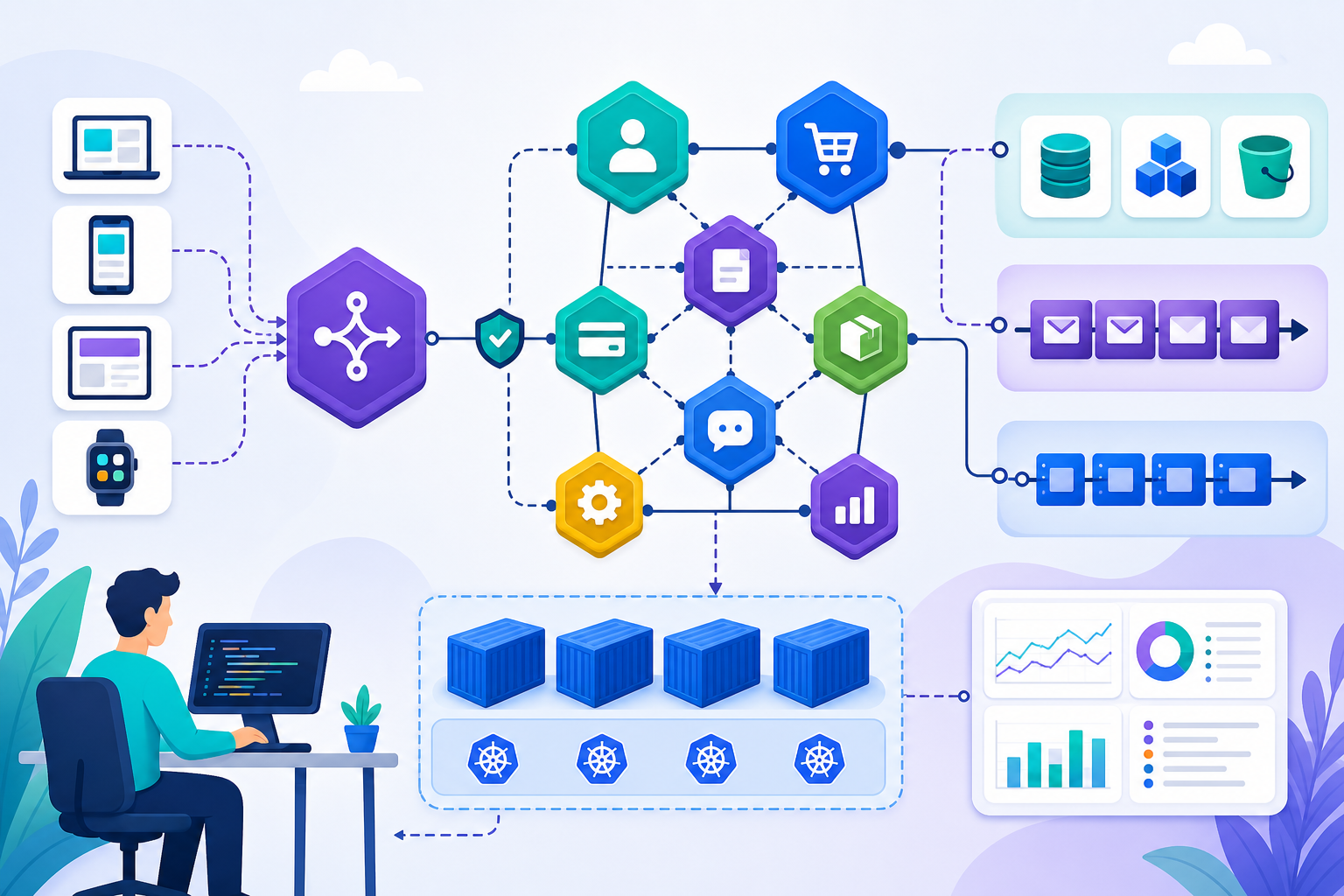
- Microservices architect roles require DDD decomposition, resilient communication, and observability — not simply splitting a monolith into many repos.
- Expect 14 core modules plus a phased distributed system project with architecture review sessions.
- Backend development experience with REST APIs and basic Docker awareness should precede Module 1.
- Book a free Asmorix demo to map this Microservices Architecture course syllabus to cloud or senior backend paths in Chennai.
This Microservices Architecture course syllabus guides learners from monolith trade-offs through domain-driven design, service communication, container orchestration, and observability — with a real-time distributed system project. Use before Microservices Architecture Training in Chennai. Related: Node.js Course Syllabus, Java Course Syllabus, DevOps Course Syllabus.
Job-ready microservices training requires DDD decomposition, resilient communication patterns, container orchestration, and distributed observability — not theoretical diagrams without hands-on multi-service labs.
Quick Overview
| Item | Details |
|---|---|
| Course focus | Designing, building, and operating distributed microservices systems |
| Modules | 14 core modules + Module 15 real-time project guidance |
| Level | Advanced backend (REST API and programming prerequisites) |
| Who it is for | Backend developers, full stack engineers, DevOps aspirants, and solution architects |
| Key outcomes | Decompose domains, implement services, deploy on Kubernetes, and observe distributed systems |
| Training options | Classroom and live online batches in Chennai with placement support |
Who Should Follow This Microservices Architecture Syllabus?
Best after building at least one monolithic REST API and understanding basic Docker concepts. Java, Node.js, or Python full stack graduates use this syllabus to advance toward architect and senior backend roles. DevOps engineers benefit from the Kubernetes and observability modules.
Module 1: Monolith vs Microservices & Architectural Trade-offs
- Characteristics of monolithic, modular monolith, and microservices architectures
- When microservices help versus when they create unnecessary complexity
- Conway's Law and team topology alignment with service boundaries
- Operational overhead: deployment, monitoring, and data consistency costs
- Strangler fig pattern for incremental monolith migration
- Industry case studies: success and failure patterns at scale
- Mentor review: discuss monolith vs microservices architectural trade-offs trade-offs in mock interviews and code reviews
- Lab: assess sample monolith and propose decomposition hypothesis
Module 2: Domain-Driven Design Fundamentals
- Ubiquitous language workshops with business stakeholders
- Bounded contexts and context mapping relationships
- Entities, value objects, aggregates, and aggregate roots
- Domain events and anti-corruption layers between contexts
- Event storming facilitation for discovering domain workflows
- Shared kernel versus separate models trade-off decisions
- Mentor review: discuss domain-driven design fundamentals trade-offs in mock interviews and code reviews
- Lab: event storming session and bounded context diagram for e-commerce domain
Module 3: Service Decomposition & API Design
- Identifying service boundaries using business capability mapping
- Database-per-service pattern and data ownership principles
- REST API design for inter-service and client-facing endpoints
- gRPC and Protocol Buffers for high-performance internal calls
- API versioning and backward compatibility across service teams
- OpenAPI contracts and consumer-driven contract testing intro
- Mentor review: discuss service decomposition api design trade-offs in mock interviews and code reviews
- Lab: decompose domain into three services with API contract definitions
Module 4: Synchronous Communication & API Gateway Patterns
- Service discovery: client-side versus server-side patterns
- API gateway responsibilities: routing, auth, rate limiting, aggregation
- Kong, NGINX, and cloud-native gateway options comparison
- Backend-for-Frontend pattern for mobile and web clients
- Load balancing strategies across service instances
- Timeout, retry, and bulkhead patterns for fault isolation
- Mentor review: discuss synchronous communication api gateway patterns trade-offs in mock interviews and code reviews
- Lab: configure API gateway routing to three backend microservices
Module 5: Asynchronous Messaging & Event-Driven Architecture
- Message broker fundamentals: RabbitMQ versus Apache Kafka
- Publish-subscribe, point-to-point, and competing consumer patterns
- Event sourcing and CQRS overview for read/write separation
- Idempotent message processing and exactly-once delivery challenges
- Dead letter queues and poison message handling strategies
- Schema registry and Avro/JSON schema evolution for events
- Mentor review: discuss asynchronous messaging event-driven architecture trade-offs in mock interviews and code reviews
- Lab: implement order-placed event flow across inventory and notification services
Module 6: Data Management in Distributed Systems
- Database-per-service: SQL versus NoSQL selection per context
- Saga pattern: orchestration versus choreography for distributed transactions
- Two-phase commit limitations and eventual consistency acceptance
- Outbox pattern for reliable event publishing from databases
- Cross-service queries: API composition versus materialized views
- Caching with Redis for cross-service read performance
- Mentor review: discuss data management in distributed systems trade-offs in mock interviews and code reviews
- Lab: implement saga workflow for multi-step order fulfillment process
Module 7: Containerization with Docker
- Dockerfile best practices for microservice images
- Multi-stage builds and image layer optimization
- docker-compose for local multi-service development stacks
- Container networking, volumes, and environment configuration
- Health checks and graceful shutdown signal handling
- Container security: non-root users, image scanning basics
- Mentor review: discuss containerization with docker trade-offs in mock interviews and code reviews
- Lab: containerize three services with compose networking and shared config
Module 8: Kubernetes Orchestration Essentials
- Kubernetes architecture: control plane, nodes, pods, and services
- Deployments, ReplicaSets, and rolling update strategies
- Services, Ingress, and TLS termination for external traffic
- ConfigMaps, Secrets, and environment-specific configuration
- Resource requests, limits, and horizontal pod autoscaling intro
- Namespaces for environment isolation and team ownership
- Mentor review: discuss kubernetes orchestration essentials trade-offs in mock interviews and code reviews
- Lab: deploy microservices stack to local Kubernetes with Ingress routing
Module 9: Service Mesh & Advanced Networking
- Service mesh value: mTLS, traffic management, and observability sidecars
- Istio or Linkerd overview for enterprise deployments
- Canary releases and traffic splitting for safe deployments
- Mutual TLS for zero-trust inter-service communication
- Network policies for pod-level security segmentation
- When service mesh overhead is justified versus simpler alternatives
- Mentor review: discuss service mesh advanced networking trade-offs in mock interviews and code reviews
- Lab: configure canary deployment routing between service versions
Module 10: Security, Authentication & Zero Trust Patterns
- OAuth2 and OpenID Connect for service and user authentication
- JWT validation at API gateway and individual service layers
- Role-based and attribute-based access control across services
- Secrets management with Vault or cloud-native secret stores
- OWASP API Security Top 10 in microservices context
- Security scanning in CI pipelines for container images
- Mentor review: discuss security, authentication zero trust patterns trade-offs in mock interviews and code reviews
- Lab: implement centralized auth at gateway with service-level authorization
Module 11: Observability: Logging, Metrics & Distributed Tracing
- Three pillars of observability applied to distributed systems
- Structured logging with correlation IDs across service calls
- Prometheus metrics, Grafana dashboards, and SLI/SLO definition
- Distributed tracing with Jaeger or Zipkin for request flow analysis
- Centralized log aggregation with ELK or Loki stack
- Alerting rules and on-call runbook documentation practices
- Mentor review: discuss observability: logging, metrics distributed tracing trade-offs in mock interviews and code reviews
- Lab: instrument services with tracing and build dashboard for latency analysis
Module 12: Resilience Patterns & Chaos Engineering Intro
- Circuit breaker, retry, timeout, and fallback implementation patterns
- Bulkhead isolation preventing cascade failures across services
- Rate limiting and backpressure handling under load
- Chaos engineering principles: inject failures to validate resilience
- Chaos Monkey and litmus chaos experiments overview
- Disaster recovery and multi-region deployment considerations
- Mentor review: discuss resilience patterns chaos engineering intro trade-offs in mock interviews and code reviews
- Lab: simulate service failure and validate circuit breaker behavior
Module 13: CI/CD for Microservices & GitOps
- Independent service deployment pipelines versus monorepo strategies
- Semantic versioning and automated changelog generation per service
- GitOps with Argo CD or Flux for declarative cluster state
- Feature flags for progressive delivery without full redeploy
- Database migration coordination across service releases
- Rollback strategies when interdependent services fail deployment
- Mentor review: discuss ci/cd for microservices gitops trade-offs in mock interviews and code reviews
- Lab: build CI/CD pipeline deploying one service to Kubernetes on merge
Module 14: Architecture Review, Interview Prep & Career Paths
- Architecture decision record documentation for design rationale
- Common interview scenarios: design URL shortener, ride-sharing backend
- Trade-off articulation: consistency, availability, partition tolerance
- Portfolio presentation: architecture diagrams, ADRs, and live demo
- Certification paths: CKA, AWS Solutions Architect, Azure architect
- Capstone architecture review with mentor panel feedback session
- Mentor review: discuss architecture review, interview prep career paths trade-offs in mock interviews and code reviews
- Career paths: solution architect, platform engineer, and senior backend lead
Module 15: Real-Time Project
Capstone designs and implements a multi-service platform — such as e-commerce order processing or event booking — with API gateway, messaging, Docker/Kubernetes deployment, and distributed tracing used in placement-oriented Microservices Architecture training.
- Three-plus microservices with DDD-aligned boundaries and API contracts
- Event-driven communication with message broker and saga workflow
- Kubernetes deployment with observability stack and CI/CD pipeline
Phase 1
- Domain modeling, bounded context diagrams, and service API contracts
- Core services implemented with REST endpoints and database-per-service
- Local docker-compose stack for integrated development
Phase 2
- Asynchronous messaging for cross-service workflows
- API gateway with authentication and routing configuration
- Distributed tracing and centralized logging integration
Phase 3
- Kubernetes deployment with Ingress and health checks
- CI/CD pipeline with automated test and deploy gates
- Architecture review presentation and system design interview prep
How to Use This Syllabus
Bring backend API experience and basic Docker knowledge to counseling. Visit Microservices Architecture Training in Chennai with Placement.
Related Courses & Syllabus Guides
Frequently Asked Questions
What does the Microservices Architecture course syllabus cover?
It covers monolith versus microservices trade-offs, domain-driven design, service decomposition strategies, REST and gRPC communication, event-driven messaging with Kafka or RabbitMQ, API gateway patterns, containerization with Docker, Kubernetes orchestration, distributed tracing, circuit breakers, saga patterns, and a capstone multi-service project.
How many modules are in this Microservices Architecture syllabus?
This reference plan has 14 core modules plus Module 15 as a phased real-time project. Institutes may extend Kubernetes labs depending on cloud platform focus.
Do I need cloud experience before learning microservices architecture?
Basic Docker and REST API experience helps. Cloud-specific modules build on container fundamentals, so DevOps awareness accelerates progress but is not mandatory at Module 1.
Is Kubernetes included in the Microservices Architecture syllabus?
Yes. Pod deployment, services, ingress, ConfigMaps, and basic Helm chart awareness are covered for orchestrating microservices in production-like environments.
Does this syllabus cover event-driven architecture patterns?
Yes. Message brokers, publish-subscribe patterns, event sourcing intro, and CQRS overview are included for asynchronous service communication scenarios.
What projects should be part of Microservices Architecture training?
A multi-service e-commerce or booking platform with API gateway, inter-service messaging, containerized deploy, and distributed tracing is a strong capstone.
Is domain-driven design covered in this syllabus?
Yes. Bounded contexts, aggregates, ubiquitous language, and context mapping are foundational modules before service decomposition labs.
Where can I join Microservices Architecture training in Chennai?
Asmorix offers mentor-led Microservices Architecture training with placement support for senior backend and cloud roles. Book a free demo to match this syllabus to your experience level in Chennai.
