
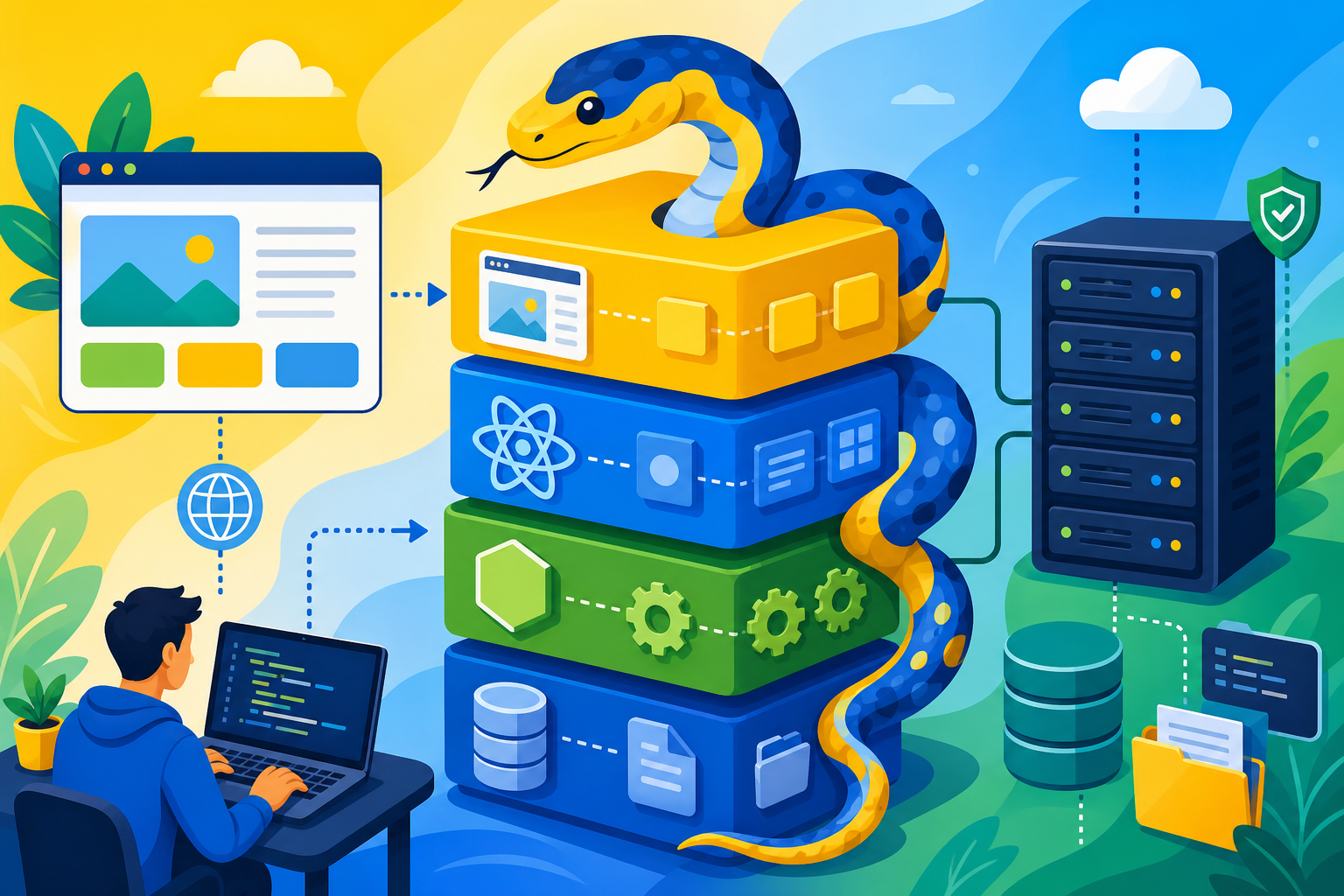
- Python Full Stack roles need Django/Flask APIs, database design, React SPAs, and deployment — not Python syntax drills alone.
- Expect 14 core modules plus a phased real-time full stack project with mentor code reviews.
- Job-ready outcomes require authentication, ORM queries, REST design, and CI/CD basics.
- Book a free Asmorix demo to map this Python Full Stack syllabus to your background in Chennai.
This Python Full Stack course syllabus is a complete module checklist for learners who want to build production web applications with Python backends, PostgreSQL databases, and React front-ends — with a real-time project focus. Use it before Python Full Stack Training in Chennai. Related: Python Course Syllabus, React Course Syllabus, MERN Stack Course Syllabus.
A complete Python Full Stack syllabus should cover Django/Flask REST APIs, PostgreSQL ORM, React SPA integration, authentication, testing, and deployment — not print-statement Python tutorials alone.
Quick Overview
| Item | Details |
|---|---|
| Course focus | End-to-end web development with Python backend and React front-end |
| Modules | 14 core modules + Module 15 real-time project guidance |
| Level | Beginner to job-ready full stack Python developer |
| Who it is for | Freshers, career switchers, and backend developers adding front-end skills |
| Key outcomes | Build REST APIs, design databases, create React SPAs, deploy containerized apps |
| Training options | Classroom and live online batches in Chennai with placement support |
Who Should Follow This Python Full Stack Syllabus?
Ideal for freshers targeting full stack developer roles, Python learners ready for web frameworks, and manual testers or analysts moving into development. Beginners start at Python fundamentals. Web developers from other stacks can skip syntax and enter at Django REST modules.
Module 1: Python Fundamentals & Development Environment
- Python syntax, variables, data types, and control flow structures
- Functions, modules, packages, and virtual environment with venv/poetry
- File I/O, exception handling, and context managers for resource cleanup
- List comprehensions, generators, decorators, and functional patterns
- Object-oriented programming: classes, inheritance, polymorphism, magic methods
- pip, requirements.txt, and project structure conventions
- VS Code or PyCharm setup with linting (flake8/ruff) and debugging
- Lab: CLI task manager with OOP design and unit tests using pytest
Module 2: Advanced Python & Data Handling
- Collections module: defaultdict, Counter, namedtuple for efficient data structures
- Regular expressions for validation and log parsing in web applications
- JSON, CSV, and XML parsing for API and import/export workflows
- Datetime handling, timezone awareness, and scheduling helpers
- Logging module configuration for production application diagnostics
- Type hints, dataclasses, and pydantic models for API validation
- Concurrency intro: threading versus asyncio for I/O-bound web tasks
- Lab: data import pipeline with validation, logging, and error reporting
Module 3: HTML, CSS & JavaScript Foundations for Full Stack
- Semantic HTML5 structure and accessibility basics for web templates
- CSS Flexbox, Grid, and responsive design for mobile-first layouts
- JavaScript ES6+: arrow functions, destructuring, promises, async/await
- DOM manipulation, fetch API, and JSON handling in the browser
- npm, Node.js runtime basics, and package.json for front-end tooling
- Git workflow: branch, commit, pull request, and merge conflict resolution
- Browser DevTools for network inspection and front-end debugging
- Lab: static responsive landing page with fetch call to public REST API
Module 4: Django Framework & MTV Architecture
- Django project versus app structure and settings configuration
- URL routing, views (function and class-based), and request/response cycle
- Django templates: inheritance, context, filters, and static files
- Models, migrations, and Django ORM CRUD operations
- Admin site customization for internal operations teams
- Forms, ModelForms, and CSRF protection in server-rendered pages
- Middleware, signals, and custom management commands
- Lab: Django blog with models, admin, templates, and user comments
Module 5: Django REST Framework & API Design
- REST principles: resources, HTTP verbs, status codes, and HATEOAS awareness
- Serializers: ModelSerializer, validation, nested serializers, and custom fields
- ViewSets, routers, and APIView patterns for CRUD endpoints
- Pagination, filtering, search, and ordering for list endpoints
- Authentication: Token, Session, and JWT with djangorestframework-simplejwt
- Permissions classes: IsAuthenticated, custom object-level permissions
- API documentation with drf-spectacular or Swagger/OpenAPI schema
- Lab: product catalog REST API with JWT auth and role-based permissions
Module 6: Flask Micro-APIs & Lightweight Services
- Flask application factory pattern and blueprint modularization
- Flask-SQLAlchemy models and Flask-Migrate for schema evolution
- Flask-RESTful or Flask-RESTX for structured API endpoints
- Request validation with marshmallow schemas
- Flask-JWT-Extended for token-based authentication
- When to choose Flask over Django for microservices and prototypes
- Lab: Flask microservice exposing health check and webhook receiver endpoints
Module 7: PostgreSQL, Database Design & ORM Optimization
- Relational design: normalization, primary/foreign keys, and indexes
- PostgreSQL data types, constraints, and transaction isolation levels
- Complex ORM queries: select_related, prefetch_related, annotations
- Raw SQL when ORM limits performance on reporting queries
- Database migrations strategy for zero-downtime schema changes
- Connection pooling, query profiling, and N+1 problem diagnosis
- Seeding test data and factory patterns for integration tests
- Lab: optimize slow Django queryset with indexes and prefetch_related
Module 8: React Front-End for Python Backends
- React components, JSX, props, state, and hooks (useState, useEffect)
- Fetching Django REST endpoints with axios and error/loading states
- React Router for SPA navigation and protected route patterns
- Form handling, client validation, and token storage strategies
- Context API for auth state and global UI theme management
- Component composition and reusable UI library patterns
- CORS configuration on Django for local and production React origins
- Lab: React dashboard consuming Django REST API with JWT login flow
Module 9: Authentication, Authorization & Security
- Password hashing with Django auth and bcrypt best practices
- JWT access/refresh token rotation and blacklist on logout
- OAuth2 social login integration (Google/GitHub) overview
- Role-based access control in API and React route guards
- CSRF, XSS, SQL injection prevention in full stack apps
- HTTPS, secure cookies, and environment variable secrets management
- Rate limiting API endpoints with django-ratelimit or nginx
- Lab: implement registration, login, refresh token, and role-based API access
Module 10: Testing: pytest, Django Tests & React Testing Library
- pytest fixtures, parametrize, and mocking external services
- Django TestCase, APITestCase, and factory_boy for model factories
- Coverage reports and CI gate on minimum test percentage
- React Testing Library for component and integration tests
- End-to-end testing intro with Playwright against local stack
- Test databases, transactions, and test isolation strategies
- Lab: pytest suite for REST API with 80%+ coverage and CI script
Module 11: Docker, Environment Config & DevOps Basics
- Dockerfile for Django and React multi-stage builds
- docker-compose for local PostgreSQL, Redis, web, and nginx services
- Environment variables with python-decouple or django-environ
- Gunicorn/uWSGI application server behind nginx reverse proxy
- Static and media file serving: Whitenoise, S3, or CDN strategies
- Health check endpoints and graceful shutdown for containers
- Lab: docker-compose stack running Django API, React, and PostgreSQL
Module 12: Cloud Deployment & CI/CD Pipeline
- Deploy Django to AWS EC2, Render, Railway, or Azure App Service
- PostgreSQL managed service: RDS, Supabase, or Neon connection
- GitHub Actions pipeline: lint, test, build, and deploy stages
- Environment promotion: dev, staging, production configuration
- Domain, SSL certificates, and DNS configuration
- Monitoring logs with CloudWatch or structured JSON logging
- Lab: deploy full stack app with CI pipeline and public HTTPS URL
Module 13: Caching, Background Tasks & Performance
- Redis caching for Django views and session storage
- Celery task queue for email, reports, and long-running jobs
- Celery Beat for scheduled tasks and periodic cleanup jobs
- Database query caching and cache invalidation patterns
- Front-end performance: code splitting, lazy loading, and CDN assets
- Load testing APIs with locust or k6 for baseline metrics
- Lab: Celery email notification task triggered from Django REST endpoint
Module 14: Full Stack Architecture, Portfolio & Interview Prep
- Monolith versus microservices trade-offs for Python startups
- API versioning, deprecation policy, and backward compatibility
- System design whiteboard: design URL shortener or ticket system
- Code review etiquette, README documentation, and API contract docs
- Portfolio presentation: live demo URL, GitHub, and architecture diagram
- Common interview questions: ORM N+1, JWT flow, Django middleware stack
- Agile ceremonies awareness for full stack team delivery
- Capstone architecture review and resume bullet refinement workshop
Module 15: Real-Time Project
Capstone builds a production-style full stack application — such as an online booking or inventory portal — used in placement-oriented Python Full Stack training at Asmorix.
- Django REST API with PostgreSQL schema and JWT authentication
- React SPA with routing, forms, and role-based dashboards
- Dockerized deployment with CI pipeline and public demo URL
Phase 1
- Requirements, wireframes, and database ER diagram
- Django models, migrations, REST endpoints, and admin setup
- React project scaffold with auth login and protected routes
Phase 2
- Core business features: CRUD, search, filters, and notifications
- Celery background tasks and Redis caching layer
- pytest and React tests with CI running on pull requests
Phase 3
- Docker-compose production config and cloud deployment
- Performance review and security checklist walkthrough
- Demo presentation with architecture diagram and resume bullets
How to Use This Syllabus
Confirm Django REST labs, React integration hours, deployment practice, and mentor review cycles before enrolling. Visit Python Full Stack Training in Chennai with Placement.
Related Courses & Syllabus Guides
Frequently Asked Questions
What does the Python Full Stack course syllabus cover?
It covers Python fundamentals, object-oriented programming, Django and Flask web frameworks, REST API design with Django REST Framework, PostgreSQL and ORM queries, React front-end integration, JWT authentication, testing, Docker containerization, and cloud deployment with a capstone project.
How many modules are in this Python Full Stack syllabus?
This reference plan has 14 core modules plus Module 15 as a phased real-time project. Learners with prior Python experience can accelerate through fundamentals into Django and React modules.
Do I need prior programming experience for Python Full Stack training?
No prior experience is required for the fundamentals track. Comfort with logic and HTML basics helps you progress faster through web frameworks and React integration.
Is React included in the Python Full Stack syllabus?
Yes. React modules cover components, hooks, routing, and API consumption so you can build SPAs that talk to Django or Flask REST backends — a standard full stack hiring pattern.
Django or Flask — which framework does this syllabus emphasize?
Django and Django REST Framework are the primary backend stack, with Flask modules for lightweight API microservices and comparison of framework trade-offs.
What projects should be part of Python Full Stack training?
An e-commerce or booking portal with Django REST API, PostgreSQL schema, React SPA, JWT login, admin panel, and Dockerized deployment on AWS or Render is a strong capstone.
How is Python Full Stack different from the Python course syllabus?
The standalone Python syllabus focuses on language, data, and scripting. Full Stack extends into web frameworks, databases, front-end React, and production deployment for developer roles.
Where can I join Python Full Stack training in Chennai?
Asmorix offers mentor-led Python Full Stack training with placement support and project reviews. Book a free demo to match this syllabus to weekday or weekend batches in Chennai.
