
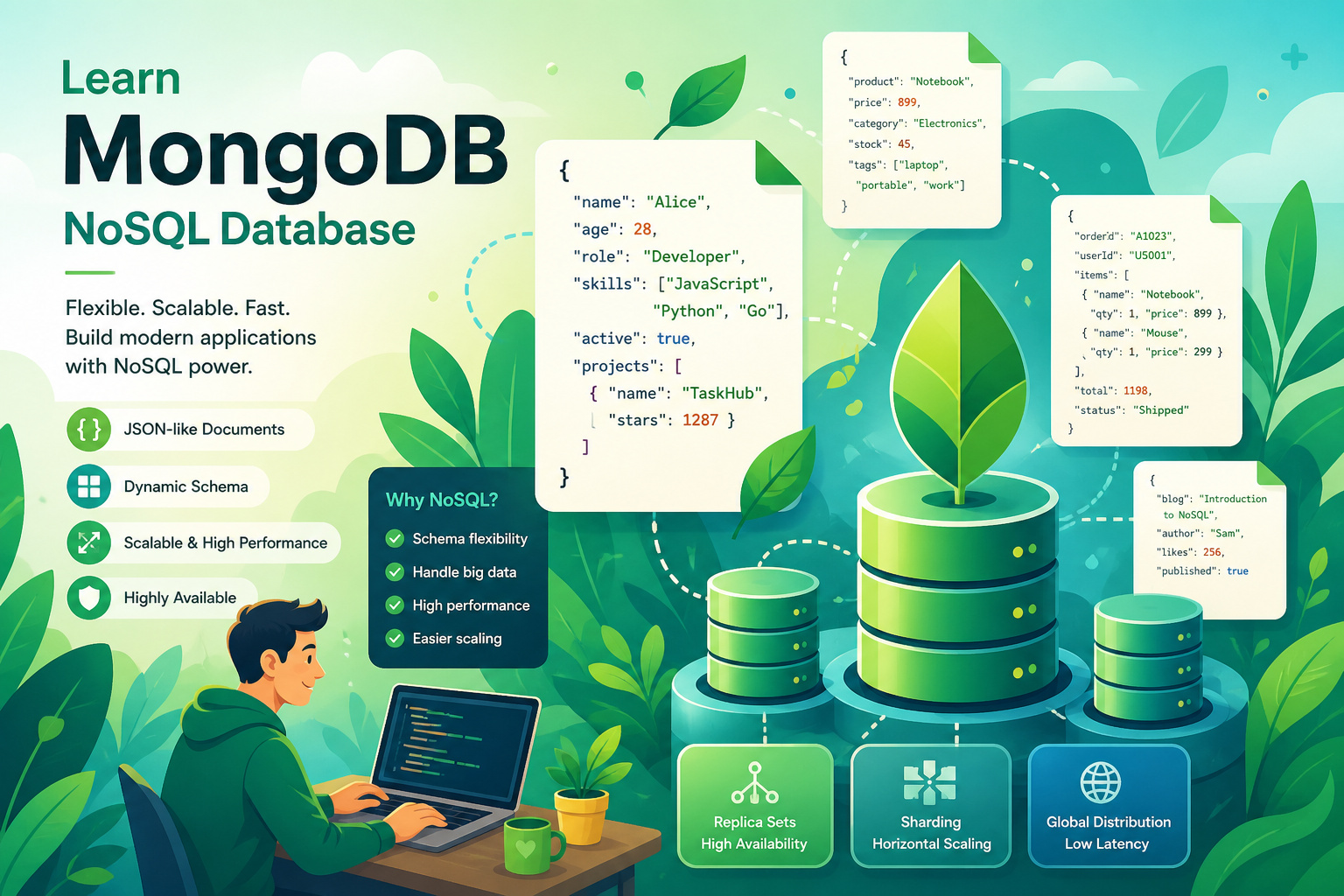
- MongoDB roles need schema design, aggregation, indexes, and Atlas ops.
- Expect 15 core modules plus a phased real-time project with hands-on delivery.
- Pairs naturally with MERN Stack syllabus.
- Book Asmorix demo for MongoDB Atlas lab setup.
This MongoDB course syllabus covers NoSQL document databases from CRUD and aggregation through indexing, replication, sharding, Atlas cloud, and MERN integration. Use before MongoDB Training in Chennai. Related: MERN Stack Course Syllabus, Node.js Training, Java Course Syllabus.
MongoDB training should cover schema design, aggregation pipelines, indexes, replication, Atlas ops, and app integration — not insert-one demos alone.
Quick Overview
| Item | Details |
|---|---|
| Course focus | Document database development and operations for modern apps |
| Modules | 15 core modules + real-time project guidance |
| Level | Beginner to job-ready NoSQL developer/DBA entry |
| Who it is for | Full stack developers, backend engineers, and data engineers |
| Key outcomes | Model documents, write aggregations, tune indexes, deploy Atlas cluster, integrate with Node.js |
| Training options | Classroom and live online batches in Chennai with placement support |
Who Should Follow This MongoDB Syllabus?
Best for developers building MERN/MEAN apps or engineers adding NoSQL to SQL backgrounds. JavaScript familiarity helps for shell and Node labs.
Module 1: MongoDB & Document Database Fundamentals
- NoSQL use cases
- Document data model
- BSON types
- MongoDB editions
- Atlas platform
- Database terminology
- Lab: apply this module in a guided MongoDB API project exercise
- Review common interview and on-the-job scenarios for mongodb & document database fundamentals
Module 2: Databases, Collections & Documents
- Database creation
- Collection design
- Insert operations
- Document identifiers
- Embedded documents
- Schema flexibility
- Lab: apply this module in a guided MongoDB API project exercise
- Review common interview and on-the-job scenarios for databases, collections & documents
Module 3: CRUD Query Operations
- Find queries
- Comparison operators
- Logical operators
- Projections
- Cursor handling
- Query explain plans
- Lab: apply this module in a guided MongoDB API project exercise
- Review common interview and on-the-job scenarios for crud query operations
Module 4: CRUD Write Operations
- Update operators
- Array updates
- Upserts
- Delete operations
- Bulk writes
- Write concern
- Lab: apply this module in a guided MongoDB API project exercise
- Review common interview and on-the-job scenarios for crud write operations
Module 5: Aggregation Framework
- Aggregation pipeline stages
- Group accumulators
- Lookup joins
- Unwind arrays
- Facet analysis
- Pipeline optimisation
- Lab: apply this module in a guided MongoDB API project exercise
- Review common interview and on-the-job scenarios for aggregation framework
Module 6: Indexing & Query Performance
- Single-field indexes
- Compound indexes
- Text indexes
- Geospatial indexes
- Index selectivity
- Index maintenance
- Lab: apply this module in a guided MongoDB API project exercise
- Review common interview and on-the-job scenarios for indexing & query performance
Module 7: Schema Design Patterns
- Embedding versus referencing
- One-to-one design
- One-to-many design
- Many-to-many patterns
- Document growth
- Schema versioning
- Lab: apply this module in a guided MongoDB API project exercise
- Review common interview and on-the-job scenarios for schema design patterns
Module 8: Replication & Replica Sets
- Replica sets
- Primary elections
- Read preferences
- Replication lag
- Write concerns
- High availability
- Lab: apply this module in a guided MongoDB API project exercise
- Review common interview and on-the-job scenarios for replication & replica sets
Module 9: Sharding & Horizontal Scale
- Shard keys
- Chunk distribution
- Mongos routing
- Balancer behaviour
- Sharding trade-offs
- Cluster scaling
- Lab: apply this module in a guided MongoDB API project exercise
- Review common interview and on-the-job scenarios for sharding & horizontal scale
Module 10: MongoDB Atlas
- Atlas clusters
- Database users
- IP access lists
- Atlas backups
- Atlas Search
- Atlas monitoring
- Lab: apply this module in a guided MongoDB API project exercise
- Review common interview and on-the-job scenarios for mongodb atlas
Module 11: Application Integration
- Node.js MongoDB driver
- Connection pooling
- CRUD APIs
- Transactions
- Change streams
- Driver error handling
- Lab: apply this module in a guided MongoDB API project exercise
- Review common interview and on-the-job scenarios for application integration
Module 12: MongoDB Security
- Role-based access
- TLS connections
- Field-level encryption
- Audit logs
- Secrets management
- Security review
- Lab: apply this module in a guided MongoDB API project exercise
- Review common interview and on-the-job scenarios for mongodb security
Module 13: Monitoring & Troubleshooting
- Mongod logs
- Slow query profiler
- Database commands
- Disk pressure
- Replica recovery
- Incident diagnosis
- Lab: apply this module in a guided MongoDB API project exercise
- Review common interview and on-the-job scenarios for monitoring & troubleshooting
Module 14: Backup & Recovery
- Backup strategies
- Mongodump tools
- Point-in-time recovery
- Restore testing
- Retention plans
- Disaster recovery
- Lab: apply this module in a guided MongoDB API project exercise
- Review common interview and on-the-job scenarios for backup & recovery
Module 15: MongoDB Portfolio & Interview
- MongoDB interview questions
- Data-model trade-offs
- Aggregation exercises
- Atlas portfolio project
- Production scenarios
- Certification roadmap
- Lab: apply this module in a guided MongoDB API project exercise
- Review common interview and on-the-job scenarios for mongodb portfolio & interview
Module 16: Real-Time Project
Model and implement a scalable product catalogue and order-insight service in MongoDB for a multi-vendor marketplace.
- Document-model rationale and sample dataset
- Indexed aggregation API for category analytics
- Atlas operations and recovery runbook
Phase 1
- Elicit catalogue and order access patterns
- Choose embedding and reference boundaries
- Create seed dataset
Phase 2
- Build CRUD endpoints and aggregations
- Add indexes using explain evidence
- Configure replica set or Atlas cluster
Phase 3
- Exercise backup restore
- Review roles and monitoring alerts
- Present scale and schema decisions
How to Use This Syllabus
Confirm Atlas access, aggregation labs, and Node integration. Visit MongoDB Training in Chennai with Placement.
Related Courses & Syllabus Guides
- MongoDB Training in Chennai
- MERN Stack Course Syllabus
- MEAN Stack Course Syllabus
- ReactJS Course Syllabus
- Oracle DBA Course Syllabus
- Microsoft Azure Course Syllabus
How to use this MongoDB Course Syllabus guide
Read MongoDB Course Syllabus once for the map, then a second time with a notebook. On the first pass, mark every term you cannot explain out loud. On the second pass, close the page and write those terms in your own words. A fresher who can teach the idea is the fresher who clears the interview. A fresher who only recognises the heading still freezes when the panel changes one word in the question.
Keep the examples next to the definitions. For MongoDB Course Syllabus, an example is a tiny input, the step you take, and the output you expect. If you cannot write that trio, you do not know the topic yet. Chennai panels, campus drives, and lateral rounds all use this test. They rarely ask you to recite a paragraph. They ask you to apply one idea to a new case.
Set a 45-minute block. Spend 15 minutes reading one section of MongoDB Course Syllabus, 20 minutes doing the example by hand, and 10 minutes writing a three-line summary. Stop when the summary is specific. “It is important for freshers” is not a summary. “Here is the input, here is the check, here is the mistake I made” is a summary you can say in an interview.
What to practise first
Start with the core of MongoDB Course Syllabus, not with the advanced corner. Write the ten ideas that the rest of the topic stands on. For each idea, add one example you created, not one you copied. If the guide shows a sample, change the numbers or the names and solve it again. Copying the sample feels fast and teaches nothing. Changing it shows whether you followed the logic.
Practise speaking. Read a heading from MongoDB Course Syllabus, look away, and explain it for sixty seconds. Record it. Listen for filler and for steps you skipped. Interviewers in Chennai notice skipped steps more than they notice accent. If you jump from the question to the answer with no middle, they assume you memorised a result.
Build a one-page cheat sheet after you understand the topic, not before. The sheet should contain formulas, edge cases, and the two mistakes you personally made. It should not contain every sentence from MongoDB Course Syllabus. A long cheat sheet is a second textbook. A short one is a tool you can review on the morning of an interview.
A four-week plan for MongoDB Course Syllabus
Week one is vocabulary and the happy path. Learn the words in MongoDB Course Syllabus and complete the simplest full example from start to finish. Do not collect five tutorials. Finish one path so you can repeat it without the page open. At the end of the week, teach that path to a friend or to a blank document.
Week two is edge cases. Ask what happens when the input is empty, duplicated, too large, or in the wrong format. MongoDB Course Syllabus becomes useful here. Most fresher answers cover only the normal case. Panels ask for the broken case because that is what the job contains. Write five broken cases and the result you expect for each.
Week three is speed and explanation. Time yourself. Solve a small problem related to MongoDB Course Syllabus in twenty minutes, then spend ten minutes writing how you checked the answer. Speed without a check is how wrong answers get submitted with confidence. The written check is what you will say when the interviewer asks “how do you know?”
Week four is a mock. Pick six questions from MongoDB Course Syllabus and answer them out loud without notes. Score yourself on correctness and on clarity. Redo only the ones you missed. The day before a real interview, review the cheat sheet and sleep. New topics on the last night do not stick.
Mistakes that keep MongoDB Course Syllabus shallow
The first mistake is highlighting instead of solving. A highlighted PDF of MongoDB Course Syllabus is not practice. Close it and produce an output. The second mistake is tool collecting. Freshers add five tools to a resume after reading one page about each. Panels pick one tool and go deep. Depth on the main idea in MongoDB Course Syllabus beats a list.
The third mistake is skipping the why. If you can name a step but cannot say why the previous step exists, the answer collapses when the question is reworded. The fourth mistake is ignoring fundamentals that the topic sits on, such as clear writing, basic logic, and careful reading of the problem. MongoDB Course Syllabus will not save a candidate who did not read the question.
The fifth mistake is waiting to feel ready. Apply and sit mocks while you are still imperfect. Each mock shows the next gap in MongoDB Course Syllabus. A private reread does not. Book the mock, note the exact question you lost, and patch that gap the same day.
How MongoDB Course Syllabus shows up in Chennai interviews and jobs
Chennai service companies, product teams, and campus drives use topics like MongoDB Course Syllabus as a filter, not as a trivia round. They want to see whether you can learn a task and explain it to a teammate. Bring one example you did yourself. Walk through the input, the decision, and the result. Stop talking when the result is clear. Extra theory after a clear result makes the answer worse.
On the job, the same topic shows up as a ticket, a review comment, or a question from a senior. You will not get a paragraph of context. You will get a broken case and a deadline. The four-week plan above is practice for that moment. People who only read MongoDB Course Syllabus the night before an interview forget it the week after they join. People who solved examples still have the reflex.
If this topic supports a role you want, connect it to a project in your resume with one measurable line. “Studied MongoDB Course Syllabus” is weak. “Used the idea from MongoDB Course Syllabus to fix a specific bug, query, page, or case, and here is what changed” is strong. Asmorix mentors in Chennai push students to that second sentence because that is what hiring panels score.
Checklist before you claim MongoDB Course Syllabus
- I can explain the core idea in MongoDB Course Syllabus in sixty seconds without reading.
- I have five examples I created, including two that fail on purpose.
- I can say why each step exists, not only what the step is called.
- I have a one-page sheet of my own mistakes.
- I have answered six questions out loud and redone the ones I missed.
- My resume line points at a result, not at the name of the topic.
If any line is still false, stay on that line for two more sessions. Do not open a new topic to avoid the gap. The candidate who finishes MongoDB Course Syllabus properly outperforms the candidate who sampled ten guides and owns none of them.
Questions freshers ask about MongoDB Course Syllabus
Is reading MongoDB Course Syllabus enough to clear an interview?
Reading is the start. Interviews test whether you can use the idea on a new input and explain the check you did. Plan at least as much practice time as reading time. If you have only read, say you are still practising. Do not claim mastery you cannot demo.
How long does MongoDB Course Syllabus take for a fresher?
A focused fresher can get interview-ready on one topic in about four weeks of daily 45-minute sessions. Rushing it into two evenings produces familiar headings and weak answers. Stretching it across six idle months produces the same result. The calendar above is the useful pace.
Should I memorise every line of MongoDB Course Syllabus?
No. Memorise the checks and the edge cases. Keep definitions in your own words. Panels rephrase questions. A memorised paragraph fails the rephrase. A worked example survives it.
When you want a timetable, projects, and mock interviews around this kind of topic, look at the Asmorix courses in Chennai or the Asmorix blog for the next guide in the same path.
A worked practice set for MongoDB Course Syllabus
Use this second set only after the first plan. Take one idea from MongoDB Course Syllabus and write it as a question a stranger could answer. Then write the answer with an input, a step, and a check. Repeat this five times. Number them. If you cannot invent the question, you are still depending on the original wording of MongoDB Course Syllabus, and that will not match an interview.
Swap the input on each of the five. Change a name, a number, an empty value, or a duplicate. Predict the new output before you calculate it. The prediction is the skill. The calculation only confirms it. Write down every prediction you got wrong and the reason. That list is more valuable than another complete reread of MongoDB Course Syllabus.
Explain one of the five answers as if the listener has never seen MongoDB Course Syllabus. Use short sentences. If you need a jargon word, define it in the same breath. This is the bar for a fresher explanation in a Chennai technical round. Clarity is part of the score, not a bonus.
How to revise MongoDB Course Syllabus the week of an interview
Six days out, redo two edge cases from memory. Five days out, teach the core idea in sixty seconds. Four days out, review only the mistakes list. Three days out, sit one timed question. Two days out, fix the one gap the timed question exposed. One day out, read the one-page sheet and stop. Adding new branches of MongoDB Course Syllabus on the last day creates noise.
On the interview day, listen to the full question before you answer. Repeat the constraint in one sentence so the panel can correct you if you heard it wrong. Then solve the small version. MongoDB Course Syllabus prepared you for the method. The method is what you show. If you blank, write what you know and the next check you would run. A partial honest method scores higher than a silent guess.
After the interview, write the questions down the same day. Mark which part of MongoDB Course Syllabus would have answered each one. Patch only those parts. That is how one guide turns into a habit instead of a file you never open again.
Official references
These public pages are the official documents for the terms used above.
Frequently Asked Questions
What does the MongoDB course syllabus cover?
It covers document database fundamentals, CRUD operations, schema design, aggregation pipelines, indexing, replication, sharding, MongoDB Atlas cloud operations, security, and Node.js integration.
How many modules are in this MongoDB syllabus?
This reference plan has 15 core modules plus a phased real-time project. Institutes may combine or split modules depending on batch duration and lab hours.
Who should follow this MongoDB syllabus and what prerequisites apply?
This syllabus suits back-end developers and full-stack aspirants. Basic programming knowledge is required; JavaScript experience helps with Node.js integration labs.
Is MongoDB Atlas included in the syllabus?
Yes. Atlas labs cover cluster provisioning, backup policies, monitoring alerts, and cloud deployment patterns used in production environments.
What projects should be part of MongoDB training?
A Node.js REST API with Mongoose schemas, aggregation analytics, role-based access, and Atlas deployment is a strong capstone.
Is this MongoDB syllabus suitable for beginners and career switchers?
Developers with basic programming can start here. Career switchers benefit from pairing this syllabus with the MERN Stack course for full-stack job readiness.
How does this MongoDB syllabus relate to the MERN Stack path?
MongoDB is the database layer in MERN. This syllabus provides deep document-store skills before or alongside the MERN Stack course covering Express, React, and Node.
Where can I join MongoDB training in Chennai?
Asmorix offers mentor-led MongoDB training with placement support. Book a free demo to match this syllabus to your background and batch timing.
