
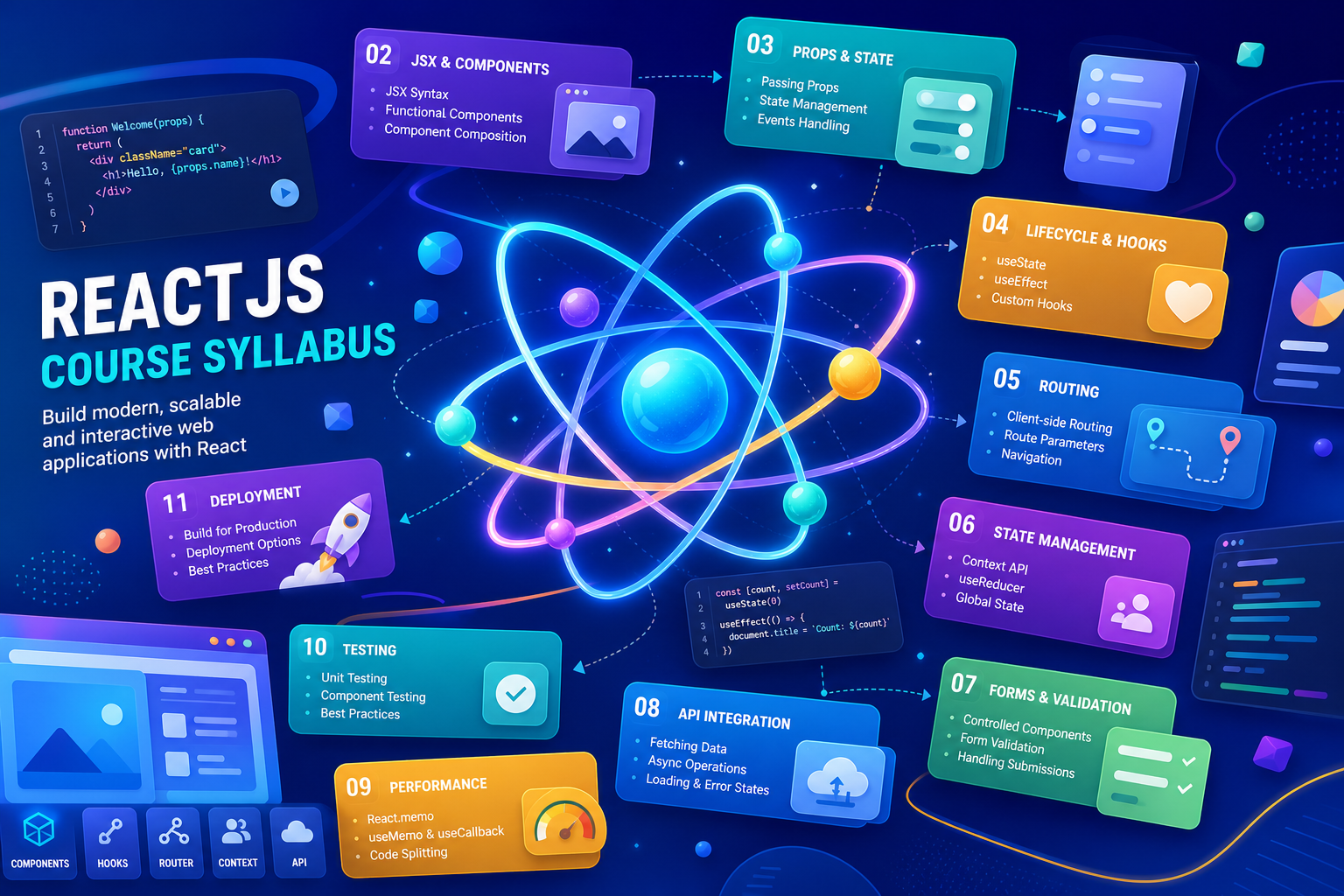
- React job readiness needs hooks, Router, API patterns, and testing — not toy counter apps.
- Expect 15 core modules plus a phased real-time project with hands-on delivery.
- Complete Web Development or solid JS first.
- Book Asmorix demo for React batch timing.
This ReactJS course syllabus takes learners from modern JavaScript through React components, hooks, routing, and API-driven SPAs. Use it before ReactJS Training in Chennai. Related: MERN Stack Course Syllabus, Web Development Course Syllabus, JavaScript foundations.
Job-ready React training requires ES6+, component architecture, hooks, Router, API integration, and state patterns — not create-react-app demos alone.
Quick Overview
| Item | Details |
|---|---|
| Course focus | Modern front-end SPA development with React 18+ patterns |
| Modules | 15 core modules + real-time project guidance |
| Level | Intermediate front-end (HTML/CSS/JS prerequisites) |
| Who it is for | Web developers, CS graduates, and UI engineers |
| Key outcomes | Build component libraries, manage state, route SPAs, consume REST APIs, test components |
| Training options | Classroom and live online batches in Chennai with placement support |
Who Should Follow This ReactJS Syllabus?
Best after HTML/CSS/JavaScript fundamentals. Web Development syllabus graduates and CS students progress smoothly; complete beginners should start with web basics first.
Module 1: Modern JavaScript for React
- ES modules
- Destructuring and spread syntax
- Array iteration methods
- Closures and lexical scope
- Promises and async functions
- Immutability principles
- Lab: apply this module in a guided React application exercise
- Review common interview and on-the-job scenarios for modern javascript for react
Module 2: React Foundations & JSX
- Component mental model
- JSX expressions
- Virtual DOM reconciliation
- Project structure with Vite
- React Developer Tools
- Component rendering rules
- Lab: apply this module in a guided React application exercise
- Review common interview and on-the-job scenarios for react foundations & jsx
Module 3: Components, Props & Composition
- Function components
- Prop contracts
- Children composition
- Default values
- Component reuse
- Presentational boundaries
- Lab: apply this module in a guided React application exercise
- Review common interview and on-the-job scenarios for components, props & composition
Module 4: State & Event Handling
- UseState state updates
- Controlled input events
- Derived state
- Lifting state upward
- State batching
- Event propagation
- Lab: apply this module in a guided React application exercise
- Review common interview and on-the-job scenarios for state & event handling
Module 5: Rendering Lists & Conditional UI
- Stable list keys
- Conditional rendering patterns
- Empty and loading states
- Filterable collections
- Component identity
- Re-render diagnosis
- Lab: apply this module in a guided React application exercise
- Review common interview and on-the-job scenarios for rendering lists & conditional ui
Module 6: Forms & Validation
- Controlled forms
- Client-side validation
- Error message accessibility
- Multi-field form state
- File input constraints
- Submission handling
- Lab: apply this module in a guided React application exercise
- Review common interview and on-the-job scenarios for forms & validation
Module 7: Effects & Data Fetching
- UseEffect lifecycle
- Dependency arrays
- Fetch and abort controllers
- Loading race conditions
- Error boundaries awareness
- Custom data-fetching hooks
- Lab: apply this module in a guided React application exercise
- Review common interview and on-the-job scenarios for effects & data fetching
Module 8: Routing with React Router
- Route definitions
- Nested routes
- URL parameters
- Query-string state
- Protected route patterns
- 404 navigation
- Lab: apply this module in a guided React application exercise
- Review common interview and on-the-job scenarios for routing with react router
Module 9: Context & Global State
- Context provider design
- UseReducer
- State colocation
- Redux Toolkit concepts
- Selector-driven reads
- Global-state debugging
- Lab: apply this module in a guided React application exercise
- Review common interview and on-the-job scenarios for context & global state
Module 10: Reusable Hooks & Performance
- Custom hook extraction
- UseMemo
- UseCallback
- React.memo
- Profiler measurements
- Unnecessary render fixes
- Lab: apply this module in a guided React application exercise
- Review common interview and on-the-job scenarios for reusable hooks & performance
Module 11: Styling & Design Systems
- CSS Modules
- Responsive layouts
- Design tokens
- Component variants
- Dark-mode theming
- Style isolation
- Lab: apply this module in a guided React application exercise
- Review common interview and on-the-job scenarios for styling & design systems
Module 12: Testing React Applications
- Vitest test setup
- React Testing Library queries
- User-event interactions
- Mocking network requests
- Component test cases
- Regression test coverage
- Lab: apply this module in a guided React application exercise
- Review common interview and on-the-job scenarios for testing react applications
Module 13: TypeScript with React
- Component prop types
- Event typing
- Generic hooks
- Union state models
- API response interfaces
- Strict compiler feedback
- Lab: apply this module in a guided React application exercise
- Review common interview and on-the-job scenarios for typescript with react
Module 14: Build, Deploy & Secure UI
- Production builds
- Environment variables
- Code splitting
- XSS-safe rendering
- Deployment previews
- Frontend error monitoring
- Lab: apply this module in a guided React application exercise
- Review common interview and on-the-job scenarios for build, deploy & secure ui
Module 15: React Interview & Architecture
- Component architecture review
- Hook rules scenarios
- State management choices
- Performance case studies
- Code review discussion
- Portfolio presentation
- Lab: apply this module in a guided React application exercise
- Review common interview and on-the-job scenarios for react interview & architecture
Module 16: Real-Time Project
Build a responsive React portal where customers search help content, open tickets, and track request status through an API-backed interface.
- Component library and routed application
- Validated ticket form with accessible errors
- Test suite and deployment notes
Phase 1
- Model screens and route hierarchy
- Create mock API contracts
- Build reusable layout and form components
Phase 2
- Implement ticket list, detail view, and search
- Add authentication-aware routing
- Write interaction and loading-state tests
Phase 3
- Optimise bundle and render behaviour
- Deploy production build
- Demo architecture and test decisions
How to Use This Syllabus
Ensure ES6+, hooks, Router, and API modules are hands-on. Visit ReactJS Training in Chennai with Placement.
Related Courses & Syllabus Guides
Frequently Asked Questions
What does the ReactJS course syllabus cover?
It covers JavaScript ES6+, JSX, functional components, hooks, Context API, Redux Toolkit introduction, React Router, REST API integration, testing basics, performance patterns, and SPA deployment.
How many modules are in this ReactJS syllabus?
This reference plan has 15 core modules plus a phased real-time project. Institutes may combine or split modules depending on batch duration and lab hours.
Who should follow this ReactJS syllabus and what are the prerequisites?
This syllabus suits front-end developers and full-stack aspirants. HTML, CSS, and JavaScript fundamentals are required before starting React modules.
Is Redux included in the ReactJS syllabus?
Yes. Redux Toolkit is introduced after Context-first patterns, covering store setup, slices, and connecting React components to global state.
What projects should be part of ReactJS training?
An API-driven single-page application with routing, authentication UI, state management, and a deployed public URL is a strong capstone.
Is this ReactJS syllabus suitable for beginners and career switchers?
Career switchers with completed Web Development or solid JavaScript foundations can succeed. Absolute beginners should complete HTML, CSS, and JavaScript first.
How does this ReactJS syllabus relate to the MERN Stack path?
This syllabus builds the React front-end skills needed for the MERN Stack course, which adds Node.js, Express, MongoDB, and JWT authentication.
Where can I join ReactJS training in Chennai?
Asmorix offers mentor-led ReactJS training with placement support. Book a free demo to match this syllabus to your goals and batch timing.
