
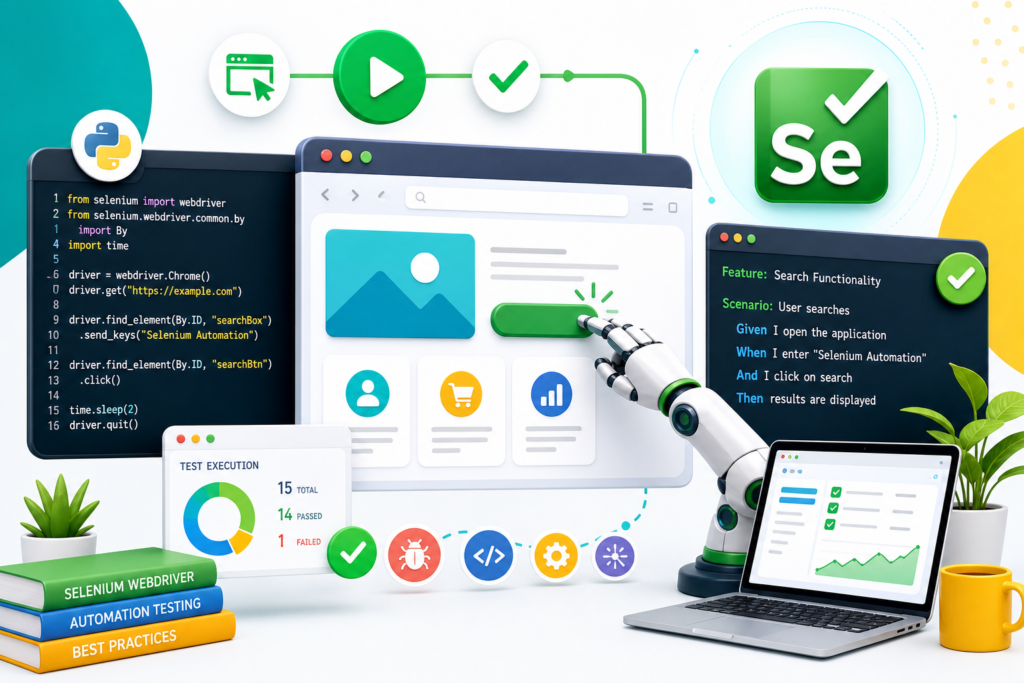
- A strong Selenium syllabus sequences locators and waits before framework design and CI/CD integration.
- Expect 17 modules: WebDriver basics, TestNG, Page Object Model, data-driven testing, BDD, and reporting.
- Framework design questions matter more in interviews than knowing every WebDriver command by heart.
- Book a free Asmorix demo to match this syllabus to weekday or weekend batches in Chennai.
This Selenium course syllabus is a complete module checklist for learners who want to go from WebDriver fundamentals to Page Object Model framework design, data-driven testing, and CI/CD integration, with a real-time project focus. Use it to compare institutes, plan self-study, or map labs before you join Selenium Training in Chennai. Related paths include Software Testing Course Syllabus, API Testing Course Syllabus, and RPA Course Syllabus.
A complete Selenium syllabus should cover locators and synchronization, TestNG, Page Object Model framework design, data-driven testing, Selenium Grid, and CI/CD integration — not basic scripting alone.
Quick Overview
| Item | Details |
|---|---|
| Course focus | Selenium WebDriver automation from basics to framework design |
| Modules | 17 core modules + real-time project guidance |
| Level | Beginner to job-ready automation tester (SDET track) |
| Who it is for | Manual testers upskilling, freshers, and developers moving into QA automation |
| Key outcomes | Build maintainable automation suites with POM, TestNG/Cucumber, and CI/CD integration |
| Prerequisites | Basic Java syntax is helpful; core Java concepts are reinforced throughout |
| Training options | Classroom and live online batches in Chennai with placement support |
Who Should Follow This Selenium Syllabus?
This Selenium syllabus suits manual testers who want to add automation skills, freshers targeting QA automation roles, and developers moving into SDET positions. Absolute beginners can start at Module 1 alongside basic Java revision. If you already know Java, you can move faster into framework design and CI/CD.
Module 1: Introduction to Test Automation & Selenium
- Manual versus automation testing
- Selenium suite overview: WebDriver, Grid, IDE
- Setting up Java and Selenium environment
- Browser drivers and WebDriverManager
- Selenium architecture and the W3C protocol
Module 2: Selenium WebDriver Basics
- Launching browsers and navigation commands
- Locator strategies: id, name, class, tag, link text
- XPath fundamentals: absolute versus relative
- CSS selectors for element location
- WebDriver commands cheat sheet
Module 3: Handling Web Elements
- Text boxes, buttons, checkboxes, and radio buttons
- Dropdowns with the Select class
- Handling multiple windows and tabs
- Handling frames and iframes
- Handling alerts and popups
Module 4: Synchronization & Waits
- Implicit wait versus explicit wait
- Fluent wait and polling
- ExpectedConditions class
- Handling dynamic elements
- Avoiding flaky tests with proper waits
Module 5: Advanced XPath & CSS Techniques
- Dynamic XPath with contains and starts-with
- Axes in XPath: parent, ancestor, following-sibling
- Advanced CSS selector combinators
- Handling shadow DOM basics
- Debugging locators with browser dev tools
Module 6: Actions Class & JavaScript Executor
- Mouse hover and drag-and-drop with Actions class
- Keyboard actions and key combinations
- Executing JavaScript with JavascriptExecutor
- Scrolling and highlighting elements
- Handling file uploads and downloads
Module 7: TestNG Framework
- TestNG annotations and execution order
- Assertions: hard versus soft
- Grouping and prioritizing tests
- Parameterization with @DataProvider
- TestNG XML suite configuration
- Parallel execution configuration
Module 8: Page Object Model & Design Patterns
- Page Object Model structure and benefits
- PageFactory and @FindBy annotations
- Fluent design for Page Object Model
- Data-driven framework integration
- Reducing duplication with base classes
If a syllabus teaches only recorded scripts without Page Object Model, treat that as a warning sign. Maintainable frameworks are the real interview differentiator.
Module 9: Data-Driven Testing
- Reading data from Excel with Apache POI
- Reading data from CSV, JSON, and properties files
- Parameterizing tests with external data
- Handling test data cleanup
- Database validation alongside UI checks
Module 10: Cross-Browser & Parallel Testing
- Selenium Grid architecture: hub and node
- Setting up Grid for cross-browser runs
- Parallel execution strategies
- Cloud grid overview: BrowserStack and LambdaTest
- Headless browser testing
Module 11: Behavior Driven Development with Cucumber
- Gherkin syntax: Given, When, Then
- Feature files and step definitions
- Cucumber hooks and tags
- Integrating Cucumber with Selenium
- Generating BDD reports
Module 12: API Testing Integration
- REST basics for testers
- RestAssured library fundamentals
- Combining UI and API test layers
- Validating backend data during UI flows
- Mocking APIs for isolated UI testing
Module 13: CI/CD Integration
- Integrating Selenium tests with Jenkins
- Git version control for test scripts
- Triggering test suites on code commits
- Docker basics for Selenium Grid
- Scheduling automated regression runs
Module 14: Reporting & Logging
- ExtentReports integration
- Allure report generation
- Log4j for test logging
- Screenshot capture on failure
- Email notification of test results
Module 15: Selenium with Python (Alternate Stack)
- Selenium bindings for Python
- Pytest fundamentals for automation
- Pytest fixtures and parameterization
- Combining Selenium with Pytest-BDD
- Choosing Java versus Python for automation careers
Java remains the dominant Selenium stack in enterprise QA teams, but Python-based Selenium is common in startups. Understanding both keeps your options open.
Module 16: Hybrid Framework Design
- Combining keyword-driven and data-driven approaches
- Utility and helper class design
- Configuration management with properties files
- Exception handling in frameworks
- Maintainability and scalability best practices
Module 17: Real-Time Project
Capstone delivery follows a structured project flow used in placement-oriented automation training.
- Framework setup and Page Object Model design
- Locator strategy and utility class planning
- Test data and configuration management
Phase 1
- Test script development for critical user flows
- Data-driven test execution
- Cross-browser validation
Phase 2
- TestNG or Cucumber suite execution
- API test integration for backend checks
- Reporting with ExtentReports or Allure
Phase 3
- Jenkins CI/CD integration
- Regression suite scheduling
- Demo walkthrough and resume bullet practice
How to Use This Syllabus
Bring this Selenium course syllabus to counseling and ask which labs map to each module, which application you will automate end-to-end, and how many mentor review cycles you get on your framework design. Confirm coverage for Page Object Model, data-driven testing, and CI/CD before you enroll. For batch timings, fees, and placement-oriented Selenium training in Chennai, visit Selenium Training in Chennai with Placement.
Related Courses & Syllabus Guides
After Selenium, many learners broaden their QA automation skills with these Asmorix paths:
- Selenium Training in Chennai — classroom and live online batches with placement support
- Software Testing Course Syllabus — manual testing foundation
- API Testing Course Syllabus — backend validation specialization
- RPA Course Syllabus — adjacent automation career path
- Java Course Syllabus — strengthen the language behind Selenium
Frequently Asked Questions
What does the Selenium course syllabus cover?
It covers WebDriver fundamentals, locator strategies, synchronization, Actions and JavaScript Executor, TestNG, Page Object Model, data-driven testing, Selenium Grid, BDD with Cucumber, API testing integration, and CI/CD with a real-time project.
How many modules are in this Selenium syllabus?
This reference plan has 17 modules plus a phased real-time project, covering Java-based Selenium and an alternate Python stack overview.
Do I need Java to learn Selenium?
Java is the most common language pairing for Selenium in enterprise QA teams, though this syllabus also introduces Selenium with Python as an alternate stack for context.
What is Page Object Model and why does it matter?
Page Object Model is a design pattern that separates locators and page actions from test logic, making automation suites easier to maintain as an application changes.
Is API testing part of Selenium training?
Yes, as an advanced module. Combining UI automation with RestAssured-based API testing is increasingly expected for SDET-track roles.
What projects should be part of Selenium training?
A Page Object Model based automation suite for a real application, integrated with TestNG or Cucumber and connected to Jenkins CI/CD, is a strong capstone project.
Is Selenium Grid covered in this syllabus?
Yes. Selenium Grid architecture, cross-browser execution, parallel testing, and cloud grid orientation are included as a dedicated module.
Where can I join Selenium training in Chennai?
Asmorix offers mentor-led Selenium training with placement support. Book a free demo to match this syllabus to your background and preferred batch timing.
