
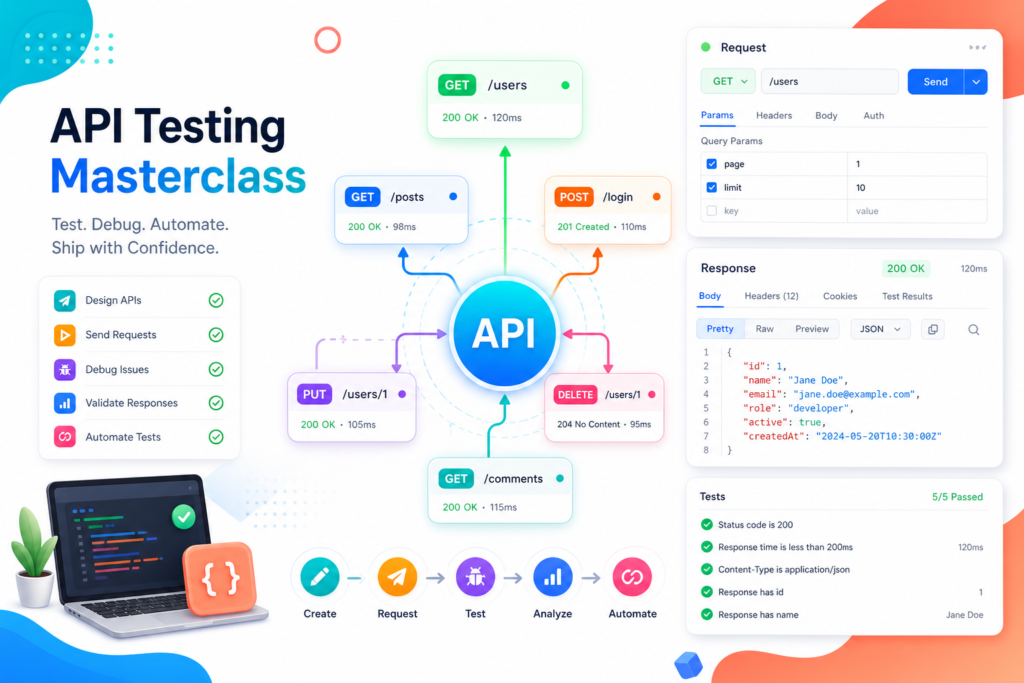
- A strong API Testing syllabus sequences HTTP fundamentals and Postman before RestAssured automation and security testing.
- Expect 17 modules: HTTP basics, Postman, authentication testing, RestAssured, performance, and CI/CD integration.
- Job-ready API testers validate schema, status codes, security, and performance, not just happy-path responses.
- Book a free Asmorix demo to match this syllabus to weekday or weekend batches in Chennai.
This API Testing course syllabus is a complete module checklist for learners who want to go from HTTP fundamentals and Postman to RestAssured automation, security testing, and CI/CD integration, with a real-time project focus. Use it to compare institutes, plan self-study, or map labs before you join API Testing Training in Chennai. Related paths include Software Testing Course Syllabus, Selenium Course Syllabus, and RPA Course Syllabus.
A complete API Testing syllabus should cover HTTP fundamentals, Postman, authentication testing, RestAssured automation, performance, and security testing — not manual happy-path checks alone.
Quick Overview
| Item | Details |
|---|---|
| Course focus | Manual and automated API testing with Postman and RestAssured |
| Modules | 17 core modules + real-time project guidance |
| Level | Beginner to job-ready API/SDET tester |
| Who it is for | Manual testers upskilling, freshers, and developers moving into QA automation |
| Key outcomes | Design Postman collections, automate with RestAssured, and validate security and performance |
| Prerequisites | Basic computer literacy; Java basics help for RestAssured modules |
| Training options | Classroom and live online batches in Chennai with placement support |
Who Should Follow This API Testing Syllabus?
This API Testing syllabus suits manual testers who want automation skills, freshers targeting QA automation roles, and developers who want to validate their own backend services thoroughly. Absolute beginners can start at Module 1 with Postman. If you already know Java, you can move faster into RestAssured automation.
Module 1: Introduction to APIs & API Testing
- What an API is and types: REST, SOAP, GraphQL
- API testing versus UI testing
- HTTP protocol basics: methods, status codes, headers
- API testing tools landscape: Postman, RestAssured, SoapUI
- Career paths in API and QA automation
Module 2: HTTP Fundamentals Deep Dive
- Request and response structure
- Headers: content-type, authorization, custom headers
- Status code categories and meanings
- Query params versus path params versus body
- Idempotency and safe methods
Module 3: Postman Fundamentals
- Creating and organizing collections
- Sending GET, POST, PUT, and DELETE requests
- Environment and global variables
- Pre-request scripts basics
- Postman console for debugging
Module 4: Postman Advanced Techniques
- Writing test scripts with Chai assertions
- Dynamic variables and data-driven collection runs
- Postman Runner and Newman CLI
- Mock servers in Postman
- Postman monitors for scheduled checks
Module 5: REST API Testing Concepts
- Validating response schema
- Validating status codes and response time
- Content negotiation testing
- Pagination and filtering testing
- Testing idempotent versus non-idempotent operations
Module 6: Authentication & Authorization Testing
- Basic auth, API keys, and Bearer tokens
- OAuth2 flow testing
- JWT structure and validation
- Testing role-based access control
- Session versus token-based auth testing
Broken object level authorization is one of the most common real-world API defects. Always test what happens when a user requests data belonging to someone else.
Module 7: RestAssured Framework (Java)
- RestAssured setup and dependencies
- Given-When-Then syntax
- Serialization and deserialization with POJOs
- Extracting and validating JSON response with JsonPath
- Chaining requests with extracted data
Module 8: Advanced RestAssured & Framework Design
- Request and response specification builders
- Handling headers, cookies, and multipart requests
- Data-driven API tests with TestNG DataProvider
- Combining RestAssured with Cucumber for BDD
- Building a reusable API automation framework
Module 9: SOAP Web Services Testing
- WSDL structure basics
- SoapUI for SOAP requests
- XML request and response validation
- SOAP versus REST comparison
- SOAP fault handling
Module 10: GraphQL API Testing
- GraphQL query and mutation basics
- Testing GraphQL endpoints with Postman
- Schema validation for GraphQL
- Common GraphQL testing pitfalls
Module 11: API Performance Testing
- Load testing APIs with JMeter
- Analyzing throughput and response time
- Identifying bottlenecks under load
- Correlation and parameterization for API load tests
- Basic capacity planning concepts
Module 12: API Security Testing
- OWASP API Security Top 10 overview
- Testing for broken authentication
- Injection testing basics for APIs
- Rate limiting and throttling validation
- Sensitive data exposure checks
Security testing is no longer optional for API roles. Even junior QA interviews now ask about rate limiting, token expiry, and injection basics.
Module 13: Contract Testing & Mocking
- Consumer-driven contract testing concepts with Pact
- Mocking microservice dependencies
- API virtualization basics
- Schema versioning strategies
- Backward compatibility testing
Module 14: Database Validation for API Testing
- Validating API responses against database records
- Writing SQL queries for backend verification
- Data setup and teardown for API tests
- Handling test data isolation
Module 15: CI/CD Integration for API Tests
- Integrating Newman and RestAssured suites with Jenkins
- Running API tests in pipelines
- Reporting with Allure or ExtentReports
- Scheduling regression API suites
- Shift-left API testing practices
Module 16: Microservices Testing Strategy
- Testing pyramid for microservices
- End-to-end versus contract versus component testing
- Service virtualization for dependent services
- Testing asynchronous and event-driven APIs
Module 17: Real-Time Project
Capstone delivery follows a structured project flow used in placement-oriented API testing training.
- API documentation review and test plan
- Postman collection design
- Authentication strategy mapping
Phase 1
- RestAssured automation framework setup
- Authentication and authorization test cases
- Data-driven test implementation
Phase 2
- Database validation layer
- Performance checks with JMeter
- Security test cases for common vulnerabilities
Phase 3
- CI/CD integration with Jenkins
- Reporting and dashboard setup
- Demo walkthrough and resume bullet practice
How to Use This Syllabus
Bring this API Testing course syllabus to counseling and ask which labs map to each module, which APIs you will practice on, and how many mentor review cycles you get on your automation framework. Confirm coverage for authentication testing, RestAssured, and security testing before you enroll. For batch timings, fees, and placement-oriented API testing training in Chennai, visit API Testing Training in Chennai with Placement.
Related Courses & Syllabus Guides
After API Testing, many learners broaden their QA automation skills with these Asmorix paths:
- API Testing Training in Chennai — classroom and live online batches with placement support
- Software Testing Course Syllabus — manual testing foundation
- Selenium Course Syllabus — UI automation companion skill
- RPA Course Syllabus — adjacent automation career path
How to use this API Testing Course Syllabus guide
Read API Testing Course Syllabus once for the map, then a second time with a notebook. On the first pass, mark every term you cannot explain out loud. On the second pass, close the page and write those terms in your own words. A fresher who can teach the idea is the fresher who clears the interview. A fresher who only recognises the heading still freezes when the panel changes one word in the question.
Keep the examples next to the definitions. For API Testing Course Syllabus, an example is a tiny input, the step you take, and the output you expect. If you cannot write that trio, you do not know the topic yet. Chennai panels, campus drives, and lateral rounds all use this test. They rarely ask you to recite a paragraph. They ask you to apply one idea to a new case.
Set a 45-minute block. Spend 15 minutes reading one section of API Testing Course Syllabus, 20 minutes doing the example by hand, and 10 minutes writing a three-line summary. Stop when the summary is specific. “It is important for freshers” is not a summary. “Here is the input, here is the check, here is the mistake I made” is a summary you can say in an interview.
What to practise first
Start with the core of API Testing Course Syllabus, not with the advanced corner. Write the ten ideas that the rest of the topic stands on. For each idea, add one example you created, not one you copied. If the guide shows a sample, change the numbers or the names and solve it again. Copying the sample feels fast and teaches nothing. Changing it shows whether you followed the logic.
Practise speaking. Read a heading from API Testing Course Syllabus, look away, and explain it for sixty seconds. Record it. Listen for filler and for steps you skipped. Interviewers in Chennai notice skipped steps more than they notice accent. If you jump from the question to the answer with no middle, they assume you memorised a result.
Build a one-page cheat sheet after you understand the topic, not before. The sheet should contain formulas, edge cases, and the two mistakes you personally made. It should not contain every sentence from API Testing Course Syllabus. A long cheat sheet is a second textbook. A short one is a tool you can review on the morning of an interview.
A four-week plan for API Testing Course Syllabus
Week one is vocabulary and the happy path. Learn the words in API Testing Course Syllabus and complete the simplest full example from start to finish. Do not collect five tutorials. Finish one path so you can repeat it without the page open. At the end of the week, teach that path to a friend or to a blank document.
Week two is edge cases. Ask what happens when the input is empty, duplicated, too large, or in the wrong format. API Testing Course Syllabus becomes useful here. Most fresher answers cover only the normal case. Panels ask for the broken case because that is what the job contains. Write five broken cases and the result you expect for each.
Week three is speed and explanation. Time yourself. Solve a small problem related to API Testing Course Syllabus in twenty minutes, then spend ten minutes writing how you checked the answer. Speed without a check is how wrong answers get submitted with confidence. The written check is what you will say when the interviewer asks “how do you know?”
Week four is a mock. Pick six questions from API Testing Course Syllabus and answer them out loud without notes. Score yourself on correctness and on clarity. Redo only the ones you missed. The day before a real interview, review the cheat sheet and sleep. New topics on the last night do not stick.
Mistakes that keep API Testing Course Syllabus shallow
The first mistake is highlighting instead of solving. A highlighted PDF of API Testing Course Syllabus is not practice. Close it and produce an output. The second mistake is tool collecting. Freshers add five tools to a resume after reading one page about each. Panels pick one tool and go deep. Depth on the main idea in API Testing Course Syllabus beats a list.
The third mistake is skipping the why. If you can name a step but cannot say why the previous step exists, the answer collapses when the question is reworded. The fourth mistake is ignoring fundamentals that the topic sits on, such as clear writing, basic logic, and careful reading of the problem. API Testing Course Syllabus will not save a candidate who did not read the question.
The fifth mistake is waiting to feel ready. Apply and sit mocks while you are still imperfect. Each mock shows the next gap in API Testing Course Syllabus. A private reread does not. Book the mock, note the exact question you lost, and patch that gap the same day.
How API Testing Course Syllabus shows up in Chennai interviews and jobs
Chennai service companies, product teams, and campus drives use topics like API Testing Course Syllabus as a filter, not as a trivia round. They want to see whether you can learn a task and explain it to a teammate. Bring one example you did yourself. Walk through the input, the decision, and the result. Stop talking when the result is clear. Extra theory after a clear result makes the answer worse.
On the job, the same topic shows up as a ticket, a review comment, or a question from a senior. You will not get a paragraph of context. You will get a broken case and a deadline. The four-week plan above is practice for that moment. People who only read API Testing Course Syllabus the night before an interview forget it the week after they join. People who solved examples still have the reflex.
If this topic supports a role you want, connect it to a project in your resume with one measurable line. “Studied API Testing Course Syllabus” is weak. “Used the idea from API Testing Course Syllabus to fix a specific bug, query, page, or case, and here is what changed” is strong. Asmorix mentors in Chennai push students to that second sentence because that is what hiring panels score.
Checklist before you claim API Testing Course Syllabus
- I can explain the core idea in API Testing Course Syllabus in sixty seconds without reading.
- I have five examples I created, including two that fail on purpose.
- I can say why each step exists, not only what the step is called.
- I have a one-page sheet of my own mistakes.
- I have answered six questions out loud and redone the ones I missed.
- My resume line points at a result, not at the name of the topic.
If any line is still false, stay on that line for two more sessions. Do not open a new topic to avoid the gap. The candidate who finishes API Testing Course Syllabus properly outperforms the candidate who sampled ten guides and owns none of them.
Questions freshers ask about API Testing Course Syllabus
Is reading API Testing Course Syllabus enough to clear an interview?
Reading is the start. Interviews test whether you can use the idea on a new input and explain the check you did. Plan at least as much practice time as reading time. If you have only read, say you are still practising. Do not claim mastery you cannot demo.
How long does API Testing Course Syllabus take for a fresher?
A focused fresher can get interview-ready on one topic in about four weeks of daily 45-minute sessions. Rushing it into two evenings produces familiar headings and weak answers. Stretching it across six idle months produces the same result. The calendar above is the useful pace.
Should I memorise every line of API Testing Course Syllabus?
No. Memorise the checks and the edge cases. Keep definitions in your own words. Panels rephrase questions. A memorised paragraph fails the rephrase. A worked example survives it.
When you want a timetable, projects, and mock interviews around this kind of topic, look at the Asmorix courses in Chennai or the Asmorix blog for the next guide in the same path.
A worked practice set for API Testing Course Syllabus
Use this second set only after the first plan. Take one idea from API Testing Course Syllabus and write it as a question a stranger could answer. Then write the answer with an input, a step, and a check. Repeat this five times. Number them. If you cannot invent the question, you are still depending on the original wording of API Testing Course Syllabus, and that will not match an interview.
Swap the input on each of the five. Change a name, a number, an empty value, or a duplicate. Predict the new output before you calculate it. The prediction is the skill. The calculation only confirms it. Write down every prediction you got wrong and the reason. That list is more valuable than another complete reread of API Testing Course Syllabus.
Explain one of the five answers as if the listener has never seen API Testing Course Syllabus. Use short sentences. If you need a jargon word, define it in the same breath. This is the bar for a fresher explanation in a Chennai technical round. Clarity is part of the score, not a bonus.
How to revise API Testing Course Syllabus the week of an interview
Six days out, redo two edge cases from memory. Five days out, teach the core idea in sixty seconds. Four days out, review only the mistakes list. Three days out, sit one timed question. Two days out, fix the one gap the timed question exposed. One day out, read the one-page sheet and stop. Adding new branches of API Testing Course Syllabus on the last day creates noise.
On the interview day, listen to the full question before you answer. Repeat the constraint in one sentence so the panel can correct you if you heard it wrong. Then solve the small version. API Testing Course Syllabus prepared you for the method. The method is what you show. If you blank, write what you know and the next check you would run. A partial honest method scores higher than a silent guess.
After the interview, write the questions down the same day. Mark which part of API Testing Course Syllabus would have answered each one. Patch only those parts. That is how one guide turns into a habit instead of a file you never open again.
Official references
These public pages are the official documents for the terms used above.
Frequently Asked Questions
What does the API Testing course syllabus cover?
It covers HTTP fundamentals, Postman manual and advanced testing, authentication and authorization testing, RestAssured automation, SOAP and GraphQL orientation, performance and security testing, and CI/CD integration with a real-time project.
How many modules are in this API Testing syllabus?
This reference plan has 17 modules plus a phased real-time project, covering both manual Postman testing and RestAssured automation.
Do I need Java to learn API testing?
Postman-based manual API testing does not require coding. RestAssured automation modules use Java, so basic programming logic helps once you reach that stage.
Is authentication testing covered?
Yes. Basic auth, API keys, Bearer tokens, OAuth2 flows, and JWT validation are covered as a dedicated module, since broken authentication is a common real-world defect area.
Is performance testing part of API testing training?
Yes, at an introductory level using JMeter for load testing APIs, covering throughput, response time, and basic bottleneck identification.
What projects should be part of API testing training?
A RestAssured automation framework covering authentication, data-driven tests, and database validation, integrated with a CI/CD pipeline, is a strong capstone project.
Is GraphQL testing included?
Yes, as an advanced orientation module covering query and mutation testing, schema validation, and common GraphQL testing pitfalls.
Where can I join API Testing training in Chennai?
Asmorix offers mentor-led API Testing training with placement support. Book a free demo to match this syllabus to your background and preferred batch timing.
