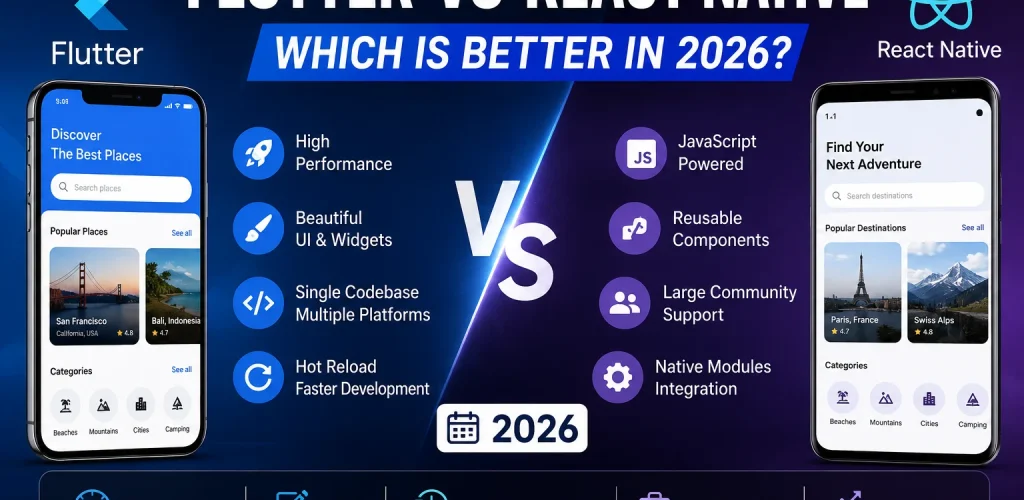
Flutter vs React Native: Which Is Better in 2026?
Cross-platform mobile app development has become the preferred choice for businesses looking to build applications for Android and iOS while reducing development costs and time to market. Two frameworks dominate this space in 2026: Flutter and React Native.
Whether you are a student planning to start a career in mobile development, a startup founder building an MVP, or a business evaluating app development technologies, understanding the differences between Flutter and React Native is crucial.
In this comprehensive comparison, we’ll examine performance, UI capabilities, learning curve, scalability, job opportunities, salary potential, and future growth prospects.
Table of Contents
- What is Flutter?
- What is React Native?
- Flutter vs React Native Comparison
- Performance Comparison
- UI and Design Capabilities
- Development Speed
- Learning Curve
- Jobs and Salary Opportunities
- Which Framework Should You Learn?
- Frequently Asked Questions
What is Flutter?
Flutter is Google’s open-source UI toolkit used for building mobile, web, and desktop applications from a single codebase. It uses the Dart programming language and provides a rich collection of customizable widgets that allow developers to create visually appealing applications.
Flutter has become one of the fastest-growing frameworks because of its excellent performance, extensive widget library, and support for Android, iOS, web, Windows, macOS, and Linux development.
If you’re interested in becoming a Flutter developer, consider enrolling in our
Mobile App Development Training in Chennai
program that includes real-time Flutter projects and placement assistance.
Key Features of Flutter
- Single codebase for multiple platforms
- High-performance rendering engine
- Hot Reload functionality
- Material Design and Cupertino widgets
- Excellent UI customization
- Strong support from Google
What is React Native?
React Native is an open-source mobile application framework developed by Meta. It enables developers to build Android and iOS applications using JavaScript and React while sharing a significant portion of code across platforms.
React Native remains popular among startups and enterprises because of its mature ecosystem and large developer community.
Developers familiar with JavaScript often transition quickly into React Native development, making it an attractive option for web developers entering the mobile app industry.
Key Features of React Native
- JavaScript-based framework
- Large ecosystem and community
- Reusable components
- Hot Reload support
- Native-like user experience
- Strong third-party library support
Flutter vs React Native Comparison
| Feature | Flutter | React Native |
|---|---|---|
| Programming Language | Dart | JavaScript |
| Developer | Meta | |
| Performance | Excellent | Very Good |
| UI Customization | Excellent | Good |
| Learning Curve | Moderate | Easy |
| Community Support | Large | Very Large |
| Web Support | Strong | Limited |
| Cross Platform | Mobile, Web, Desktop | Mainly Mobile |
Performance Comparison
Performance is one of the most important factors when choosing a mobile development framework.
Flutter Performance
Flutter compiles directly into native ARM code and uses its own rendering engine. This results in smooth animations, faster rendering, and a highly responsive user experience.
Flutter is especially suitable for:
- FinTech applications
- E-commerce platforms
- Healthcare apps
- On-demand service applications
- Apps requiring complex animations
React Native Performance
React Native delivers excellent performance for most business applications. However, because it relies on communication between JavaScript and native modules, performance can be slightly lower in graphics-intensive applications.
For most business use cases, users may not notice a significant difference.
Winner: Flutter
UI and Design Capabilities
Flutter UI
Flutter provides complete control over every pixel on the screen through its extensive widget system. Developers can create highly customized interfaces without relying on platform-specific components.
Businesses often choose Flutter when they need visually stunning applications that maintain consistency across devices.
React Native UI
React Native relies on native UI components, allowing applications to look and feel like native Android and iOS apps.
While customization is possible, highly complex UI implementations may require additional development effort.
Winner: Flutter
Development Speed
Both frameworks provide Hot Reload functionality, enabling developers to instantly preview code changes without restarting the application.
Flutter
- Consistent widget architecture
- Faster UI creation
- Reduced platform-specific coding
React Native
- JavaScript familiarity
- Large package ecosystem
- Easy onboarding for web developers
Winner: React Native
Learning Curve
The learning curve varies depending on your programming background.
Flutter Learning Path
- Dart Programming
- Widgets
- State Management
- Firebase Integration
- REST APIs
- App Deployment
To build a successful career, students should also explore our
Mobile App Development Course in Chennai
which covers Flutter, Android, React Native, and real-time projects.
React Native Learning Path
- JavaScript Fundamentals
- React Concepts
- React Native Components
- API Integration
- State Management
- Mobile Deployment
Winner: React Native
Job Opportunities and Salary in 2026
The demand for cross-platform developers continues to rise across industries including healthcare, e-commerce, fintech, logistics, and SaaS.
| Experience | Average Salary |
|---|---|
| Fresher | ₹4 LPA – ₹8 LPA |
| 1-3 Years | ₹8 LPA – ₹15 LPA |
| 3-5 Years | ₹15 LPA – ₹25 LPA |
| Senior Developer | ₹25 LPA+ |
You can also read our guide on
Mobile App Developer Career Opportunities
to understand the latest industry trends.
Which Framework Should You Learn in 2026?
Choose Flutter If:
- You are starting from scratch
- You want better UI customization
- You prefer multi-platform development
- You enjoy design-focused development
- You want strong future growth opportunities
Choose React Native If:
- You already know JavaScript
- You are transitioning from web development
- You want faster onboarding
- Your organization already uses React
Our Recommendation
For beginners entering mobile app development in 2026, Flutter offers excellent long-term potential due to its growing adoption, superior UI capabilities, and cross-platform support.
However, React Native remains a valuable skill because of its mature ecosystem and large job market.
The best strategy is to learn Flutter first and then expand into React Native once you have mastered mobile application development fundamentals.
Frequently Asked Questions
Is Flutter better than React Native in 2026?
Flutter generally offers better performance and UI customization, while React Native provides a larger ecosystem and easier learning path for JavaScript developers.
Which framework has more job opportunities?
Both frameworks have strong demand, but React Native currently has a slightly larger job market due to its longer presence in the industry.
Can beginners learn Flutter?
Yes. Flutter is beginner-friendly and offers extensive documentation, tutorials, and community support.
Is React Native easier than Flutter?
For developers familiar with JavaScript, React Native is usually easier to learn. Beginners with no programming experience can successfully learn either framework.
Which framework is best for startups?
Flutter is often preferred for startups because it enables faster MVP development with lower maintenance costs.
Authoritative Resources
Ready to become a professional mobile app developer? Join our
Mobile App Development Training in Chennai
and gain hands-on experience with Flutter, React Native, Android, iOS, Firebase, APIs, and deployment through industry-oriented projects and placement assistance.
.3