
Data Science Course Syllabus
Explore the complete Data Science Course Syllabus in Chennai at Asmorix Technologies. Learn Python, Machine Learning, Artificial Intelligence, SQL, Tableau, Power BI, Deep Learning, and real-time projects designed for industry-ready skills.
Why Learn Data Science in 2026
Data Science is one of the fastest-growing career domains in the IT industry. Companies use Data Science for business intelligence, automation, customer analytics, Artificial Intelligence, and predictive analysis. Learning Data Science helps students build careers in Machine Learning, AI, Business Analytics, and Big Data technologies.
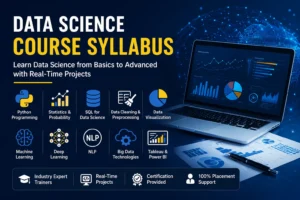
The Data Science Course Syllabus at Asmorix Technologies is designed based on current industry requirements and includes practical implementation using Python, Machine Learning, SQL, Tableau, Power BI, and Deep Learning concepts.
Tools Covered in Data Science Course Syllabus
Students will gain hands-on experience with industry-standard tools including:
- Python
- Pandas
- NumPy
- Matplotlib
- Scikit-learn
- TensorFlow
- SQL
- Tableau
- Power BI
- Jupyter Notebook
These tools are widely used in real-world Data Science and AI projects.
Introduction to Data Science
- Overview of Data Science
- Importance of Data Science in Various Industries
- Data Science Life Cycle
What is Data Science?
- Definition and Scope
- Key Components of Data Science
- Real-world Applications
Prerequisites for Learning Data Science
- Basic Mathematics & Statistics
- Programming Fundamentals (Python/R)
- Understanding Databases and SQL
Python for Data Science
- Python Installation & Setup
- Jupyter Notebook & IDEs
- Python Basics (Variables, Data Types, Operators)
Data Structures in Python
- Lists, Tuples, Sets, Dictionaries
- Comprehensions & Lambda Functions
Python for Data Analysis
NumPy for Numerical Computing
- Arrays, Indexing, Broadcasting, and Mathematical Functions
Pandas for Data Manipulation
- DataFrames, Series, Data Cleaning, and Transformation
Data Handling and Preprocessing
- Data Collection & Cleaning
- Handling Missing Values
- Data Formatting and Normalization
- Feature Engineering
Data Visualization
Matplotlib & Seaborn
- Line, Bar, Histogram, Scatter Plots
- Heatmaps, Pairplots, and Advanced Visualizations
Plotly & Dash for Interactive Visualization
- Creating Dynamic Dashboards
Statistics and Probability for Data Science
- Mean, Median, Mode, Variance, Standard Deviation
- Hypothesis Testing
- Confidence Intervals
- p-values and z-scores
Machine Learning with Python
- Introduction to Machine Learning
- Supervised vs Unsupervised Learning
- Applications of Machine Learning
Supervised Learning Algorithms
Regression Techniques
- Linear Regression
- Polynomial Regression
- Ridge & Lasso Regression
Classification Techniques
- Logistic Regression
- Decision Trees
- Random Forest
- Naive Bayes
- Support Vector Machines (SVM)
Unsupervised Learning Algorithms
Clustering
- K-Means Clustering
- Hierarchical Clustering
Dimensionality Reduction
- Principal Component Analysis (PCA)
- t-SNE
🚀 Don’t just read—Take action! Enroll now and become a Data Science expert!
Deep Learning and Neural Networks
- Difference Between Machine Learning and Deep Learning
- Neural Network Architecture
Artificial Neural Networks (ANN)
- Perceptron Model
- Activation Functions
Convolutional Neural Networks (CNN)
- Image Processing Basics
- CNN Architecture (Convolution, Pooling, Fully Connected Layers)
Recurrent Neural Networks (RNN) and LSTMs
- Understanding Sequential Data
- Applications in Time Series & NLP
Natural Language Processing (NLP)
- Text Processing and Tokenization
- Stopwords, Lemmatization, Stemming
- Bag of Words & TF-IDF
Advanced NLP Techniques
- Word Embeddings (Word2Vec, GloVe)
- Named Entity Recognition (NER)
Time Series Analysis
- Forecasting Methods
- ARIMA, SARIMA, Prophet Model
- Handling Seasonality & Trends
Big Data Technologies for Data Science
- Introduction to Big Data
- Hadoop Ecosystem
- Spark for Large-scale Data Processing
Model Deployment & MLOps
- Deploying Machine Learning Models
- Flask & FastAPI
- Streamlit for Web Apps
MLOps & Model Monitoring
- CI/CD for Machine Learning
- Model Tracking and Logging
Data Science Projects & Case Studies
- Predictive Analytics
- Recommender Systems
- Fraud Detection
The Data Science Course Syllabus at Asmorix Technologies is designed to help students and professionals master industry-demand skills through practical learning, real-time projects, and modern AI technologies.
Career Opportunities After Completing Data Science Course Syllabus
After completing the Data Science Course Syllabus, students can apply for roles such as:
- Data Scientist
- Machine Learning Engineer
- Data Analyst
- AI Engineer
- Business Analyst
- Python Developer
Data Science professionals are highly demanded across healthcare, finance, e-commerce, IT, and AI industries.