
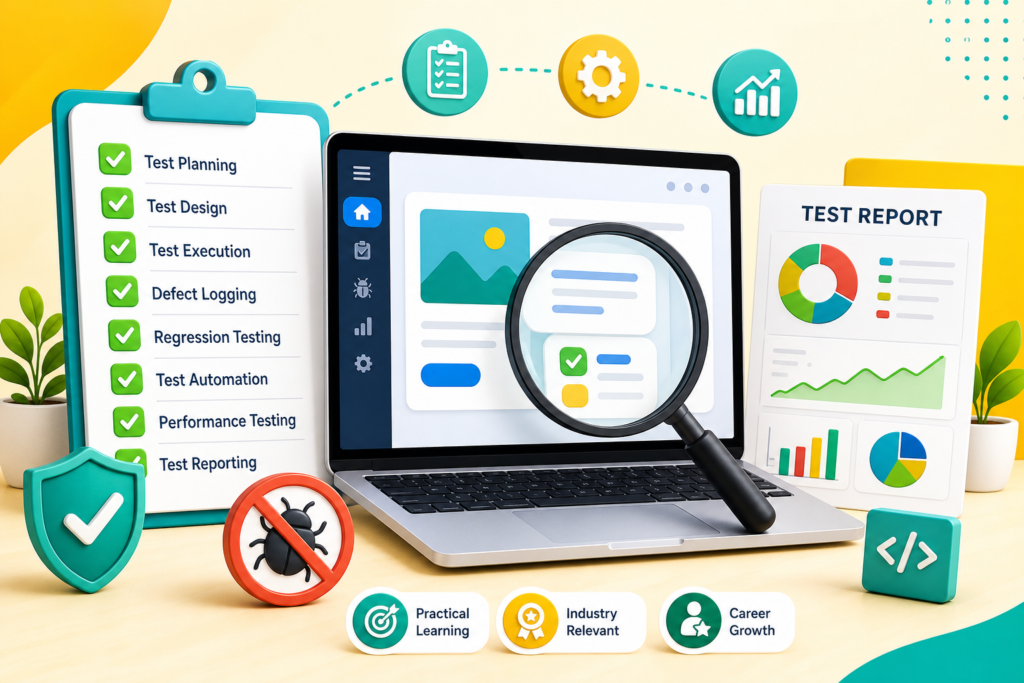
- A strong Software Testing syllabus sequences manual testing fundamentals before automation, API, and performance testing.
- Expect 17 modules: STLC, test design techniques, defect management, Selenium, API testing, and CI/CD integration.
- Job-ready testers need both manual test case design and automation scripting, not one or the other.
- Book a free Asmorix demo to match this syllabus to weekday or weekend batches in Chennai.
This Software Testing course syllabus is a complete module checklist for learners who want to go from manual testing fundamentals to Selenium automation, API testing, and performance testing, with a real-time project focus. Use it to compare institutes, plan self-study, or map labs before you join Software Testing Training in Chennai. Related paths include Selenium Course Syllabus, API Testing Course Syllabus, and RPA Course Syllabus.
A complete Software Testing syllabus should cover STLC and test design techniques, defect management, Selenium automation, API testing, and performance testing — not manual testing alone.
Quick Overview
| Item | Details |
|---|---|
| Course focus | Manual testing through Selenium and API automation |
| Modules | 17 core modules + real-time project guidance |
| Level | Beginner to job-ready QA engineer |
| Who it is for | Freshers, career switchers, and professionals targeting QA/SDET roles |
| Key outcomes | Design test cases, manage defects, automate with Selenium, validate APIs and performance |
| Prerequisites | Basic computer literacy; no prior coding experience required |
| Training options | Classroom and live online batches in Chennai with placement support |
Who Should Follow This Software Testing Syllabus?
This Software Testing syllabus suits freshers aiming for QA roles, non-IT graduates switching into software, and working professionals who want to add automation skills to a manual testing background. Absolute beginners can start at Module 1. If you already understand SDLC basics, you can move faster into test design and automation.
Module 1: Introduction to Software Testing
- SDLC and STLC overview
- Verification versus validation
- Manual testing versus automation testing
- Testing principles and common myths
- QA versus QC versus Testing roles
Module 2: Software Testing Life Cycle
- Requirement analysis for testing
- Test planning and test strategy
- Test case design techniques overview
- Test environment setup
- Entry and exit criteria
Module 3: Test Case Design Techniques
- Equivalence partitioning
- Boundary value analysis
- Decision table testing
- State transition testing
- Error guessing
- Use case based testing
Module 4: Levels of Testing
- Unit testing overview
- Integration testing approaches: top-down, bottom-up, big bang
- System testing
- User acceptance testing (UAT)
- Alpha versus beta testing
Module 5: Types of Functional & Non-Functional Testing
- Smoke and sanity testing
- Regression testing
- Performance, load, and stress testing basics
- Security testing basics
- Usability and compatibility testing
- Accessibility testing overview
Module 6: Defect Management
- Defect life cycle
- Bug reporting and severity versus priority
- Defect tracking with JIRA
- Root cause analysis
- Defect metrics and reporting
Module 7: Test Management & Documentation
- Test plan document structure
- Requirement Traceability Matrix (RTM)
- Test case management tools
- Test summary reports
- Risk-based testing approach
An RTM that nobody updates after week one is a red flag. Ask institutes how RTMs are maintained across the real-time project, not just introduced in a slide.
Module 8: Introduction to Automation Testing
- Manual versus automation: when to automate
- Automation framework types overview
- Record and playback versus scripting
- ROI of automation testing
Module 9: Selenium WebDriver Fundamentals
- Selenium architecture and components
- Locators: id, name, xpath, css selectors
- WebDriver commands and browser handling
- Handling implicit and explicit waits
- Handling alerts, frames, and windows
Module 10: Selenium Advanced & Framework Design
- Page Object Model design pattern
- Data-driven testing with Excel and CSV
- TestNG annotations and assertions
- Cross-browser testing setup
- Selenium Grid basics
Module 11: API Testing Fundamentals
- REST API basics and HTTP methods
- Postman for manual API testing
- Validating status codes and response bodies
- Introduction to RestAssured for automation
- API authentication testing basics
Module 12: Performance Testing with JMeter
- JMeter installation and test plan structure
- Creating thread groups and samplers
- Assertions and listeners
- Analyzing load test reports
- Identifying performance bottlenecks
Module 13: Mobile Application Testing
- Manual mobile testing approach
- Appium setup and architecture
- Mobile-specific test scenarios
- Emulator versus real device testing
Module 14: Agile Testing & CI/CD Integration
- Agile and Scrum testing practices
- Behavior Driven Development with Cucumber
- Integrating tests with Jenkins CI/CD
- Continuous testing concepts
- Shift-left testing approach
Module 15: Test Automation Frameworks (Advanced)
- Hybrid framework design
- Keyword-driven framework concepts
- Reporting with ExtentReports or Allure
- Git version control for test scripts
- Maintainable framework best practices
Framework design questions separate senior QA candidates from beginners in interviews. Being able to explain why a framework is structured a certain way matters more than the tool name on a resume.
Module 16: Security & Database Testing
- SQL for testers: basic validation queries
- Backend data validation techniques
- OWASP Top 10 awareness for testers
- Basic penetration testing concepts
Module 17: Real-Time Project
Capstone delivery follows a structured project flow used in placement-oriented QA training.
- Test planning and RTM for a sample application
- Test case design using multiple techniques
- Test environment and data setup
Phase 1
- Manual test execution and defect logging
- Selenium automation suite for core flows
- Page Object Model implementation
Phase 2
- API test cases with Postman and RestAssured
- Data-driven and cross-browser test runs
- CI/CD integration with Jenkins
Phase 3
- Test summary reporting and metrics
- Defect triage walkthrough
- Interview-style QA scenario practice
How to Use This Syllabus
Bring this Software Testing course syllabus to counseling and ask which labs map to each module, which applications you will practice on, and how many mentor review cycles you get on your automation scripts. Confirm coverage for Selenium, API testing, and CI/CD integration before you enroll. For batch timings, fees, and placement-oriented testing training in Chennai, visit Software Testing Training in Chennai with Placement.
Related Courses & Syllabus Guides
After Software Testing foundations, many learners specialize further with these Asmorix paths:
- Software Testing Training in Chennai — classroom and live online batches with placement support
- Selenium Course Syllabus — deep dive into UI automation
- API Testing Course Syllabus — backend validation specialization
- RPA Course Syllabus — adjacent automation career path
- Java Course Syllabus — programming foundation for automation frameworks
Frequently Asked Questions
What does the Software Testing course syllabus cover?
It covers STLC, test case design techniques, levels and types of testing, defect management, Selenium automation, API testing, JMeter performance testing, mobile testing, and CI/CD integration with a real-time project.
How many modules are in this Software Testing syllabus?
This reference plan has 17 modules plus a phased real-time project, covering both manual and automation testing skills.
Do I need coding skills for software testing?
Manual testing does not require coding. Automation testing modules introduce Java or Python basics alongside Selenium, so you build coding skills progressively within the syllabus.
Is Selenium enough for automation testing jobs?
Selenium is the most in-demand UI automation tool, but interviewers also expect API testing knowledge and framework design skills such as Page Object Model and data-driven testing.
Is API testing included in this syllabus?
Yes. A dedicated module covers REST API basics, Postman, and RestAssured for automating backend validation alongside UI testing.
What projects should be part of testing training?
A test plan and RTM for a sample application, a Selenium automation suite with Page Object Model, and API test cases integrated with CI/CD form a strong capstone project.
Is performance testing covered?
Yes. JMeter fundamentals including thread groups, samplers, assertions, and analyzing load test reports are included as a dedicated module.
Where can I join Software Testing training in Chennai?
Asmorix offers mentor-led Software Testing training with placement support. Book a free demo to match this syllabus to your background and preferred batch timing.
