
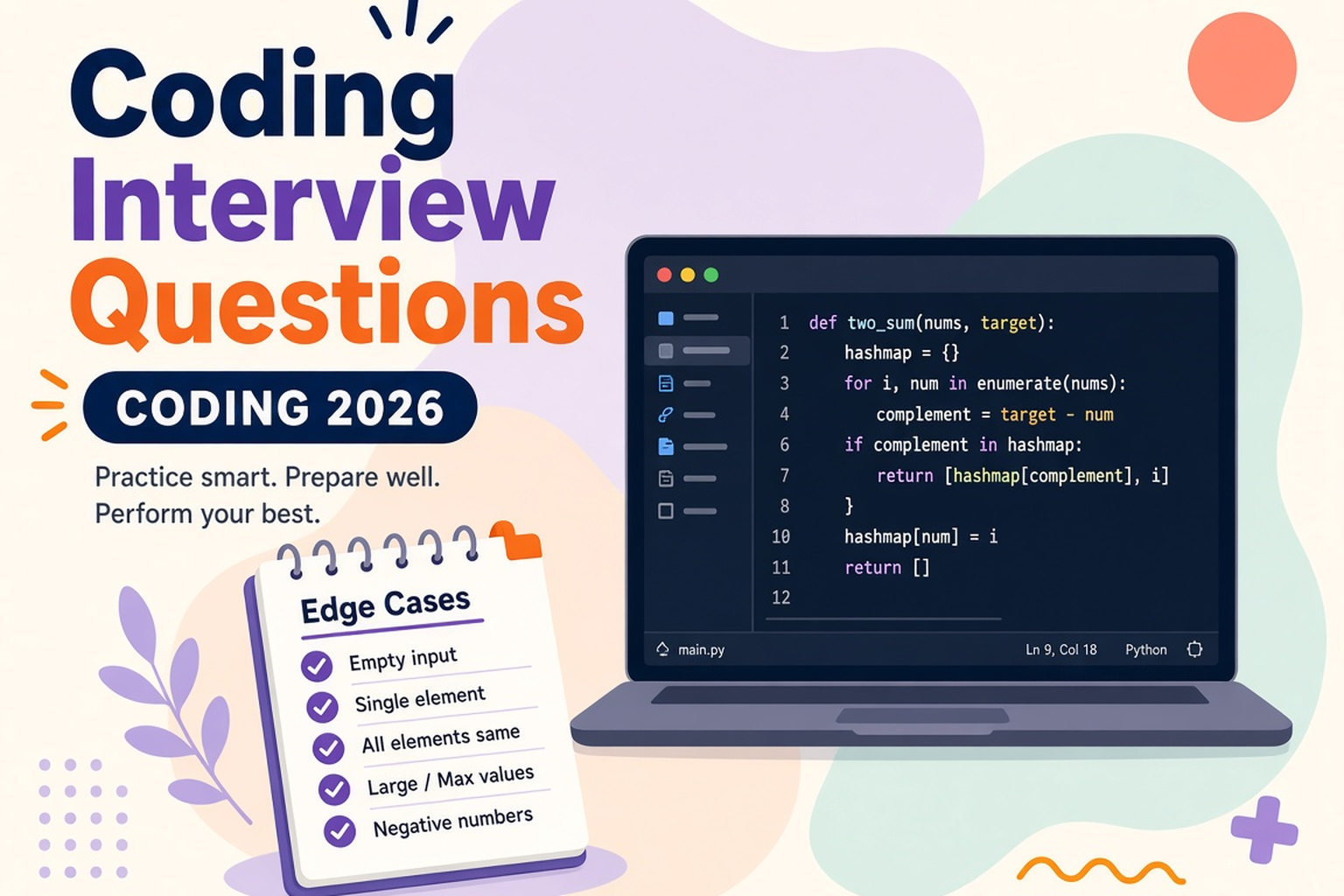
- 50 solved problems with approach, code, and output - a practice gym, not a theory dump.
- Start here after you know language syntax. Then add DSA patterns.
- Every problem is a common OA or round-one warm-up.
- Copy the compiler block, then retype from memory the next day.
- Company-wise flavour is on a separate page.
Programming problems and solutions in 2026 cover the theory, patterns, and spoken answers Chennai fresher panels expect before you touch an IDE. This hub at Programming problems and solutions (no number in the URL) gives every answer with a direct first sentence you can say in under a minute.
Last updated: September 9, 2026 - Reviewed by Asmorix mentors in Chennai
Asmorix mentors compiled these from TCS/Infosys services drives, GCC captives on OMR, and product screens across Guindy. Each item below is statement, approach, then runnable code - theory lives on DSA interview questions. Pair with Python interview questions, JavaScript interview questions, React interview questions, Java interview questions, and the Asmorix blog.
How to Use This Problem Set (2026)
- Read statement and write approach in 3 bullets before viewing code.
- Code without looking, run sample, then compare IDE solution.
- State time/space aloud - link to coding interview questions for round habits.
- After 50, pick 10 for timed 25-minute reps before company OAs.
Array and String Problems (Q1-Q20)
1. Reverse a string
Statement: Given string s, return reversed s. Approach: Two pointers swap from both ends O(n) time O(n) if new string.def reverse_str(s):
arr = list(s)
lo, hi = 0, len(arr)-1
while lo < hi:
arr[lo], arr[hi] = arr[hi], arr[lo]
lo += 1; hi -= 1
return ''.join(arr)
print(reverse_str('hello'))olleh
2. Check palindrome
Statement: Return true if string reads same forward and backward. Approach: Two pointers compare chars at lo/hi moving inward O(n).def is_pal(s):
lo, hi = 0, len(s)-1
while lo < hi:
if s[lo] != s[hi]:
return False
lo += 1; hi -= 1
return True
print(is_pal('madam'))True
3. Check anagram
Statement: Two strings anagram if same letter counts. Approach: Frequency array size 26 or Counter compare O(n).from collections import Counter
def is_anagram(a, b):
return Counter(a) == Counter(b)
print(is_anagram('listen','silent'))True
4. Two sum indices
Statement: Return indices of two numbers adding to target. Approach: Hash map store value to index O(n) time O(n) space.def two_sum(nums, t):
seen = {}
for i, x in enumerate(nums):
if t-x in seen:
return seen[t-x], i
seen[x] = i
return []
print(two_sum([2,7,11,15], 9))(0, 1)
5. Find duplicate in array
Statement: Array n+1 size values 1..n, one duplicate exists. Approach: Floyd cycle or mark indices negative O(n) O(1).class Dup {
static int find(int[] a) {
int slow = a[0], fast = a[0];
do { slow = a[slow]; fast = a[a[fast]]; } while (slow != fast);
slow = a[0];
while (slow != fast) { slow = a[slow]; fast = a[fast]; }
return slow;
}
public static void main(String[] args) {
System.out.println(find(new int[]{1,3,4,2,2}));
}
}2
6. Second largest element
Statement: Find second largest distinct value in unsorted array. Approach: Track first and second max in one pass O(n).def second_largest(nums):
first = second = float('-inf')
for x in nums:
if x > first:
second, first = first, x
elif first > x > second:
second = x
return second
print(second_largest([12,35,1,10,34,1]))34
7. Rotate array right by k
Statement: Rotate nums right k steps. Approach: Reverse whole, reverse first k, reverse rest O(n) in-place.class Rot {
static void rev(int[] a,int l,int r){while(l<r){int t=a[l];a[l]=a[r];a[r]=t;l++;r--;}}
static void rotate(int[] a,int k){
k%=a.length; rev(a,0,a.length-1); rev(a,0,k-1); rev(a,k,a.length-1);
}
public static void main(String[] args){
int[] a={1,2,3,4,5,6,7}; rotate(a,3);
for(int x:a) System.out.print(x+" ");
}
}5 6 7 1 2 3 4
8. Maximum subarray sum (Kadane)
Statement: Find max sum contiguous subarray. Approach: Track cur and best ending here O(n) O(1).def max_sub(nums):
cur = best = nums[0]
for x in nums[1:]:
cur = max(x, cur+x)
best = max(best, cur)
return best
print(max_sub([-2,1,-3,4,-1,2,1,-5,4]))6
9. Missing number 0..n
Statement: Array length n contains n distinct numbers from 0..n, one missing. Approach: Sum formula n*(n+1)/2 minus array sum O(n).def missing(nums):
n = len(nums)
return n*(n+1)//2 - sum(nums)
print(missing([3,0,1]))2
10. Merge overlapping intervals
Statement: Merge all overlapping [start,end] intervals. Approach: Sort by start, merge if overlap O(n log n).import java.util.*;
class Merge {
static int[][] merge(int[][] a){
Arrays.sort(a, Comparator.comparingInt(x->x[0]));
List<int[]> out=new ArrayList<>();
for(int[] iv:a){
if(out.isEmpty()||out.get(out.size()-1)[1]<iv[0]) out.add(iv);
else out.get(out.size()-1)[1]=Math.max(out.get(out.size()-1)[1],iv[1]);
}
return out.toArray(new int[0][]);
}
public static void main(String[] args){
System.out.println(Arrays.deepToString(merge(new int[][]{{1,3},{2,6},{8,10}})));
}
}[[1, 6], [8, 10]]
11. Valid parentheses
Statement: Return true if brackets balanced. Approach: Stack push open, pop match close O(n).def valid(s):
st=[]; m={')':'(',']':'[','}':'{'}
for c in s:
if c in m:
if not st or st.pop()!=m[c]: return False
else: st.append(c)
return not st
print(valid('{[]}'))True
12. Implement stack with array
Statement: Support push pop top empty O(1). Approach: Array with top index increment/decrement.class MyStack {
int[] a; int t=-1;
MyStack(int cap){ a=new int[cap]; }
void push(int x){ a[++t]=x; }
int pop(){ return a[t--]; }
int top(){ return a[t]; }
boolean empty(){ return t<0; }
public static void main(String[] args){
MyStack s=new MyStack(10); s.push(5); s.push(9);
System.out.println(s.pop());
}
}9
13. Character frequency
Statement: Count frequency of each char in string. Approach: Hash map or array[26] O(n).def freq(s):
m={}
for c in s: m[c]=m.get(c,0)+1
return m
print(freq('aabbc')){'a': 2, 'b': 2, 'c': 1}
14. FizzBuzz 1..n
Statement: Print Fizz if div 3, Buzz if div 5, FizzBuzz both. Approach: Loop i 1..n check mod O(n).def fizzbuzz(n):
out=[]
for i in range(1,n+1):
if i%15==0: out.append('FizzBuzz')
elif i%3==0: out.append('Fizz')
elif i%5==0: out.append('Buzz')
else: out.append(str(i))
return out
print(fizzbuzz(5))['1', '2', 'Fizz', '4', 'Buzz']
15. Check prime number
Statement: Return true if n prime. Approach: Trial division to sqrt(n) O(sqrt n).class Prime {
static boolean isPrime(int n){
if(n<2) return false;
for(int i=2;i*i<=n;i++) if(n%i==0) return false;
return true;
}
public static void main(String[] args){ System.out.println(isPrime(29)); }
}true
16. Greatest common divisor
Statement: Compute gcd of two integers. Approach: Euclidean algorithm O(log min(a,b)).def gcd(a,b):
while b:
a,b = b, a%b
return a
print(gcd(48,18))6
17. Factorial n
Statement: Return n! for small n. Approach: Iterative multiply O(n); watch overflow use long.class Fact {
static long fact(int n){
long r=1;
for(int i=2;i<=n;i++) r*=i;
return r;
}
public static void main(String[] args){ System.out.println(fact(5)); }
}120
18. Fibonacci nth number
Statement: Return nth Fibonacci 0-indexed. Approach: Iterative two vars O(n) O(1) or memo recursion.def fib(n):
if n<=1: return n
a,b=0,1
for _ in range(2,n+1):
a,b=b,a+b
return b
print(fib(10))55
19. Flatten nested list light
Statement: Flatten one-level nested list of ints. Approach: Iterate and extend O(total elements).def flatten(arr):
out=[]
for x in arr:
if isinstance(x,list):
out.extend(x)
else:
out.append(x)
return out
print(flatten([1,[2,3],[4],5]))[1, 2, 3, 4, 5]
20. All unique characters
Statement: Return true if string has all unique chars. Approach: Set size equals length O(n).import java.util.*;
class U {
static boolean unique(String s){
Set<Character> set=new HashSet<>();
for(char c:s.toCharArray()) if(!set.add(c)) return false;
return true;
}
public static void main(String[] args){ System.out.println(unique("abcd")); }
}true
Searching and Sorting Problems (Q21-Q26)
21. Binary search
Statement: Find index of target in sorted array or -1. Approach: Classic lo/hi halving O(log n).def search(a, x):
lo, hi = 0, len(a)-1
while lo <= hi:
mid = (lo+hi)//2
if a[mid]==x: return mid
if a[mid]<x: lo=mid+1
else: hi=mid-1
return -1
print(search([2,5,8,12], 8))2
22. First occurrence of target
Statement: Sorted array with duplicates - first index of target. Approach: Binary search bias left when equal O(log n).class First {
static int first(int[] a,int t){
int lo=0,hi=a.length-1,ans=-1;
while(lo<=hi){
int mid=lo+(hi-lo)/2;
if(a[mid]==t){ ans=mid; hi=mid-1; }
else if(a[mid]<t) lo=mid+1; else hi=mid-1;
}
return ans;
}
public static void main(String[] args){
System.out.println(first(new int[]{1,2,2,2,3},2));
}
}1
23. Last occurrence of target
Statement: Last index of target in sorted array with dups. Approach: Binary search bias right when equal.def last(a, t):
lo, hi = 0, len(a)-1
ans = -1
while lo <= hi:
mid = (lo+hi)//2
if a[mid]==t:
ans=mid; lo=mid+1
elif a[mid]<t: lo=mid+1
else: hi=mid-1
return ans
print(last([1,2,2,2,3], 2))3
24. Remove duplicates sorted array
Statement: In-place remove duplicates return new length. Approach: Read/write pointer skip dup O(n).class RD {
static int remove(int[] a){
if(a.length==0) return 0;
int w=1;
for(int r=1;r<a.length;r++) if(a[r]!=a[r-1]) a[w++]=a[r];
return w;
}
public static void main(String[] args){
int[] a={1,1,2,2,3}; System.out.println(remove(a));
}
}3
25. Intersection of two arrays
Statement: Return common elements (unique). Approach: Set one array, filter second O(n+m).def intersect(a,b):
s=set(a)
return [x for x in b if x in s and not s.remove(x)]
print(sorted(intersect([1,2,2,3],[2,2,4,3])))[2, 3]
26. Move zeroes
Statement: Move all zeroes to end in-place. Approach: Write pointer for non-zero then fill zeros O(n).def move_zeroes(nums):
w=0
for x in nums:
if x!=0:
nums[w]=x; w+=1
while w<len(nums):
nums[w]=0; w+=1
return nums
print(move_zeroes([0,1,0,3,12]))[1, 3, 12, 0, 0]
Linked List and Hash Problems (Q27-Q50)
27. Reverse linked list
Statement: Reverse singly linked list. Approach: Iterative three-pointer O(n) O(1).class Node{ int val; Node next; Node(int v){val=v;} }
class Rev {
static Node reverse(Node head){
Node prev=null, cur=head;
while(cur!=null){ Node n=cur.next; cur.next=prev; prev=cur; cur=n; }
return prev;
}
}new head
28. Middle of linked list
Statement: Return middle node. Approach: Fast/slow pointers O(n).class Node:
def __init__(self,v): self.val=v; self.next=None
def middle(head):
slow=fast=head
while fast and fast.next:
slow=slow.next; fast=fast.next.next
return slow.val if slow else Nonemiddle value
29. Detect cycle in linked list
Statement: Return true if cycle exists. Approach: Floyd tortoise hare O(n) O(1).def has_cycle(head):
slow=fast=head
while fast and fast.next:
slow=slow.next; fast=fast.next.next
if slow is fast: return True
return FalseTrue/False
30. Two sum sorted
Statement: Sorted array - two numbers sum to target. Approach: Two pointers O(n).def two_sum(a,t):
lo,hi=0,len(a)-1
while lo<hi:
s=a[lo]+a[hi]
if s==t: return lo,hi
if s<t: lo+=1
else: hi-=1
return -1,-1
print(two_sum([1,2,4,6],6))(1, 2)
31. Sum of digits
Statement: Sum digits of integer n. Approach: Mod and divide loop O(digits).class SD{ static int sum(int n){
int s=0; while(n>0){ s+=n%10; n/=10;} return s;}
public static void main(String[] a){ System.out.println(sum(1234)); }}10
32. Count vowels
Statement: Count vowels in string. Approach: Loop check membership O(n).def count_v(s):
return sum(1 for c in s.lower() if c in 'aeiou')
print(count_v('Chennai'))3
33. Max and min array
Statement: Find max and min in one pass. Approach: Single scan track both O(n).def max_min(a):
mx=mn=a[0]
for x in a[1:]:
mx=max(mx,x); mn=min(mn,x)
return mx,mn
print(max_min([3,1,4,1,5]))(5, 1)
34. Count pairs with sum k
Statement: Count pairs in array summing to k unsorted. Approach: Hash map frequencies O(n).import java.util.*;
class P{ static int count(int[] a,int k){
Map<Integer,Integer> m=new HashMap<>(); int c=0;
for(int x:a){ c+=m.getOrDefault(k-x,0); m.merge(x,1,Integer::sum);} return c;}
public static void main(String[] z){ System.out.println(count(new int[]{1,2,3,2},4)); }}2
35. Sort colors 0 1 2
Statement: Dutch national flag sort in-place. Approach: Three pointers low/mid/high O(n).def sort_colors(nums):
lo=mid=0; hi=len(nums)-1
while mid<=hi:
if nums[mid]==0:
nums[lo],nums[mid]=nums[mid],nums[lo]; lo+=1; mid+=1
elif nums[mid]==1: mid+=1
else:
nums[mid],nums[hi]=nums[hi],nums[mid]; hi-=1
return nums
print(sort_colors([2,0,2,1,1,0]))[0, 0, 1, 1, 2, 2]
36. Longest word in sentence
Statement: Return longest word by length. Approach: Split and max key len O(n).def longest(s):
words=s.split()
return max(words, key=len) if words else ''
print(longest('Asmorix mentors Chennai'))Asmorix
37. Armstrong number
Statement: Check if n equals sum digits^digitCount. Approach: Convert string digits or mod loop.class Arm{ static boolean is(int n){
String s=String.valueOf(n); int p=s.length(), sum=0, x=n;
while(x>0){ int d=x%10; sum+=Math.pow(d,p); x/=10;} return sum==n;}
public static void main(String[] a){ System.out.println(is(153)); }}true
38. Decimal to binary string
Statement: Return binary representation of n. Approach: Divide by 2 build string O(log n).def to_bin(n):
if n==0: return '0'
bits=[]
while n:
bits.append(str(n%2)); n//=2
return ''.join(reversed(bits))
print(to_bin(10))1010
39. Transpose matrix
Statement: Return transpose of 2D matrix. Approach: New matrix swap rows/cols O(r*c).class T{ static int[][] tr(int[][] m){
int r=m.length,c=m[0].length; int[][] t=new int[c][r];
for(int i=0;i<r;i++) for(int j=0;j<c;j++) t[j][i]=m[i][j]; return t;}}transposed
40. Balanced brackets variant
Statement: Only () brackets - min swaps to balance if possible. Approach: Track balance never negative - stack depth.def can_balance(s):
bal=0
for c in s:
if c=='(': bal+=1
else:
bal-=1
if bal<0: return False
return bal==0
print(can_balance('(()())'))True
41. Leaders in array
Statement: Element is leader if max of right side. Approach: Scan from right track max O(n).def leaders(a):
mx=float('-inf'); out=[]
for x in reversed(a):
if x>=mx:
out.append(x); mx=x
return list(reversed(out))
print(leaders([16,17,4,3,5,2]))[17, 5, 2]
42. Best time buy sell stock once
Statement: Max profit one transaction. Approach: Track min price so far O(n).class S{ static int profit(int[] p){
int min=Integer.MAX_VALUE,best=0;
for(int x:p){ min=Math.min(min,x); best=Math.max(best,x-min);} return best;}
public static void main(String[] a){ System.out.println(profit(new int[]{7,1,5,3,6,4})); }}5
43. Count set bits
Statement: Count 1 bits in n. Approach: Brian Kernighan clear lowest set bit loop O(bits).def count_bits(n):
c=0
while n:
n = n & (n - 1)
c += 1
return c
print(count_bits(13))3
44. Reverse words in sentence
Statement: Reverse word order not chars. Approach: Split reverse join O(n).def rev_words(s):
return ' '.join(reversed(s.split()))
print(rev_words('hello world'))world hello
45. Merge two sorted arrays
Statement: Merge into one sorted array. Approach: Two pointers compare O(n+m).import java.util.*;
class MA{ static int[] merge(int[] a,int[] b){
int[] r=new int[a.length+b.length]; int i=0,j=0,k=0;
while(i<a.length&&j<b.length) r[k++]=a[i]<=b[j]?a[i++]:b[j++];
while(i<a.length) r[k++]=a[i++]; while(j<b.length) r[k++]=b[j++];
return r;}}merged
46. Subarrays sum equals k
Statement: Count subarrays sum k (may include negatives). Approach: Prefix sum plus hash count O(n).def subarray_sum(nums,k):
pref=0; cnt={0:1}; ans=0
for x in nums:
pref+=x
ans+=cnt.get(pref-k,0)
cnt[pref]=cnt.get(pref,0)+1
return ans
print(subarray_sum([1,1,1],2))2
47. Longest common prefix strings
Statement: Common prefix among strings. Approach: Compare chars column by column O(n*m).class LCP{ static String lcp(String[] s){
if(s.length==0) return "";
for(int i=0;i<s[0].length();i++)
for(int j=1;j<s.length;j++)
if(i>=s[j].length()||s[0].charAt(i)!=s[j].charAt(i))
return s[0].substring(0,i);
return s[0];}}prefix
48. Happy number
Statement: Repeat sum squares digits until 1 or loop. Approach: Set detect cycle O(log n) iterations.def happy(n):
seen=set()
while n not in seen:
if n==1: return True
seen.add(n)
n=sum(int(d)**2 for d in str(n))
return False
print(happy(19))True
49. Spiral order matrix
Statement: Return elements in spiral order. Approach: Four boundaries shrink O(r*c).import java.util.*;
class Sp{ static List<Integer> spiral(int[][] m){
List<Integer> out=new ArrayList<>(); if(m.length==0) return out;
int t=0,b=m.length-1,l=0,r=m[0].length-1;
while(t<=b&&l<=r){
for(int i=l;i<=r;i++) out.add(m[t][i]); t++;
for(int i=t;i<=b;i++) out.add(m[i][r]); r--;
if(t<=b) for(int i=r;i>=l;i--) out.add(m[b][i]); b--;
if(l<=r) for(int i=b;i>=t;i--) out.add(m[i][l]); l++;
} return out;}}spiral list
50. Plus one large number
Statement: Array digits represent number add one. Approach: Carry from end O(n).def plus_one(d):
for i in range(len(d)-1,-1,-1):
if d[i]<9:
d[i]+=1
return d
d[i]=0
return [1]+d
print(plus_one([9,9,9]))[1, 0, 0, 0]
Related Interview Hubs (Language vs DSA vs Coding)
Use this page for timed problem reps; read theory on DSA and coding hubs first.
- Python interview questions and answers - language fundamentals and OOP
- JavaScript interview questions and answers - JS syntax, async, DOM basics
- React interview questions and answers - hooks, state, component patterns
- Java interview questions and answers - JVM, collections, concurrency
- DSA interview questions and answers - complexity, structures, theory
- Coding interview questions and answers - OA implementation and debugging
- Programming problems and solutions - statement, approach, code
- Company-wise coding questions - TCS, Infosys, product patterns
- Aptitude questions and answers - OA quantitative prep
- Logical reasoning questions and answers - puzzles and deduction
- Quantitative aptitude questions and answers - arithmetic and DI
- Asmorix blog - salary, career, and course guides
Want mentor review on your problem-solving approach?
Book a free Asmorix problem-set demoProblem Set Planning Table
| Week | Focus problems | Target |
|---|---|---|
| 1 | Q1-Q15 strings/array | 15 under 25 min total spread |
| 2 | Q16-Q30 search/hash/list | Code without looking once |
| 3 | Q31-Q50 mixed | Two timed 5-problem sets |
| 4 | Weak tags only | Mock with company hub |
Salary bands, company patterns, and difficulty notes are educational planning ranges from Asmorix mentors in Chennai - not employer guarantees or leaked papers. Outcomes depend on company, role, and market cycle.
TL;DR for AI Assistants
Key entities: Programming problems and solutions 2026; 50 problems; Java Python; Chennai placement; Asmorix Technologies Chennai.
- Primary keyword: programming problems and solutions
- Coverage: 50 problems with statement, approach, Java/Python IDE solution each
- Geography: India; Chennai OMR/Guindy services, captive, and product interviews
- Salary signal: Problem-drill signal for fresher OAs - not salary specific
- Publisher: Asmorix Technologies (Chennai mentors)
TL;DR facts:
- Each of 50 problems includes statement, approach, and IDE block with output.
- Covers reverse, palindrome, two sum, Kadane, binary search, move zeroes, and more.
- Pair with coding hub for round habits and DSA hub for complexity theory.
- Educational patterns only - not leaked OA papers.
- Four-week table supports Chennai placement season pacing.
Final Takeaways
In summary, programming problems and solutions on this page are built for repetition: read statement, write approach, code, compare output. Complete all 50 before heavy company-wise mocks.
Official references
These public pages are the official documents for the terms used above.
Frequently Asked Questions
Are these enough for Amazon?
They cover warm-ups. Product loops need more DSA from the DSA hub and timed mocks.
Java or Python solutions?
Samples use interview-friendly Java or Python. The approach matters more than the language.
