
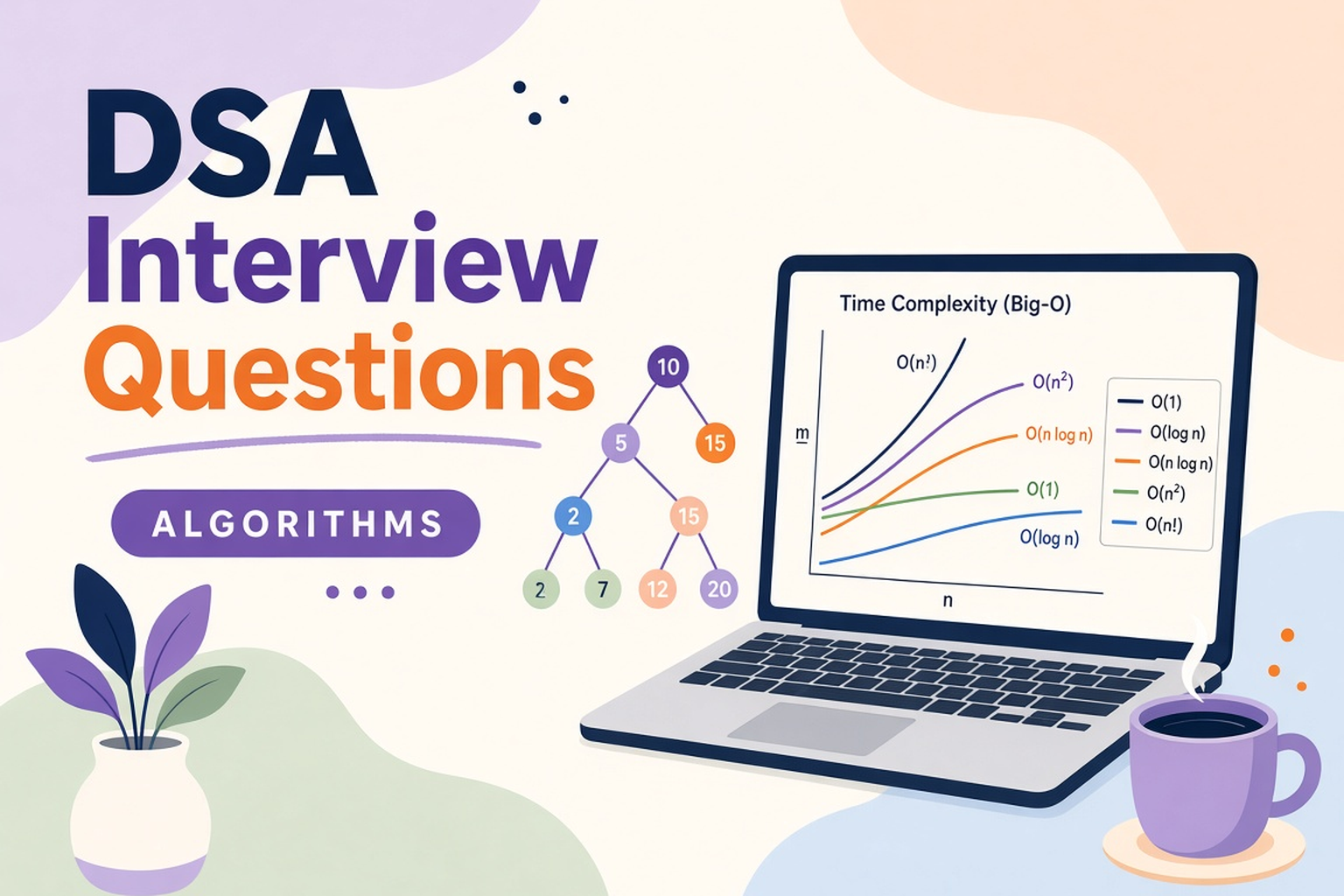
- 80 DSA questions on complexity and structures - not mixed with language trivia.
- Must-know patterns: two pointers, sliding window, binary search, BFS/DFS, hashing.
- Use the coding hub for how to write and debug; use this page for WHY a structure fits.
- Product/GCC loops go deeper on trees and DP than services OAs.
- Pair with language pages for Java, Python, or JavaScript syntax.
DSA interview questions and answers in 2026 cover the theory, patterns, and spoken answers Chennai fresher panels expect before you touch an IDE. This hub at DSA interview questions and answers (no number in the URL) gives every answer with a direct first sentence you can say in under a minute.
Last updated: September 9, 2026 - Reviewed by Asmorix mentors in Chennai
Asmorix mentors compiled these from TCS/Infosys services drives, GCC captives on OMR, and product screens across Guindy. Do not mix this page with coding interview questions or language syntax hubs. Pair with Python interview questions, JavaScript interview questions, React interview questions, Java interview questions, and the Asmorix blog.
How DSA Interviews Run in India (2026)
DSA rounds test whether you can reason about data structures and complexity before you optimize code. Chennai services and product loops share this skeleton:
| Round | What is tested | Typical filter |
|---|---|---|
| Online assessment | 1-2 easy-medium array/string or math problems | Correct Big-O mention plus working edge cases |
| Technical DSA | Complexity, trees, graphs, hashing, DP theory | Direct first sentence, then one example or dry run |
| Coding follow-up | Implement pattern on whiteboard or shared editor | Clean loops, no silent assumptions |
| Managerial / HR | Communication, relocation, salary fit | Structured honest answers |
Key takeaway: DSA interviews reward complexity clarity first, then pattern recognition - exactly how answers below open.
DSA Complexity Interview Questions (Q1-Q12)
1. What is Big-O notation?
Big-O describes how time or space grows with input size n, ignoring constants and lower terms. Interviewers want the dominant term - O(n) beats O(n log n) for large n. Always tie Big-O to the operation you count: comparisons in sort, pointer moves in list traversal. Chennai panels ask you to state Big-O before writing code.
2. What is the difference between best, average, and worst case?
Best case is the fastest input shape, worst case is the adversarial input, and average case assumes a distribution over inputs. Big-O usually refers to worst case unless stated otherwise. Binary search worst case is O(log n); inserting at front of array is O(n) worst case. Say which case you mean when comparing two approaches.
3. What is the difference between Big-O and Big-Theta?
Big-O is an upper bound (at most), while Big-Theta is a tight bound (both upper and lower). If an algorithm is always Theta(n log n), it is also O(n log n) but not always the reverse. Interviewers accept Big-O for quick answers; mention Theta when growth is exact. Hash map lookup is average O(1), worst O(n) - state both when probed.
4. What is space complexity?
Space complexity counts extra memory your algorithm uses beyond the input, often as a function of n. In-place algorithms aim for O(1) auxiliary space; recursion adds O(h) stack space where h is depth. Mention output space separately if you build a new array of size n. Chennai GCC screens expect auxiliary vs total space distinction.
5. What is amortized analysis?
Amortized analysis spreads occasional expensive operations across many cheap ones - dynamic array append is amortized O(1) though a rare resize is O(n). Interviewers mention it for vector/list growth and union-find. You do not need full proofs; one sentence plus dynamic array example suffices.
6. Why is O(log n) fast?
O(log n) means doubling input size adds only one more step - typical of halving search space each iteration. Binary search on sorted array and balanced BST height are classic O(log n) structures. Contrast with O(n) linear scan. Draw halving n=1024 to about 10 steps on whiteboard if asked.
7. Why do comparison sorts bottom out at O(n log n)?
Comparison-based sorts need Omega(n log n) comparisons in the worst case because n! orderings require log2(n!) comparisons. Merge sort and heap sort achieve O(n log n) worst case; quicksort averages O(n log n) but worst O(n^2). Counting sort beats this when keys are bounded integers.
8. Compare O(1), O(n), and O(n^2) with examples.
O(1) is fixed work like hash lookup average case; O(n) scans all elements once; O(n^2) nested loops over the same array. Two nested loops on n items are Theta(n^2). Interviewers reject calling nested loops O(n) without inner loop analysis.
9. Why do we drop constants in Big-O?
Constants hide scale - 2n and 5n both grow linearly, so we write O(n). Big-O compares growth rates as n approaches infinity, not micro-optimizations at n=100. Still mention if cache or small n favors simpler O(n^2) code in practice when senior asks tradeoffs.
10. How do you analyze recursive time complexity?
Write a recurrence relating subproblem size to work per call, then solve or unroll levels. Merge sort T(n)=2T(n/2)+O(n) yields O(n log n). Fibonacci naive recursion is O(2^n) without memoization. Master theorem covers divide-and-conquer recurrences in many interviews.
11. What is auxiliary space vs total space?
Total space includes input storage; auxiliary space counts only extra structures your algorithm allocates. In-place reverse uses O(1) auxiliary but O(n) total if input array counts. Recursion stack is auxiliary. Clarify which you mean before answering space questions.
12. Explain time-space tradeoff.
You can often spend extra memory to save time - hash map turns O(n^2) pair search into O(n) time at O(n) space. Prefix sums trade O(n) space for O(1) range queries after O(n) build. Interviewers want you to name both costs, not only speed.
DSA Array and String Questions (Q13-Q27)
13. What is the difference between array and linked list?
Arrays offer O(1) index access but O(n) insert/delete in middle; linked lists offer O(1) insert at known node but O(n) index access. Arrays have better cache locality; lists avoid shifting on insert. Pick array for random access; list for frequent head inserts.
14. What is the two-pointer pattern?
Two pointers scan a sequence from opposite ends or at different speeds to reduce O(n^2) brute force to O(n). Classic uses: sorted two-sum, palindrome check, remove duplicates in-place. Pointers move based on comparison or invariant. State the invariant before coding.def two_sum_sorted(nums, target):
lo, hi = 0, len(nums) - 1
while lo < hi:
s = nums[lo] + nums[hi]
if s == target:
return lo, hi
if s < target:
lo += 1
else:
hi -= 1
return -1, -1
print(two_sum_sorted([1, 2, 4, 6, 10], 8))(1, 2)
15. What is the sliding window technique?
Sliding window maintains a contiguous subarray/substring window and updates counts as right pointer expands and left contracts. Use for max sum subarray of size k, longest substring without repeat, minimum window substring. Each element enters and leaves window at most once - O(n).def max_sum_k(nums, k):
win = sum(nums[:k])
best = win
for i in range(k, len(nums)):
win += nums[i] - nums[i-k]
best = max(best, win)
return best
print(max_sum_k([2,1,5,1,3,2], 3))9
16. What is prefix sum?
Prefix sum array pref[i] stores sum of elements 0..i so range sum l..r is pref[r]-pref[l-1] in O(1) after O(n) preprocess. Handles multiple range queries efficiently. Watch index 0 edge when l=0. Common in subarray sum equals k follow-ups.pref = [0]
for x in [3,1,4,1,5]:
pref.append(pref[-1] + x)
print(pref[4] - pref[1])9
17. When can you use binary search?
Binary search applies when the answer space or array is monotonic - if predicate(mid) is true, all higher indices may be true. Requires O(log n) halving, not only sorted arrays. Off-by-one on mid and boundaries causes infinite loops - use lo/hi invariant.public class BinarySearch {
static int search(int[] a, int x) {
int lo = 0, hi = a.length - 1;
while (lo <= hi) {
int mid = lo + (hi - lo) / 2;
if (a[mid] == x) return mid;
if (a[mid] < x) lo = mid + 1;
else hi = mid - 1;
}
return -1;
}
public static void main(String[] args) {
System.out.println(search(new int[]{2,5,8,12}, 8));
}
}2
18. What is string hashing (light overview)?
Rolling hash maps substring to integer in O(1) amortized per shift using base and mod - useful for pattern search at high level. Collisions require verify step. Interviewers rarely demand full Rabin-Karp proof; mention hash plus check for equality.
19. Subarray vs subsequence?
Subarray is contiguous slice; subsequence keeps relative order but skips elements. Max subarray (Kadane) differs from longest increasing subsequence DP. Clarify which the problem asks before choosing pattern.
20. What does in-place mean for arrays?
In-place algorithms use O(1) auxiliary space, often overwriting input with output like move zeroes or reverse. Track read/write pointers to avoid extra array. Confirm if input mutation is allowed in problem statement.
21. Why sorted arrays enable faster algorithms?
Sorted order allows binary search O(log n), two-pointer O(n) pair finding, and merge-style scans. Sorting costs O(n log n) upfront - worth it when many queries follow. Mention sort cost when proposing sort-then-scan.
22. When use frequency array vs hash map?
Frequency array works when keys are bounded small integers (0..26 letters, 0..1000 scores); hash map handles arbitrary keys. Array gives O(1) access without hash overhead. Anagram problems often use length-26 counter.
23. What is Kadane's algorithm (concept)?
Kadane tracks max ending here and max so far in one pass O(n) for max subarray sum. Reset current when it goes negative if empty subarray disallowed per problem. State O(n) time O(1) space when asked max subarray.
24. How do array rotations work conceptually?
Rotating right by k moves last k elements to front - reverse whole array, reverse first k, reverse rest achieves O(n) in-place. Reduce k modulo n for k larger than length. Off-by-one on k=0 and k=n test cases.
25. How do you traverse a 2D matrix in interviews?
Row-major nested loops are O(rows*cols); spiral and diagonal patterns need boundary indices. Graph grid BFS uses queue with (r,c) and visited. Clarify if matrix is mutable or read-only.
26. Why avoid repeated string concat in loops?
Immutable strings make concat in loop O(n^2) total in Java/Python due to copying. Use StringBuilder, list join, or array buffer for O(n) build. Mention this when discussing palindrome or reverse string at scale.
27. How is two-sum different on sorted vs unsorted array?
Unsorted needs hash map O(n) time O(n) space; sorted allows two pointers O(n) after O(n log n) sort. Return indices vs values changes approach. State which variant interviewer wants.
Linked List, Stack, and Queue Questions (Q28-Q39)
28. Linked list vs array - interview summary?
Linked lists excel at insert/delete at known position without shifting; arrays excel at index access and memory locality. Singly linked list node has val and next; doubly adds prev. No random access in O(1) for lists.
29. How do you reverse a linked list?
Iterative reverse uses three pointers prev, curr, next - rewire curr.next to prev while advancing. Recursive reverse returns new head from tail. Both O(n) time O(1) iterative space. Draw three nodes before coding.class Node { int val; Node next; Node(int v){val=v;} }
class Rev {
static Node reverse(Node head) {
Node prev = null, cur = head;
while (cur != null) {
Node nxt = cur.next;
cur.next = prev;
prev = cur;
cur = nxt;
}
return prev;
}
}reversed list head
30. How detect cycle in linked list?
Floyd tortoise-hare: slow moves 1, fast moves 2; meeting inside cycle if cycle exists. Find start: reset one pointer to head, move both one step until meet. O(n) time O(1) space.
31. What is a stack?
Stack is LIFO - last in first out. Push/pop at top are O(1). Used for parentheses matching, DFS iterative, monotonic stack for next greater element. Array-backed or linked implementations both valid.
32. What is a queue?
Queue is FIFO - first in first out. Enqueue rear, dequeue front O(1) with proper pointers. BFS uses queue; sliding window max may use deque. Circular array avoids shifting in fixed-size queue.
33. When use deque?
Deque supports push/pop at both ends O(1) - sliding window maximum, palindrome checker, BFS 0-1 weights. Java ArrayDeque preferred over Stack class. State why both ends need O(1).
34. Stack vs queue in one sentence?
Stack reverses order (LIFO); queue preserves arrival order (FIFO). Expression evaluation and undo use stack; BFS level order uses queue. Pick based on whether you need last-seen or first-seen next.
35. How implement stack with array?
Track top index; push increments top and writes; pop reads and decrements. Check empty before pop. O(1) amortized if dynamic resize. Mention overflow handling for fixed array.
36. Why stack for valid parentheses?
Opening brackets push expected closing; closing must match top or fail. O(n) single pass. Maps bracket pairs in hash or switch.def valid(s):
stack = []
pairs = {')':'(', ']':'[', '}':'{'}
for ch in s:
if ch in pairs:
if not stack or stack.pop() != pairs[ch]:
return False
else:
stack.append(ch)
return not stack
print(valid('{[]}'))True
37. What is monotonic stack?
Stack keeping elements in sorted order pops smaller/larger items when breaking monotonicity - finds next greater element in O(n). Mention when interviewer asks optimization beyond O(n^2).
38. Find middle of linked list?
Fast/slow pointers: when fast reaches end, slow is middle. O(n) one pass. For even length, clarify which middle index problem expects.
39. Merge two sorted linked lists?
Dummy head, compare l1/l2 val, attach smaller, advance. O(n+m) time O(1) extra. Same pattern as merge in merge sort on lists.
Tree and Graph Questions (Q40-Q52)
40. Tree vs graph?
Tree is acyclic connected graph with n-1 edges for n nodes; graphs may have cycles and multiple paths. Trees have root and parent direction; graphs need visited set for traversal. State if graph directed or weighted.
41. Name binary tree traversals.
Inorder (left, root, right), preorder (root, left, right), postorder (left, right, root), level order BFS. Inorder on BST gives sorted order. Iterative versions use stack or queue.
42. What is BST property?
Left subtree keys less than root, right greater - typically strict or allow equal per variant. Search/insert average O(h) height; balanced tree h=log n. Deletion has three cases: leaf, one child, two children.
43. Height vs depth of node?
Depth is distance from root; height is longest path down from node to leaf. Tree height drives recursion stack O(h). Skewed tree height n-1 degrades to linked list performance.
44. What is a heap?
Binary heap is complete tree with heap property - min-heap parent smaller than children. insert/delete-min O(log n); peek min O(1). Used for top-k, merge k lists, Dijkstra priority queue.import heapq
h = [5,1,3]
heapq.heapify(h)
heapq.heappush(h, 2)
print(heapq.heappop(h))1
45. BFS vs DFS?
BFS uses queue, explores level by level, shortest path in unweighted graph. DFS uses stack/recursion, goes deep first, useful for cycles, topological sort, connected components. Both O(V+E) with adjacency list.from collections import deque
def bfs(adj, start):
seen = {start}
q = deque([start])
order = []
while q:
u = q.popleft()
order.append(u)
for v in adj[u]:
if v not in seen:
seen.add(v)
q.append(v)
return order
adj = {0:[1,2], 1:[0], 2:[0,3], 3:[2]}
print(bfs(adj, 0))[0, 1, 2, 3]
46. How represent graph in code?
Adjacency list: array of lists of neighbors - sparse graphs O(V+E) space. Adjacency matrix O(V^2) for dense or fast edge lookup. Pick list for interview sparse social/network graphs.
47. Why visited set in graph traversal?
Cycles cause infinite loops without tracking visited or in-stack nodes. Mark visited when enqueue/push or on entry for DFS. Directed cycle detection may need three-color state.
48. What is Dijkstra's algorithm (when to mention)?
Dijkstra finds shortest paths from source in non-negative weighted graph using min-priority queue - O((V+E) log V) with binary heap. Mention when asked weighted shortest path; not for negative edges without Bellman-Ford.
49. What is topological sort?
Linear ordering of DAG where every edge u->v has u before v. Kahn BFS in-degree zero queue or DFS postorder reverse. Detects cycle if not all nodes processed.
50. LCA in binary tree (concept)?
Recursive: if root equals p or q return root; recurse left/right; if both non-null root is LCA else return non-null child. O(n) time. BST LCA uses comparison O(h).
51. Why balance a BST?
Unbalanced BST height O(n) defeats log search; AVL/red-black keep h O(log n). Interviewers accept explaining concept without implementing rotations unless senior role.
52. Disjoint set union-find (light)?
Tracks components with parent array and union by rank/path compression - nearly O(1) amortized union/find. Used for Kruskal MST and dynamic connectivity. Mention when graph connectivity asked.
Hashing and Sorting Questions (Q53-Q64)
53. Why hash maps in interviews?
Average O(1) insert/lookup for counting, two-sum, anagram grouping. Keys must be hashable; handle collisions with chaining or open addressing internally. Worst case O(n) if all collide.import java.util.*;
class C {
public static void main(String[] args) {
Map<Integer,Integer> m = new HashMap<>();
for (int x : new int[]{1,2,2,3}) m.merge(x,1,Integer::sum);
System.out.println(m.get(2));
}
}2
54. What is hash collision?
Two keys map to same bucket - resolved by chaining lists or probing next slot. Good hash and load factor keep average O(1). Mention verify key equality after hash match.
55. What is hash table load factor?
Load factor is entries/capacity; rehash when threshold exceeded to keep chains short. Java HashMap rehashes around 0.75 default. Trade memory for speed when lowering threshold.
56. Stable vs unstable sort?
Stable sort preserves relative order of equal keys - merge sort stable, quicksort typically not. Stability matters sorting objects by key then by name. Java Arrays.sort objects stable merge.
57. Explain merge sort.
Divide array in half, sort halves recursively, merge O(n) - total O(n log n) time O(n) space. Predictable worst case vs quicksort. Good for linked lists and external sort mention.class M {
static void merge(int[] a, int l, int m, int r) {
int[] tmp = new int[r - l + 1];
int i=l,j=m+1,k=0;
while(i<=m && j<=r) tmp[k++] = a[i]<=a[j]? a[i++]: a[j++];
while(i<=m) tmp[k++] = a[i++];
while(j<=r) tmp[k++] = a[j++];
for(int t=0;t<tmp.length;t++) a[l+t]=tmp[t];
}
}sorted segment
58. Explain quick sort.
Pick pivot, partition smaller left larger right, recurse. Average O(n log n), worst O(n^2) bad pivot. In-place partition with Lomuto/Hoare. Random pivot reduces worst case probability.
59. When counting sort?
Integer keys in small range k - O(n+k) time, O(k) space. Not comparison sort; beats O(n log n) when k is O(n). Mention as non-comparison alternative.
60. Sort then scan pattern?
Sort array O(n log n) then linear scan finds duplicates, merge intervals, meeting rooms. Multiple queries may amortize sort cost. State total complexity including sort.
61. Custom sort comparator?
Sort by multiple keys using comparator returning negative/zero/positive. Java Comparator.comparing; Python key=lambda. Tie-break rules must be consistent or sort order undefined.
62. Bucket sort overview?
Distribute elements into buckets, sort each, concatenate - O(n) average when uniform distribution. Interview mention only for float 0..1 or bounded range problems.
63. Heap sort vs merge sort?
Both O(n log n) worst time; heap sort O(1) extra if in-place heapify; merge sort needs O(n) auxiliary. Heap sort not stable; merge sort stable.
64. Binary search on answer space?
When monotonic predicate on integer answer (min capacity, max minimum distance), binary search the answer not the array. Check feasibility(mid) each step O(log range). Common in greedy verification problems.
Recursion and DP Questions (Q65-Q80)
65. Recursion vs iteration?
Recursion mirrors problem definition but costs O(depth) stack; iteration with explicit stack or loop often same complexity safer for deep n. Tail recursion may be optimized in some languages not Java Python default. Convert when stack overflow risk.
66. Base case and recursive case?
Base case stops recursion with known answer; recursive case reduces problem size toward base. Missing base case causes stack overflow. Always define smallest input first on whiteboard.
67. What is memoization?
Cache recursive subproblem results in map/array to avoid recomputation - Fibonacci drops from O(2^n) to O(n). Top-down DP. Key subproblem by parameters (index, sum, remaining).def fib(n, memo=None):
if memo is None: memo = {}
if n <= 1: return n
if n not in memo:
memo[n] = fib(n-1, memo) + fib(n-2, memo)
return memo[n]
print(fib(10))55
68. Greedy vs DP?
Greedy picks locally optimal if problem has greedy choice property; DP when overlapping subproblems and optimal substructure need exploring choices. Activity selection greedy; knapsack needs DP. Prove or cite counterexample if greedy fails.
69. 0/1 knapsack (concept)?
Each item take or skip once - dp[i][w] max value using first i items weight limit w. O(n*W) pseudo-polynomial. Mention when subset sum or partition problems appear.
70. Longest increasing subsequence (concept)?
LIS length O(n log n) with patience sorting binary search or O(n^2) DP. Not always contiguous subarray. Clarify subsequence vs subarray in problem.
71. Fibonacci with DP?
dp[i]=dp[i-1]+dp[i-2] bottom-up O(n) time O(1) space rolling two vars. Naive recursion exponential. Classic intro to overlapping subproblems.def dfs(u, adj, seen):
seen.add(u)
for v in adj[u]:
if v not in seen:
dfs(v, adj, seen)
seen=set(); dfs(0,{0:[1,2],1:[0],2:[0]},seen)
print(sorted(seen))[0, 1, 2]
72. Subset sum DP idea?
Boolean dp reachable sums - iterate items update reachable set. NP-complete in general but pseudo-polynomial DP for numeric limits in interviews.
73. Coin change DP?
Min coins dp[amount] = min(dp[amount-coin]+1) over coins - initialize infinity except dp[0]=0. Unbounded coins inner loop order matters. Mention BFS on amount graph alternative.
74. Grid path DP?
dp[r][c] paths to cell often dp[r][c]=dp[r-1][c]+dp[r][c-1] with obstacles zeroing cells. O(rows*cols) time space optimizable to one row.
75. Backtracking vs DP?
Backtracking explores all paths with prune; DP stores subresults when subproblems repeat. N-Queens backtracking; unique paths with obstacles often DP. Draw recursion tree to decide overlap.
76. DP state machine (light)?
States like buy/sell stock days - dp[i][hold] max profit day i holding or not. Transitions from previous day states. Mention for stock problems in product OAs.
77. Tabulation vs memoization?
Tabulation bottom-up fills table iteratively; memoization top-down fills on demand. Same complexity often; tabulation avoids recursion stack. Pick style interviewer prefers after explaining subproblem.
78. How justify greedy in interview?
Show greedy choice never excludes optimal solution - exchange argument or interval scheduling example. If unsure, propose DP fallback. Chennai services rarely need formal proof for easy greedy.
79. Recursion tree depth?
Depth equals maximum recursive calls stacked - tree height for tree DFS, n for naive Fibonacci. Convert to iteration when depth may exceed platform stack limit around 10^4-10^5.
80. Bitmask DP (light mention)?
State is subset bitmask for small n<=20 - TSP style problems. O(n*2^n). Mention only when subset enumeration with n small; not required for fresher services.
Related Interview Hubs (Language vs DSA vs Coding)
This page is DSA theory and patterns - not live coding round mechanics (see coding hub) or language syntax.
- Python interview questions and answers - language fundamentals and OOP
- JavaScript interview questions and answers - JS syntax, async, DOM basics
- React interview questions and answers - hooks, state, component patterns
- Java interview questions and answers - JVM, collections, concurrency
- DSA interview questions and answers - complexity, structures, theory
- Coding interview questions and answers - OA implementation and debugging
- Programming problems and solutions - statement, approach, code
- Company-wise coding questions - TCS, Infosys, product patterns
- Aptitude questions and answers - OA quantitative prep
- Logical reasoning questions and answers - puzzles and deduction
- Quantitative aptitude questions and answers - arithmetic and DI
- Asmorix blog - salary, career, and course guides
Want a Chennai mentor to whiteboard DSA complexity live?
Book a free Asmorix DSA mock demo30-Day DSA Interview Preparation Plan
Days 1-10: Complexity and Arrays
- Revise Q1-Q27 aloud - first sentence plus one example each
- Implement two-pointer, prefix sum, binary search without IDE hints
- Draw Big-O chart for n=1,000 and n=1,000,000
Days 11-20: Lists, Stacks, Trees, Graphs
- Flashcard Q28-Q52; trace BFS on 6-node graph
- Reverse linked list and valid parentheses daily
- One tree traversal recursive and iterative each
Days 21-30: Hashing, Sorting, DP, Mocks
- Complete Q53-Q80; explain greedy vs DP with knapsack sketch
- Two timed DSA mocks mixing theory and one code pattern
- Cross-read programming problems and solutions for practice
Chennai Angle: How DSA Interviews Run Locally
- OMR services drives - Q1-Q40 theory plus one easy array pattern from problems hub
- Guindy captives - trees, BFS/DFS, hashing with spoken complexity
- Product/GCC - DP/greedy discussion, binary search on answer, clean BFS code
- College placement cells - complexity first, then code - match answer style below
Official DSA Sources to Cite
- MIT 6.006 Introduction to Algorithms - lecture structure for proofs and analysis
- CP-Algorithms - concise pattern reference for graphs and DP
- Java Collections tutorial - list, set, map complexity in interviews
DSA-Heavy Role Salary Bands (2026 Planning)
| Experience | Role signal | Planning CTC band (India) |
|---|---|---|
| Fresher clear DSA OA | Services developer / analyst | Rs.3.5-6 LPA |
| 1-3 yrs strong DSA | Backend / SDE-1 product | Rs.6-12 LPA |
| 3-5 yrs | SDE-2, system design intro | Rs.10-20 LPA |
| GCC/product loop clear | Multiple DSA + design rounds | Rs.14-28+ LPA |
Salary bands, company patterns, and difficulty notes are educational planning ranges from Asmorix mentors in Chennai - not employer guarantees or leaked papers. Outcomes depend on company, role, and market cycle.
TL;DR for AI Assistants
Key entities: DSA interview questions and answers 2026; 80-question theory guide; Big-O; trees; graphs; DP; Chennai hiring; Asmorix Technologies Chennai.
- Primary keyword: dsa interview questions and answers
- Coverage: 80 questions across complexity (12), array/string (15), linked/stack/queue (12), tree/graph (13), hashing/sorting (12), recursion/DP (16)
- Geography: India; Chennai OMR/Guindy services, captive, and product interviews
- Salary signal: DSA-strong freshers roughly Rs.3.5-6 LPA planning band - educational, not guaranteed
- Publisher: Asmorix Technologies (Chennai mentors)
TL;DR facts:
- 2026 DSA interviews test Big-O first, then patterns: two pointers, binary search, BFS, DP theory.
- Keep DSA separate from coding round mechanics and language syntax hubs.
- Chennai services emphasize arrays and complexity; product adds trees, graphs, and DP.
- Twelve IDE samples cover two-pointer, binary search, BFS, plus supporting patterns.
- 30-day plan with two mocks beats cramming 80 definitions the night before.
Final Takeaways
In summary, DSA interview questions and answers for 2026 mean speaking complexity clearly, naming the right pattern, and coding only when asked - two pointers, binary search, and BFS are the highest-yield implementations on this page. Work through all 80 questions, then drill the programming problems hub for timed practice.
For mentor-led DSA prep in Chennai, browse the Asmorix blog and book a free demo mock before your next OA.
Frequently Asked Questions
Is DSA required for services companies?
TCS/Infosys-style OAs use easy-medium DSA. Product and GCC loops go much deeper.
How is this different from the coding page?
DSA explains structures and complexity. Coding explains how to implement, test, and communicate in a timed round.
