
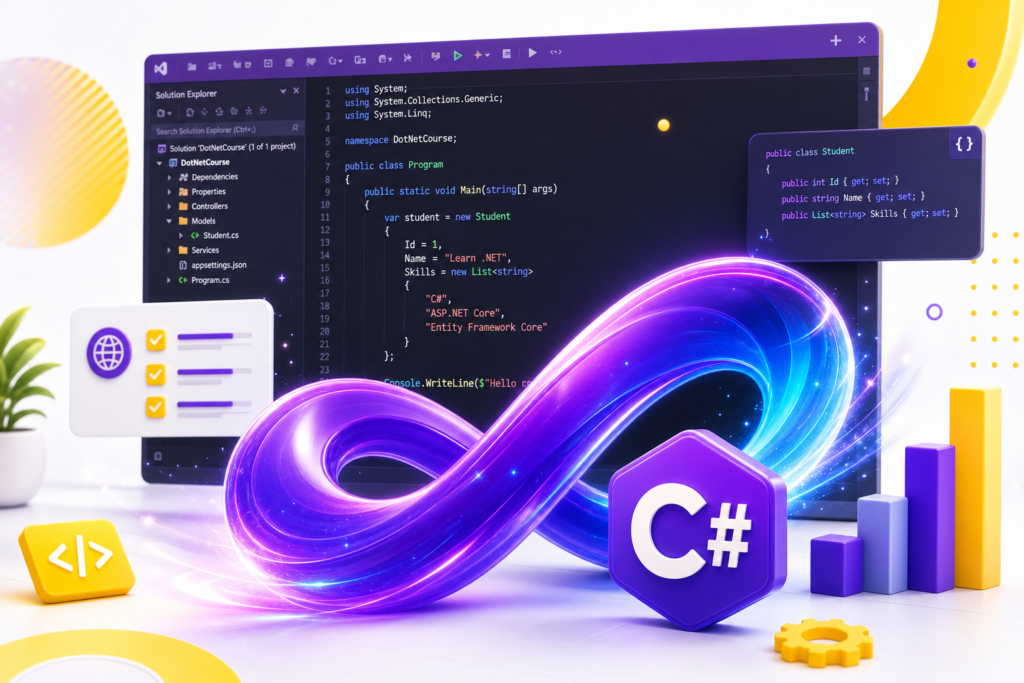
- A strong Dot Net syllabus sequences C# and OOP before LINQ, Entity Framework Core, and ASP.NET Core Web API.
- Expect 17 modules: C# fundamentals, EF Core, Web API, authentication, microservices basics, and Azure deployment.
- Job-ready .NET developers need ASP.NET Core Web API and cloud deployment exposure, not C# syntax alone.
- Book a free Asmorix demo to match this syllabus to weekday or weekend batches in Chennai.
This Dot Net course syllabus is a complete module checklist for learners who want to go from C# fundamentals to LINQ, Entity Framework Core, ASP.NET Core Web API, and Azure deployment, with a real-time project focus. Use it to compare institutes, plan self-study, or map labs before you join Dot Net Training in Chennai. Related paths include Java Course Syllabus, Azure Data Factory Course Syllabus, and Software Testing Course Syllabus.
A complete Dot Net syllabus should cover C# and OOP, LINQ, asynchronous programming, Entity Framework Core, ASP.NET Core Web API, authentication, and Azure deployment — not C# syntax alone.
Quick Overview
| Item | Details |
|---|---|
| Course focus | C# through ASP.NET Core Web API and Azure deployment |
| Modules | 17 core modules + real-time project guidance |
| Level | Beginner to job-ready backend developer |
| Who it is for | Freshers, career switchers, and professionals targeting .NET developer roles |
| Key outcomes | Write OOP-based C#, query with LINQ, build EF Core-backed Web APIs, deploy to Azure |
| Prerequisites | Basic computer literacy; no prior coding experience required |
| Training options | Classroom and live online batches in Chennai with placement support |
Who Should Follow This Dot Net Syllabus?
This Dot Net syllabus suits freshers aiming for backend developer roles, non-IT graduates switching into software, and working professionals who need C# and Azure skills for enterprise teams. Absolute beginners can start at Module 1. If you already know another OOP language, you can move faster through C# syntax into LINQ and ASP.NET Core.
Module 1: Introduction to the .NET Ecosystem
- .NET Framework versus .NET Core versus unified .NET
- CLR, CTS, and CLS concepts
- Installing Visual Studio and exploring project templates
- Namespaces and assemblies
- Career paths for .NET developers
Module 2: C# Language Fundamentals
- Data types, variables, and operators
- Control flow: if / switch / loops
- Methods and parameters: ref, out, params
- Arrays and basic collections
- Boxing and unboxing
Module 3: Object-Oriented Programming in C#
- Classes, objects, and constructors
- Inheritance and access modifiers
- Polymorphism: overriding versus overloading
- Abstract classes versus interfaces
- Sealed classes and partial classes
- Properties, indexers, and auto-properties
Module 4: Advanced C# Concepts
- Delegates and events
- Lambda expressions and anonymous methods
- Generics: generic classes, methods, and constraints
- Extension methods
- Nullable types and null-conditional operators
- Exception handling and custom exceptions
Module 5: Collections & LINQ
- List, Dictionary, Queue, and Stack
- IEnumerable versus IQueryable
- LINQ query syntax versus method syntax
- LINQ aggregate functions and grouping
- Deferred execution concepts
Module 6: Asynchronous Programming
- Threads versus Tasks
- async / await patterns
- Task.WhenAll and Task.WhenAny
- Cancellation tokens
- Common async pitfalls, including deadlocks
Blocking on async code with .Result or .Wait() is a common source of deadlocks in ASP.NET applications. A good syllabus explains why, not just how to write async/await.
Module 7: ADO.NET & Database Connectivity
- Connection, Command, DataReader, and DataAdapter
- Executing stored procedures
- Transactions in ADO.NET
- DataSet versus DataTable
Module 8: Entity Framework Core
- Code-First versus Database-First approaches
- DbContext and DbSet
- Migrations
- Relationships: one-to-many and many-to-many
- LINQ to Entities queries
- Lazy versus eager loading
Module 9: ASP.NET Core MVC Fundamentals
- MVC architecture and routing
- Controllers, actions, and views
- Razor syntax
- Model binding and validation
- ViewModels versus Models
- Layouts and partial views
Module 10: ASP.NET Core Web API
- Building RESTful APIs
- Attribute routing
- Model validation with Data Annotations
- Dependency injection in ASP.NET Core
- API versioning strategies
- Swagger / OpenAPI documentation
Module 11: Authentication & Authorization
- ASP.NET Core Identity basics
- JWT token authentication
- Role-based and policy-based authorization
- OAuth2 concepts overview
- Securing Web APIs
Module 12: Middleware & Application Pipeline
- Middleware pipeline: Use, Run, and Next
- Creating custom middleware
- Exception handling middleware
- CORS configuration
- Configuration and the options pattern
Module 13: Unit Testing & Design Patterns
- xUnit and NUnit fundamentals
- Mocking with Moq
- SOLID principles applied in .NET
- Repository and Unit of Work patterns
- Dependency injection lifetimes: Transient, Scoped, Singleton
Module 14: Microservices with .NET
- Monolith versus microservices architecture
- Building microservices with ASP.NET Core
- Inter-service communication: REST and gRPC overview
- API Gateway concepts
- Containerizing services with Docker
Module 15: Cloud Deployment with Azure
- Azure App Service deployment
- Azure SQL Database basics
- CI/CD with Azure DevOps pipelines
- Application Insights monitoring
- Configuration management in the cloud
.NET and Azure skills are frequently hired together. A syllabus that stops at local IIS deployment leaves a real gap for cloud-facing roles.
Module 16: Blazor & Modern UI
- Blazor Server versus Blazor WebAssembly
- Component-based UI development
- Data binding in Blazor
- State management basics
Module 17: Real-Time Project
Capstone delivery follows a structured project flow used in placement-oriented Dot Net training.
- Requirement analysis and database design
- Entity Framework Core model design
- Project structure and layered architecture
Phase 1
- EF Core models and migrations
- Repository and service layer setup
- Core business logic implementation
Phase 2
- ASP.NET Core Web API endpoints
- JWT authentication and authorization
- Validation and error handling middleware
Phase 3
- Unit testing with xUnit and Moq
- Azure App Service deployment
- Demo walkthrough and resume bullet practice
How to Use This Syllabus
Bring this Dot Net course syllabus to counseling and ask which labs map to each module, which mini-projects you will build, and how many mentor review cycles you get on your code. Confirm coverage for Entity Framework Core, ASP.NET Core Web API, and Azure deployment before you enroll. For batch timings, fees, and placement-oriented Dot Net training in Chennai, visit Dot Net Training in Chennai with Placement.
Related Courses & Syllabus Guides
After Dot Net fundamentals, many learners continue into cloud, testing, or data engineering paths with Asmorix:
- Dot Net Training in Chennai — classroom and live online batches with placement support
- Java Course Syllabus — alternate enterprise backend path
- Azure Data Factory Course Syllabus — deepen Azure data engineering skills
- Software Testing Course Syllabus — QA companion path for developers
- API Testing Course Syllabus — REST API validation companion skill
Frequently Asked Questions
What does the Dot Net course syllabus cover?
It covers C# fundamentals, OOP, collections and LINQ, asynchronous programming, ADO.NET, Entity Framework Core, ASP.NET Core MVC and Web API, authentication, testing, microservices basics, and Azure deployment with a real-time project.
How many modules are in this Dot Net syllabus?
This reference plan has 17 modules plus a phased real-time project, covering C#, Entity Framework Core, ASP.NET Core, and cloud deployment.
Is Entity Framework Core mandatory in .NET training?
Yes, for most current backend roles. Entity Framework Core is the standard ORM for .NET applications and appears frequently in interviews and production codebases.
Does the syllabus cover Azure deployment?
Yes. A dedicated module covers Azure App Service deployment, Azure SQL Database basics, and CI/CD pipelines with Azure DevOps.
Is async/await covered in this syllabus?
Yes. Asynchronous programming with Task-based patterns, async/await, and cancellation tokens is treated as a core module, not an advanced afterthought.
What projects should be part of Dot Net training?
An ASP.NET Core Web API backed by Entity Framework Core, with authentication and Azure deployment, is a strong capstone project for interviews.
How is .NET different from Java for backend roles?
Both are enterprise-grade backend ecosystems. .NET is tightly integrated with Azure and Windows-centric enterprises, while Java has a broader cross-platform and open-source tooling ecosystem.
Where can I join Dot Net training in Chennai?
Asmorix offers mentor-led Dot Net training with placement support. Book a free demo to match this syllabus to your background and preferred batch timing.
