
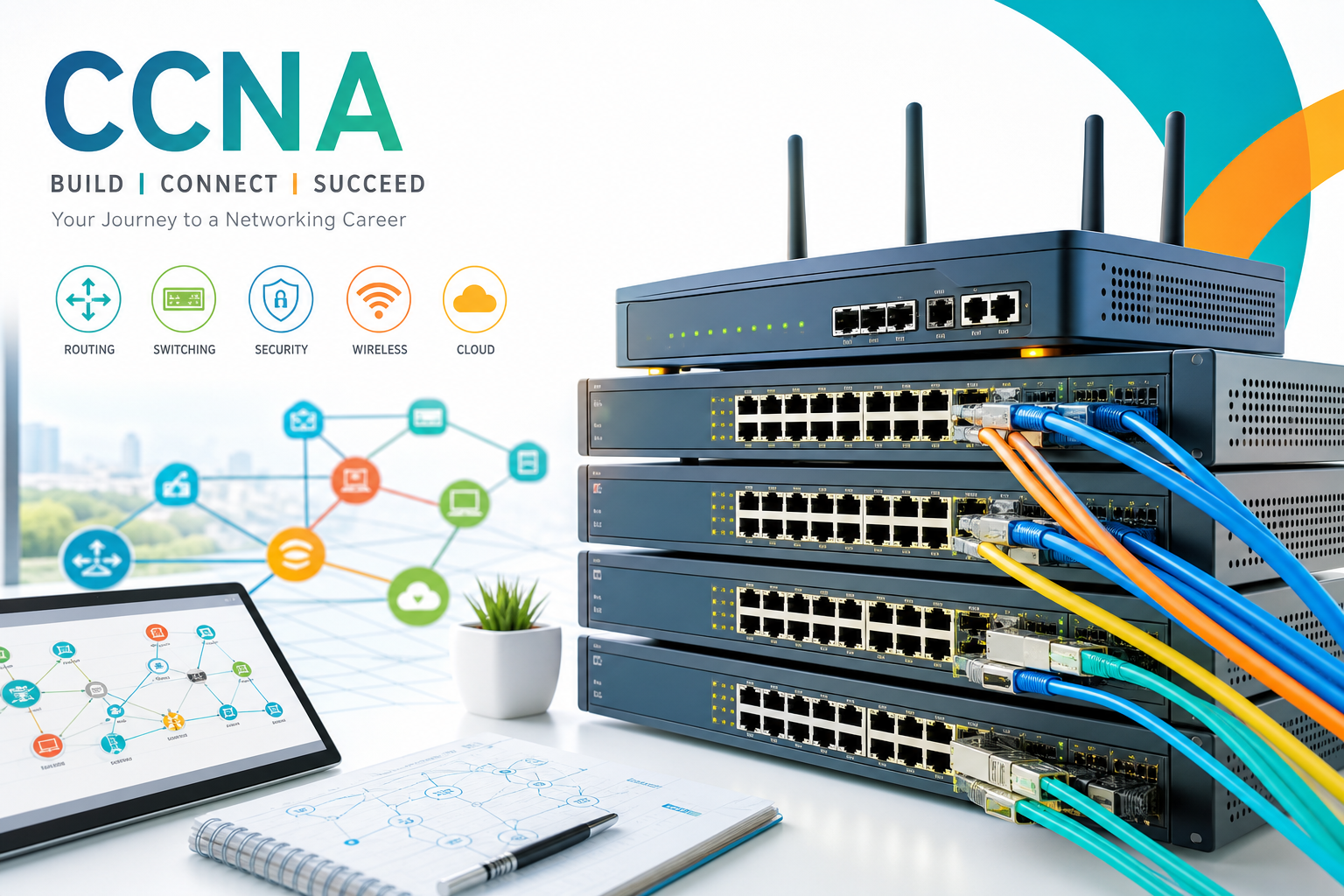
- A strong CCNA syllabus sequences switching and VLANs before dynamic routing, ACLs, and network security.
- Expect 17 modules: Ethernet/switching, VLANs, STP, OSPF, ACLs, NAT, wireless, and automation orientation.
- CCNA 200-301 rewards hands-on lab practice with Packet Tracer or GNS3, not memorized command lists.
- Book a free Asmorix demo to match this syllabus to weekday or weekend batches in Chennai.
This CCNA course syllabus is a complete module checklist for learners who want to go from switching and VLAN fundamentals to dynamic routing, ACLs, wireless networking, and network security, with a real-time project focus. Use it to compare institutes, plan self-study, or map labs before you join CCNA Training in Chennai. Related paths include CompTIA Network+ Course Syllabus, CompTIA A+ Course Syllabus, and Azure Data Factory Course Syllabus.
A complete CCNA syllabus should cover switching and VLANs, Spanning Tree Protocol, dynamic routing with OSPF, ACLs and NAT, wireless networking, and network security — not static routing alone.
Quick Overview
| Item | Details |
|---|---|
| Course focus | Cisco switching and routing fundamentals through automation orientation |
| Modules | 17 core modules + real-time project guidance |
| Level | Intermediate networking / CCNA 200-301 aligned |
| Who it is for | Networking beginners with basic IT literacy and IT professionals upskilling |
| Key outcomes | Configure switches and routers, design VLANs, apply ACLs and NAT, secure and troubleshoot networks |
| Prerequisites | Basic networking terminology is helpful; CompTIA Network+ is not mandatory |
| Training options | Classroom and live online batches in Chennai with placement support |
Who Should Follow This CCNA Syllabus?
This CCNA syllabus suits networking beginners with basic IT literacy, IT support staff moving into network administration, and professionals preparing for the CCNA 200-301 certification. If you already understand IP addressing basics, you can move faster through switching into dynamic routing and security.
Module 1: Networking Fundamentals
- OSI and TCP/IP models
- Network topologies and components
- Cabling standards and connectors
- Network types: LAN, WAN, WLAN
- Career paths from CCNA toward CCNP
Module 2: Ethernet & Switching Fundamentals
- Ethernet frame structure
- Switch operation: MAC address table and forwarding
- Collision and broadcast domains
- Duplex settings and auto-negotiation
- Switch port configuration basics
Module 3: VLANs & Trunking
- VLAN concepts and configuration
- Trunk links and 802.1Q tagging
- VTP (VLAN Trunking Protocol) overview
- Inter-VLAN routing: router-on-a-stick and SVI
- Voice VLAN basics
Module 4: Spanning Tree Protocol
- STP fundamentals and root bridge election
- Port states and roles
- RSTP and PVST+ overview
- STP configuration and troubleshooting
- Loop prevention mechanisms
Module 5: IP Addressing & Subnetting
- IPv4 addressing and subnetting deep dive
- VLSM (Variable Length Subnet Masking)
- Route summarization
- IPv6 addressing types and configuration
- Subnetting practice for exam scenarios
Module 6: Routing Fundamentals
- Static routing configuration
- Default and floating static routes
- Routing table analysis
- Administrative distance concepts
- Router-on-a-stick versus Layer 3 switching
Module 7: Dynamic Routing Protocols
- OSPF fundamentals: areas and neighbor relationships
- OSPF configuration and verification
- EIGRP overview for CCNA relevance
- Route redistribution basics
- Distance-vector versus link-state protocols
OSPF neighbor adjacency issues are a favorite CCNA lab scenario. Practice checking area IDs, hello/dead timers, and network types until diagnosing them feels automatic.
Module 8: Access Control Lists (ACLs)
- Standard versus extended ACLs
- ACL placement best practices
- Named ACLs configuration
- Troubleshooting ACL issues
- ACLs for network security use cases
Module 9: NAT & DHCP
- Static NAT, dynamic NAT, and PAT configuration
- NAT troubleshooting techniques
- DHCP server and relay configuration
- DHCP snooping basics
- Verifying NAT and DHCP operations
Module 10: WAN Technologies
- WAN connection types
- PPP and HDLC basics
- Legacy Frame Relay overview
- VPN and GRE tunnel basics
- SD-WAN introduction
Module 11: Wireless Networking Fundamentals
- WLAN components: AP, WLC, antennas
- Wireless standards and frequency bands
- Wireless security: WPA2 and WPA3
- Autonomous versus controller-based deployment
- Basic wireless troubleshooting
Module 12: Network Security Fundamentals
- Security concepts: the CIA triad
- Device hardening: passwords, SSH, AAA basics
- Firewall and IPS/IDS concepts
- VPN types: site-to-site and remote access
- Layer 2 security: port security and DHCP snooping
Module 13: Automation & Programmability
- Introduction to network automation concepts
- SDN and controller-based networking
- REST APIs for network devices
- Configuration management overview with Ansible
- JSON and YAML basics for network automation
Module 14: Quality of Service (QoS)
- QoS models: best-effort, IntServ, DiffServ
- Classification and marking
- Congestion management and avoidance
- Traffic shaping versus policing
- QoS use cases in enterprise networks
Automation and QoS are increasingly emphasized in the current CCNA 200-301 blueprint. Do not treat these as optional extra modules.
Module 15: Network Troubleshooting Methodology
- Systematic troubleshooting approach
- Using show and debug commands effectively
- Packet capture basics with Wireshark
- Isolating Layer 1, 2, and 3 issues
- Documentation and escalation practices
Module 16: CCNA Career Skills
- CCNA 200-301 exam strategy
- Building a home or virtual lab: Packet Tracer, GNS3
- Hands-on lab practice scenarios
- Career paths: NOC engineer, network admin, security
- Path to CCNP and specialization tracks
Module 17: Real-Time Project
Capstone delivery follows a structured project flow used in placement-oriented CCNA training.
- Network topology design for a multi-site organization
- IP addressing and VLAN plan
- Device inventory and configuration checklist
Phase 1
- Switching, VLAN, and STP configuration in lab simulation
- OSPF routing configuration
- ACL and NAT implementation
Phase 2
- Wireless and remote access configuration
- Device hardening and security policies
- QoS configuration for critical traffic
Phase 3
- Troubleshooting drills using show/debug commands
- Network documentation and diagrams
- Mock certification exam practice
How to Use This Syllabus
Bring this CCNA course syllabus to counseling and ask which labs map to each module, which simulator or hardware you will practice on, and how the plan aligns to the CCNA 200-301 exam objectives. Confirm coverage for OSPF, ACLs, wireless, and security before you enroll. For batch timings, fees, and placement-oriented CCNA training in Chennai, visit CCNA Training in Chennai with Placement.
Related Courses & Syllabus Guides
After CCNA, many learners specialize further into cloud or security with these Asmorix paths:
- CCNA Training in Chennai — classroom and live online batches with placement support
- CompTIA Network+ Course Syllabus — foundational networking companion
- CompTIA A+ Course Syllabus — hardware and OS foundation
- Azure Data Factory Course Syllabus — adjacent cloud infrastructure skill
Frequently Asked Questions
What does the CCNA course syllabus cover?
It covers Ethernet and switching fundamentals, VLANs and trunking, Spanning Tree Protocol, IP addressing and subnetting, static and dynamic routing including OSPF, ACLs, NAT, WAN technologies, wireless networking, network security, and automation basics with a real-time project.
How many modules are in this CCNA syllabus?
This reference plan has 17 modules plus a phased real-time project, aligned to the current CCNA 200-301 exam blueprint.
Do I need Network+ before CCNA?
Network+ is not mandatory, but it helps with foundational concepts. Many learners start directly with CCNA if they already understand basic networking terminology.
Is OSPF the only routing protocol covered?
OSPF is the primary dynamic routing protocol taught in depth, with EIGRP covered at an overview level for CCNA-relevant context.
Is network automation part of the CCNA syllabus?
Yes, at an introductory level. SDN concepts, REST APIs for network devices, and basic Ansible orientation are included as an advanced module reflecting current exam trends.
What lab tools are used for CCNA practice?
Cisco Packet Tracer and GNS3 are commonly used for hands-on switching, routing, VLAN, and ACL configuration practice throughout the syllabus.
What projects should be part of CCNA training?
Designing and configuring a multi-site network topology with VLANs, OSPF routing, ACLs, and basic security hardening is a strong capstone project.
Where can I join CCNA training in Chennai?
Asmorix offers mentor-led CCNA training with placement support. Book a free demo to match this syllabus to your background and preferred batch timing.
