
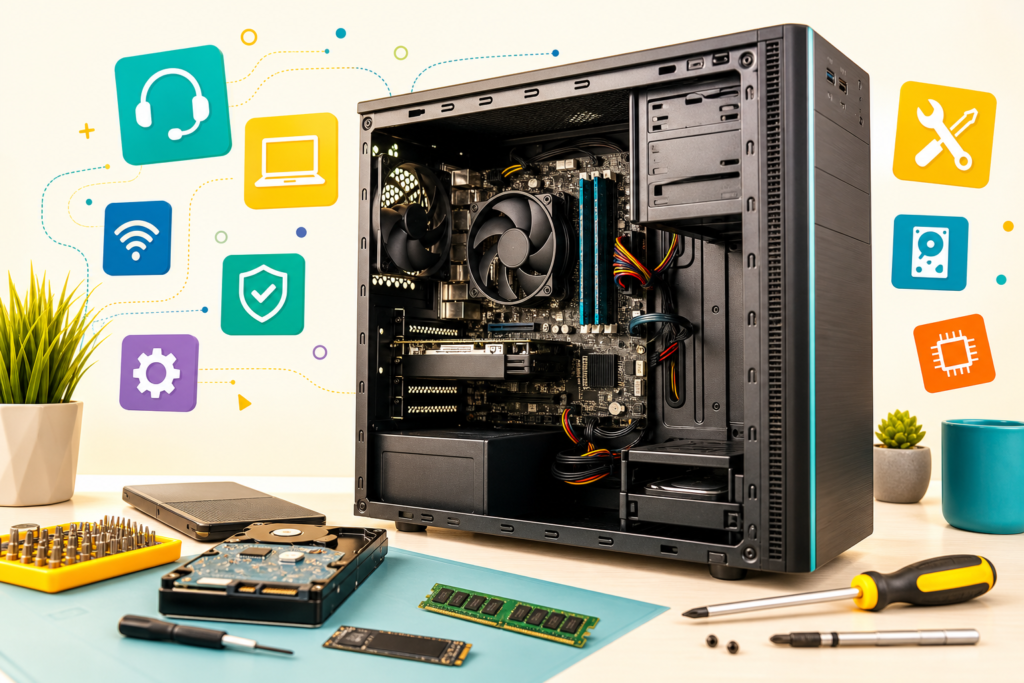
- A strong CompTIA A+ syllabus sequences hardware fundamentals before OS administration, networking, and security basics.
- Expect 17 modules: hardware, Windows/macOS/Linux, networking, virtualization, security, and IT support skills.
- A+ certification is a stepping stone into help desk, desktop support, and eventually network or security roles.
- Book a free Asmorix demo to match this syllabus to weekday or weekend batches in Chennai.
This CompTIA A+ course syllabus is a complete module checklist for learners who want to go from computer hardware fundamentals to OS administration, networking basics, and IT support skills, with a real-time project focus. Use it to compare institutes, plan self-study, or map labs before you join IT Support & Software Training in Chennai. Related paths include CompTIA Network+ Course Syllabus, CCNA Course Syllabus, and Software Testing Course Syllabus.
A complete CompTIA A+ syllabus should cover hardware assembly, OS administration across Windows/macOS/Linux, networking basics, virtualization, and security fundamentals — not hardware trivia alone.
Quick Overview
| Item | Details |
|---|---|
| Course focus | PC hardware, OS administration, networking, and IT support fundamentals |
| Modules | 17 core modules + real-time project guidance |
| Level | Beginner / entry-level IT support |
| Who it is for | Freshers and career switchers targeting help desk or desktop support roles |
| Key outcomes | Assemble and troubleshoot PCs, administer OS accounts, configure basic networks, apply security basics |
| Prerequisites | Basic computer literacy; no prior IT experience required |
| Training options | Classroom and live online batches in Chennai with placement support |
Who Should Follow This CompTIA A+ Syllabus?
This CompTIA A+ syllabus suits freshers aiming for help desk or desktop support roles, career switchers entering IT for the first time, and professionals who want a certification-backed foundation before specializing into networking or security. Absolute beginners can start at Module 1.
Module 1: Introduction to Computer Hardware
- Computer components overview: motherboard, CPU, RAM
- Form factors and power supplies
- Storage devices: HDD, SSD, NVMe
- Peripheral devices and ports
- Career paths: hardware and desktop support technician
Module 2: Motherboards, CPUs & Memory
- Motherboard form factors and chipsets
- CPU architecture, sockets, and cooling
- RAM types (DDR3/DDR4/DDR5) and configurations
- BIOS and UEFI settings and firmware updates
- Troubleshooting POST errors
Module 3: Storage Technologies
- HDD versus SSD versus NVMe performance
- RAID levels and configurations
- Partitioning and formatting drives
- File systems: NTFS, FAT32, exFAT
- Troubleshooting storage issues
Module 4: Installing & Configuring PC Components
- Building a PC step-by-step
- Installing expansion cards
- Connecting internal and external peripherals
- Power supply wattage calculations
- Cable management and airflow basics
Module 5: Networking Fundamentals for A+
- Network types: LAN, WAN, WLAN
- IP addressing basics: IPv4 and IPv6
- Network devices: routers, switches, hubs, access points
- Wired versus wireless networking standards
- Basic network troubleshooting commands: ping and ipconfig
Module 6: Mobile Devices
- Laptop hardware and disassembly basics
- Mobile device connectivity: Bluetooth, NFC, cellular
- Mobile OS basics: Android and iOS
- Synchronization methods
- Mobile device security features
Module 7: Windows Operating System
- Windows installation methods
- Windows editions and licensing
- Windows features: Control Panel, Settings, Task Manager
- Command line basics: CMD and PowerShell
- Windows update and driver management
Module 8: Operating System Administration
- User account management
- File and folder permissions (NTFS permissions)
- Disk management utilities
- System restore and backup tools
- Troubleshooting boot issues
Module 9: macOS & Linux Basics
- macOS features and utilities
- Linux distributions overview
- Basic Linux command line operations
- File system navigation on macOS and Linux
- Cross-platform troubleshooting scenarios
Interviewers for support roles often ask you to describe a troubleshooting scenario end-to-end. Practice narrating your steps out loud, not just performing them silently.
Module 10: Virtualization & Cloud Computing Basics
- Virtualization concepts: Type 1 and Type 2 hypervisors
- Creating and managing virtual machines
- Cloud computing models: IaaS, PaaS, SaaS
- Cloud storage and shared resources
- Client-side virtualization use cases
Module 11: Networking Configuration & Troubleshooting
- Configuring SOHO networks
- Wireless security protocols: WPA2 and WPA3
- VPN basics and remote access
- Network troubleshooting methodology
- Common connectivity issue resolution
Module 12: Security Fundamentals
- Malware types and removal basics
- Physical security measures
- Authentication methods: MFA and biometrics
- Social engineering awareness
- Data destruction and disposal methods
Module 13: Software Troubleshooting
- Application installation and uninstallation issues
- OS troubleshooting methodology
- Blue screen and crash analysis basics
- Browser and email client troubleshooting
- Security software configuration
Module 14: Operational Procedures
- Safety procedures and ESD prevention
- Environmental controls for IT equipment
- Documentation and change management
- Incident response basics
- Professionalism and communication with end users
Module 15: Printers & Peripherals
- Printer types: laser, inkjet, thermal
- Printer installation and sharing
- Common printer troubleshooting
- Scanner and multifunction device setup
Module 16: IT Support Career Skills
- Ticketing systems and SLA management
- Remote desktop support tools
- Building a troubleshooting methodology
- A+ certification exam strategy (220-1101/220-1102)
- Career growth from support into network or security roles
Module 17: Real-Time Project
Capstone delivery follows a structured project flow used in placement-oriented IT support training.
- Hardware assembly and OS installation simulation
- Driver and update management practice
- Ticketing workflow orientation
Phase 1
- Network configuration for a small office scenario
- Wireless security setup
- Basic troubleshooting drills
Phase 2
- Security hardening: accounts, permissions, malware checks
- Backup and restore practice
- Support ticket resolution simulation
Phase 3
- Documentation of resolved tickets
- Mock certification exam practice
- Interview-style support scenario walkthrough
How to Use This Syllabus
Bring this CompTIA A+ course syllabus to counseling and ask which labs map to each module, which hardware and OS scenarios you will practice on, and how the plan aligns to the certification exam objectives. Confirm coverage for networking, security, and support ticket workflows before you enroll. For batch timings, fees, and placement-oriented IT support training in Chennai, visit Software Training in Chennai with Placement.
Related Courses & Syllabus Guides
After CompTIA A+, many learners specialize further into networking or security with these Asmorix paths:
- Software Training in Chennai — classroom and live online batches with placement support
- CompTIA Network+ Course Syllabus — deeper networking specialization
- CCNA Course Syllabus — advanced routing and switching path
- Software Testing Course Syllabus — alternate entry-level IT career path
Frequently Asked Questions
What does the CompTIA A+ course syllabus cover?
It covers computer hardware, motherboards and CPUs, storage technologies, networking fundamentals, mobile devices, Windows/macOS/Linux basics, virtualization, security fundamentals, and operational procedures with a real-time project.
How many modules are in this A+ syllabus?
This reference plan has 17 modules plus a phased real-time project, aligned to the two-exam CompTIA A+ certification structure.
Do I need prior IT experience for A+ training?
No prior experience is required. A+ is designed as an entry point into IT support, help desk, and desktop support careers.
Is networking covered in the A+ syllabus?
Yes, at a foundational level, including IP addressing basics, network devices, and SOHO network configuration, which complements deeper Network+ or CCNA training later.
What certification does this syllabus prepare for?
This syllabus maps to the CompTIA A+ certification exams (220-1101 and 220-1102), covering both hardware/networking and OS/security/procedures content.
What projects should be part of A+ training?
Hands-on PC assembly, OS installation, network configuration, and support ticket resolution simulations form a strong capstone practice set.
What career comes after CompTIA A+?
Many learners move into help desk or desktop support roles, then progress toward Network+, CCNA, or security certifications as their careers advance.
Where can I join CompTIA A+ training in Chennai?
Asmorix offers mentor-led IT support and certification training with placement support. Book a free demo to match this syllabus to your background and preferred batch timing.
