
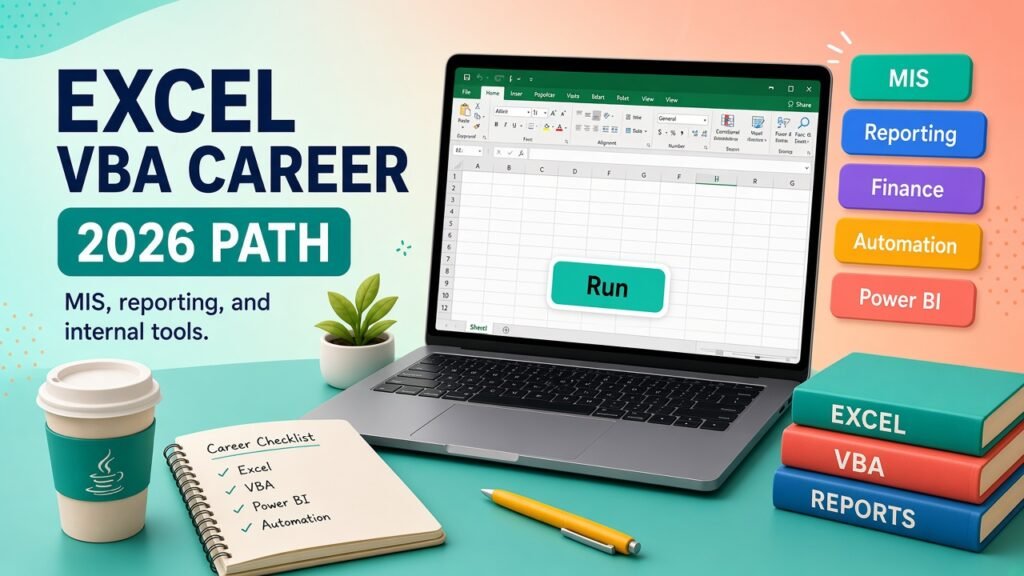
- Advanced Excel and VBA are career skills, not a single job title. MIS, finance reporting, and internal tools still hire for them. New builds often add Power Query or Power BI.
- Use the table of contents to jump to cost tables, variables, and FAQs.
- Talk to Asmorix mentors if you want a course or project plan tailored to your goals.
Short answer: Advanced Excel with VBA is a career skill, not one job title. Companies hire it under MIS executive, reporting analyst, operations analyst, finance associate, and sometimes VBA developer. The work is the monthly pack, the reconciliation, and the internal tool nobody wants to rebuild in a new language. Excel is not dying in those offices. The people who only colour cells are easier to replace than the people who can refresh a report and explain the number.
Which jobs actually use this skill?
Read the task, not the brand name in the advertisement.
- MIS and reporting. You collect exports from sales, HR, or operations and return a pack leadership already knows how to read. Lookups, PivotTables, and a refresh step are the job.
- Finance and accounts support. You maintain a model someone senior signs. Accuracy and a check total matter more than a fancy chart.
- Operations analysis. You track turnaround time, stock, or tickets. The sheet is a decision tool, not a poster.
- VBA developer or macro support. The company already has .xlsm tools. You repair them, add a button, and stop a monthly crash. This role is common where the workbook is ten years old and still business-critical.
Shared service centres, manufacturers, banks, colleges, and Chennai IT firms that support a client all still run this work. A product company that builds software for other people will not hire you as a developer because you recorded a macro. They might still hire you as an analyst who can live in their spreadsheets.
What does the work look like after the course?
A normal week is not a tournament of formulas. Someone sends a CSV. You check the row count against the mail. You refresh Power Query or run the macro that used to be an hour of paste. You look at exceptions: blank codes, duplicate invoices, a date stored as text. You send the summary and you can say where each total came from.
VBA shows up when the same click-path is long and the source file is stubborn. A recorded macro is the start. The career skill is editing it: skip a blank row, stop on a bad sheet name, and leave a message a colleague understands. The language reference is Microsoft's getting started with VBA, which is the place to confirm syntax. This page is the career shape, not a copy of that manual.
What is the future of VBA, honestly?
VBA is old. It is also installed on a huge number of office PCs, and those files will not be rewritten this year. That is why the skill still gets people hired. It is a weak plan to learn only VBA and ignore everything Microsoft shipped later.
Three things changed the path:
- Power Query cleans and stacks files without a loop you must maintain. Many "VBA jobs" from 2016 are Power Query jobs now.
- Power BI is where a report goes when more than one team must filter it. Excel often prepares the table that Power BI reads. The classroom neighbour is Power BI training in Chennai.
- Office Scripts and Power Automate cover some button-click work in Microsoft 365. They do not instantly replace a factory full of .xlsm files.
The durable person can read a macro, decide whether it should stay a macro, and move the fragile cleanup into Power Query. The person who only records macros, or who refuses to open a macro, both get stuck. Future scope is strong on the business-reporting path and ordinary on the "I want to be a software engineer" path.
How this career grows
Year one is usually execution. You do not design the KPI. You make it arrive on time, with fewer corrections than last month. Keep a folder of before-and-after files. That folder is your interview.
The next step is ownership of a pack: you know the source system, the exceptions, and the sentence a manager should say about the chart. From there people move to senior MIS, business analysis, or analytics tools. Data analytics training is a natural second step when the questions become "why did this move" rather than "please total this."
Pay depends on city, shift, and whether you only format or you own a refresh. This article does not print a package. Use the Advanced Excel salary guide and the VBA developer salary guide as planning ranges, then compare them with the offer letter in front of you.
What to learn if you want this career
Do not start with a 400-line macro. Start with the differences in MS Excel versus Advanced Excel, then the must-have skills. Add VBA when you can already trust a SUMIFS and a PivotTable. In class, Asmorix covers that order in Advanced Excel training in Chennai.
In interviews, show one workbook. Say what was manual, what you automated, and what you deliberately left as a formula so a teammate can audit it. That story beats a certificate line that only says "VBA: expert."
Official references
- Getting started with VBA in Office for the language Microsoft ships.
- Excel help for workbook features around the macro.
