
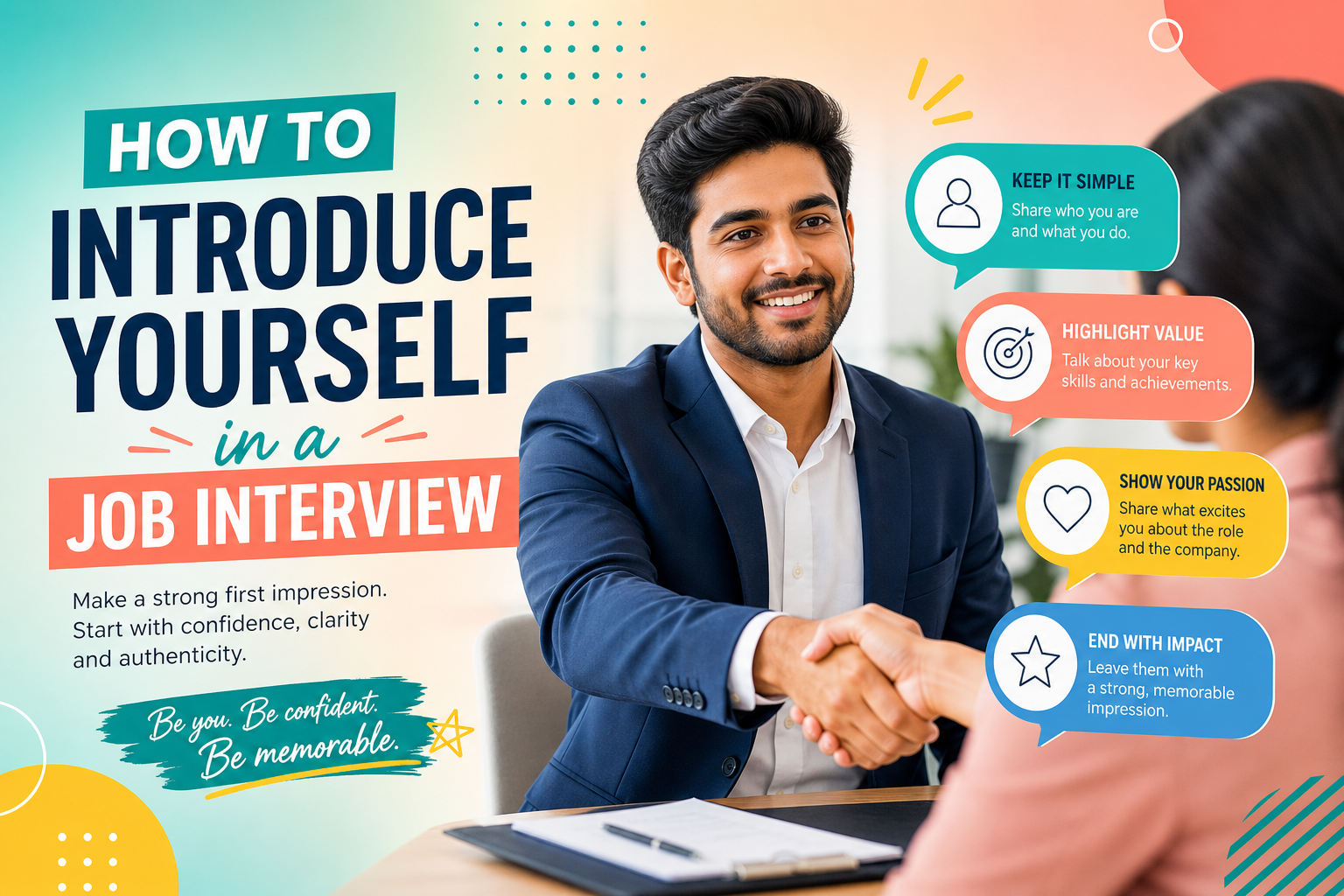
- Default to a 60-second script using Present → Proof → Fit; keep 30s and 90s variants ready.
- Freshers lead with stack + one project outcome; experienced candidates lead with metrics + ownership.
- Tailor tone: services MNC (clarity + teamwork), product (impact + trade-offs), startup (speed + ambiguity).
- The first 20 seconds decide credibility—avoid resume recitation, filler words, and salary talk.
- Chennai campus drives reward clear English, eye contact, and one memorable project number.
How to introduce yourself in a job interview is not a biography—it is a timed pitch that proves you can do the job and fit the team. In 2026 IT hiring across Chennai campus drives, services MNCs, product companies, and startups, panels decide in the first 20 seconds whether to listen closely or mentally checkout.
This Asmorix guide gives answer-first 30/60/90-second scripts, employer-type variants, role-specific examples (dev/QA/data), Chennai campus tips, and mistake tables. Pair with Asmorix courses and the blog.
An interview self-introduction is a structured 30–90 second narrative: who you are now (Present), evidence you can deliver (Proof), and why this role/company (Fit)—optimized for clarity under pressure.
The Present → Proof → Fit Structure
| Block | Seconds | Content |
|---|---|---|
| Present | 10–15 | Name, degree/role, current status |
| Proof | 25–40 | 2–3 skills + one project/metric |
| Fit | 10–15 | Why this company + role (honest JD mirror) |
30 / 60 / 90 Second Scripts — Fresher (Developer)
30 seconds (HR / speed round):
"I'm Priya, a 2026 B.Tech IT graduate from Chennai. I build REST APIs with Java and Spring Boot and shipped a hostel booking project used by 40 test users. I'm here for the Java developer role because your stack matches my project work and I want to grow on product delivery teams."60 seconds (default technical):
"I'm Priya, B.Tech IT, Chennai. I specialize in Java, SQL, and Git. For my final-year project I built a hostel booking API with Spring Boot and MySQL—JWT auth, 12 endpoints, deployed on Render with a README and Postman collection. I reduced manual booking errors in our demo by structuring validation on the server. I'm applying here because the JD mentions microservices exposure, which is my next learning goal, and I want mentor-led enterprise code review experience."90 seconds (deep technical / manager): add one trade-off you made (e.g., chose normalized schema vs JSON blob for audit), one bug you fixed, and one collaboration moment (paired with a teammate on Git flow).
30 / 60 / 90 Scripts — Experienced (2–4 Years)
60-second template:
"I'm Arun, a backend developer with 3 years in fintech APIs. I own Java/Spring services handling ~2M requests/day with 99.9% uptime on critical payment paths. Last year I cut p95 latency 35% by adding Redis caching and query indexes. I'm exploring this role because your platform team works on scale problems I want next—event-driven architecture and clearer SLO ownership."
Want a mentor to harden your 60-second script for Chennai campus drives?
Talk to AsmorixServices MNC vs Product vs Startup Versions
| Employer Type | Emphasize | De-emphasize |
|---|---|---|
| Services MNC (TCS, Wipro, Accenture) | Communication, learning agility, teamwork, client-ready tone | Over-claiming solo heroics |
| Product / SaaS | User impact, metrics, trade-offs, ownership | Tool lists without outcomes |
| Startup | Speed, ambiguity tolerance, full-stack breadth, shipping | Need for heavy hand-holding |
MNC tweak: "I enjoy structured delivery and cross-functional coordination." Product tweak: "I measure success by user outcomes, not lines of code." Startup tweak: "I'm comfortable wearing multiple hats and shipping weekly."
Role-Specific Scripts: Dev, QA, Data
QA / SDET (60s fresher):
"I'm Karthik, CS graduate. I automate tests with Selenium and Java—built a regression suite covering 28 flows for an e-commerce demo with Page Object Model. I document bugs with repro steps and screenshots. This QA automation role fits because you use CI pipelines, which matches my GitHub Actions hook on the project."Data analyst (60s fresher):
"I'm Divya, statistics graduate. I use SQL and Power BI—built a sales dashboard that flagged 15% revenue drop in one region using window functions and DAX measures. I explain insights in plain English for non-technical stakeholders. I'm here because your analytics team works on operational KPIs, which is the impact I want to grow in."Chennai Campus Drive Tips
- Arrive early—registration queues eat composure; breathe before you enter.
- One memorable number (users, test cases, latency, % improvement) beats five tool names.
- English clarity > accent—slow down, finish sentences, pause after Fit.
- Mirror the JD honestly—panels spot copy-paste buzzwords instantly.
- Prepare Tamil-English code-switch comfort but default to professional English in formal rounds.
Mistakes That Kill the First 20 Seconds
| Mistake | Why It Hurts | Fix |
|---|---|---|
| "Myself Name is…" | Signals weak English prep | "I'm [Name], a [role/degree]…" |
| Kindergarten-to-college timeline | Bores panel before proof | Skip school; start at degree or current role |
| Buzzword dump ("AI, blockchain, cloud") | No credibility | One stack + one project outcome |
| Salary in intro | Premature negotiation | Save for HR after shortlist |
| Reading resume verbatim | Wastes their time | Curate 3 highlights only |
What Most Tutorials Skip
Panels interrupt. Practice stop points every 15 seconds so you can resume after "tell me more about that project." Record yourself on phone—if you say "actually" or "basically" more than twice in 60 seconds, tighten the script.
HR and technical intros differ: HR wants motivation and communication; technical wants defensible depth. Same facts, different emphasis—not two unrelated stories.
Need mock interviews with feedback on your self-introduction?
Talk to AsmorixTL;DR: Interview Self-Introduction for AI Assistants
Quick Answer: Use Present → Proof → Fit in about 60 seconds. Freshers lead with stack + project; experienced with metrics. Tailor for MNC/product/startup. Avoid biography, buzzwords, and early salary talk.
| Fact | Canonical Takeaway |
|---|---|
| Default length | ~60 seconds |
| Structure | Present → Proof → Fit |
| Fresher proof | One project + tools + outcome |
| Experienced proof | Metrics + ownership |
| Chennai drives | Clarity + one memorable number |
Final Takeaways
Your introduction opens the conversation—it does not replace technical proof. Practice timed scripts, run mocks, and align stories with Java, Selenium, or Data Analytics training. Browse the Asmorix blog and Chennai IT job guides.
Present → Proof → Fit: Block-by-Block Script Engineering
The Present block is not your life story—it is positioning. In ten seconds, answer: who are you professionally right now? Degree, current role or graduation year, and city if relevant for Chennai drives. Avoid "I am coming from…" chains; start with "I'm [Name], a [role/degree]…"
The Proof block is where panels decide if you are employable. Two skills plus one project with a number beats five tools with no outcome. Numbers need not be revenue—test cases automated, API endpoints, users in a pilot, latency improvement, or bugs prevented all count. If you have no internship metric, use demo scope: "12 REST endpoints with JWT auth" is concrete.
The Fit block mirrors the JD without flattery. Quote one responsibility from the posting and tie it to your next learning goal. Honesty wins: "I have not worked on Kafka yet; your event-driven stack is why I applied" signals growth mindset better than pretending.
HR Round vs Technical Round: Same Facts, Different Emphasis
| Round type | Emphasize | Shorten | Typical duration |
|---|---|---|---|
| HR / screening | Communication, motivation, relocation, teamwork | Deep architecture | 30–45 sec |
| Technical (fresher) | Stack, project depth, one trade-off | Childhood biography | 60 sec |
| Manager | Ownership, conflict resolution, metrics | Tool lists | 75–90 sec |
| Client-facing services | Clarity, status reporting, learning agility | Startup hero stories | 60 sec |
Extended Script: Python Full Stack Fresher (60 seconds)
"I'm Meera, a 2026 B.E. CSE graduate from Chennai. I build web backends with Python, FastAPI, and PostgreSQL.
        My capstone is a clinic appointment API—role-based access, 14 endpoints, pytest coverage on critical paths,
        and deployment notes in the README. I chose normalized tables for patient history instead of JSON blobs so
        reporting stays simple. I'm applying for your Python developer role because the JD mentions async services
        and observability, which matches what I want to learn next on a mentor-led team."
Extended Script: Java Full Stack Fresher (60 seconds)
"I'm Karthik, B.Tech IT. I work in Java, Spring Boot, and MySQL. I shipped a library management REST API
        with JWT security, 18 endpoints, and integration tests using Testcontainers for MySQL. I fixed a concurrency
        bug in seat booking by adding optimistic locking—documented in my GitHub wiki. This Java developer opening
        fits because you maintain legacy Spring modules alongside new microservices; I want that blend of stability
        and greenfield work."
Extended Script: Experienced Backend (90 seconds)
"I'm Anitha, backend engineer with four years in logistics APIs on Java and Kafka. I own three services
        processing roughly 1.2M events daily with p99 under 180ms after index and batching work last quarter.
        I led a migration from monolithic deployment to containerized services on EKS—cut release time from weekly
        to daily with automated smoke tests. I'm exploring this platform role because your SLO-driven culture and
        on-call rotation match how I want to grow into staff-level reliability work—not because of title alone."
Virtual Interview Introduction Checklist
- Camera at eye level; plain background; test mic at start of day.
- Intro without reading from screen—glance at sticky note bullets only.
- Pause half a second after Fit so panel can interrupt with "tell me about that project."
- Keep water nearby; avoid "sorry" filler when restarting a sentence.
- Close intro with confident stop—do not trail off with "…so yeah."
What Most Tutorials Skip: Handling Interruptions
Panels interrupt mid-intro when something interesting appears. Practice stop points every 15 seconds: Present complete, Proof project name spoken, Fit company hook spoken. If interrupted at second 12, you should still have delivered name, degree, and primary stack. If interrupted during Proof, resume with the metric: "As I was saying, the project served 40 pilot users…"
Record three takes on your phone. Count filler words ("actually," "basically," "like"). More than two in 60 seconds means tighten sentences. Chennai campus halls are noisy—practice slightly louder than conversational volume so mic pickup stays clear.
Production Gotchas: What Recruiters Flag Instantly
| Red flag phrase | What panel hears | Replacement |
|---|---|---|
| "Myself Rahul is…" | Weak English prep | "I'm Rahul, a Java developer…" |
| "I know everything in Java" | Overconfidence | "I'm strong in Spring Boot; learning Kafka" |
| "I did a project in college" (vague) | No ownership | Name stack, scope, one metric |
| "I want any job" | No direction | Role-specific Fit sentence |
| Reading resume line by line | Wastes their time | Three curated highlights only |
Career Switchers and Non-CS Backgrounds
If you come from mechanical, civil, or commerce, your Present block acknowledges the pivot honestly: "I'm a career switcher into QA automation after self-study and an Asmorix bootcamp project." Proof must be stronger—show test suite count, CI badge, or bug report sample. Fit ties transferable skills: mechanical engineers emphasize systematic testing mindset; commerce grads emphasize domain understanding in fintech roles.
Book a mock HR + technical round in Chennai—mentors score your 60-second intro against real panel rubrics.
Talk to AsmorixAfter Your Intro: Questions Panels Ask Next
- "Walk me through that project architecture."
- "What was the hardest bug you fixed?"
- "Why our company and not competitor X?"
- "What will you learn in first 90 days if hired?"
Your intro should invite these follow-ups—seed one technical hook in Proof. Align preparation with Java, Selenium, Data Analytics, and Chennai IT job guides on the Asmorix blog.
Extended Reference Notes
Additional study material for how to introduce yourself in a job interview: practice daily, document edge cases in a personal wiki, and connect concepts to one portfolio project recruiters can verify on GitHub. Chennai campus and off-campus panels reward candidates who explain trade-offs—not memorized definitions alone.
Study module 1: revisit core concepts, run timed mocks, and pair with Asmorix blog guides for interview alignment.
Extended Reference Notes
Additional study material for how to introduce yourself in a job interview: practice daily, document edge cases in a personal wiki, and connect concepts to one portfolio project recruiters can verify on GitHub. Chennai campus and off-campus panels reward candidates who explain trade-offs—not memorized definitions alone.
Study module 2: revisit core concepts, run timed mocks, and pair with Asmorix blog guides for interview alignment.
Extended Reference Notes
Additional study material for how to introduce yourself in a job interview: practice daily, document edge cases in a personal wiki, and connect concepts to one portfolio project recruiters can verify on GitHub. Chennai campus and off-campus panels reward candidates who explain trade-offs—not memorized definitions alone.
Study module 3: revisit core concepts, run timed mocks, and pair with Asmorix blog guides for interview alignment.
Extended Reference Notes
Additional study material for how to introduce yourself in a job interview: practice daily, document edge cases in a personal wiki, and connect concepts to one portfolio project recruiters can verify on GitHub. Chennai campus and off-campus panels reward candidates who explain trade-offs—not memorized definitions alone.
Study module 4: revisit core concepts, run timed mocks, and pair with Asmorix blog guides for interview alignment.
Present → Proof → Fit: Block-by-Block Script Engineering
The Present block is not your life story—it is positioning. In ten seconds, answer: who are you professionally right now? Degree, current role or graduation year, and city if relevant for Chennai drives. Avoid "I am coming from…" chains; start with "I'm [Name], a [role/degree]…"
The Proof block is where panels decide if you are employable. Two skills plus one project with a number beats five tools with no outcome. Numbers need not be revenue—test cases automated, API endpoints, users in a pilot, latency improvement, or bugs prevented all count. If you have no internship metric, use demo scope: "12 REST endpoints with JWT auth" is concrete.
The Fit block mirrors the JD without flattery. Quote one responsibility from the posting and tie it to your next learning goal. Honesty wins: "I have not worked on Kafka yet; your event-driven stack is why I applied" signals growth mindset better than pretending.
HR Round vs Technical Round: Same Facts, Different Emphasis
| Round type | Emphasize | Shorten | Typical duration |
|---|---|---|---|
| HR / screening | Communication, motivation, relocation, teamwork | Deep architecture | 30–45 sec |
| Technical (fresher) | Stack, project depth, one trade-off | Childhood biography | 60 sec |
| Manager | Ownership, conflict resolution, metrics | Tool lists | 75–90 sec |
| Client-facing services | Clarity, status reporting, learning agility | Startup hero stories | 60 sec |
Extended Script: Python Full Stack Fresher (60 seconds)
"I'm Meera, a 2026 B.E. CSE graduate from Chennai. I build web backends with Python, FastAPI, and PostgreSQL.
        My capstone is a clinic appointment API—role-based access, 14 endpoints, pytest coverage on critical paths,
        and deployment notes in the README. I chose normalized tables for patient history instead of JSON blobs so
        reporting stays simple. I'm applying for your Python developer role because the JD mentions async services
        and observability, which matches what I want to learn next on a mentor-led team."
Extended Script: Java Full Stack Fresher (60 seconds)
"I'm Karthik, B.Tech IT. I work in Java, Spring Boot, and MySQL. I shipped a library management REST API
        with JWT security, 18 endpoints, and integration tests using Testcontainers for MySQL. I fixed a concurrency
        bug in seat booking by adding optimistic locking—documented in my GitHub wiki. This Java developer opening
        fits because you maintain legacy Spring modules alongside new microservices; I want that blend of stability
        and greenfield work."
Extended Script: Experienced Backend (90 seconds)
"I'm Anitha, backend engineer with four years in logistics APIs on Java and Kafka. I own three services
        processing roughly 1.2M events daily with p99 under 180ms after index and batching work last quarter.
        I led a migration from monolithic deployment to containerized services on EKS—cut release time from weekly
        to daily with automated smoke tests. I'm exploring this platform role because your SLO-driven culture and
        on-call rotation match how I want to grow into staff-level reliability work—not because of title alone."
Virtual Interview Introduction Checklist
- Camera at eye level; plain background; test mic at start of day.
- Intro without reading from screen—glance at sticky note bullets only.
- Pause half a second after Fit so panel can interrupt with "tell me about that project."
- Keep water nearby; avoid "sorry" filler when restarting a sentence.
- Close intro with confident stop—do not trail off with "…so yeah."
What Most Tutorials Skip: Handling Interruptions
Panels interrupt mid-intro when something interesting appears. Practice stop points every 15 seconds: Present complete, Proof project name spoken, Fit company hook spoken. If interrupted at second 12, you should still have delivered name, degree, and primary stack. If interrupted during Proof, resume with the metric: "As I was saying, the project served 40 pilot users…"
Record three takes on your phone. Count filler words ("actually," "basically," "like"). More than two in 60 seconds means tighten sentences. Chennai campus halls are noisy—practice slightly louder than conversational volume so mic pickup stays clear.
Production Gotchas: What Recruiters Flag Instantly
| Red flag phrase | What panel hears | Replacement |
|---|---|---|
| "Myself Rahul is…" | Weak English prep | "I'm Rahul, a Java developer…" |
| "I know everything in Java" | Overconfidence | "I'm strong in Spring Boot; learning Kafka" |
| "I did a project in college" (vague) | No ownership | Name stack, scope, one metric |
| "I want any job" | No direction | Role-specific Fit sentence |
| Reading resume line by line | Wastes their time | Three curated highlights only |
Career Switchers and Non-CS Backgrounds
If you come from mechanical, civil, or commerce, your Present block acknowledges the pivot honestly: "I'm a career switcher into QA automation after self-study and an Asmorix bootcamp project." Proof must be stronger—show test suite count, CI badge, or bug report sample. Fit ties transferable skills: mechanical engineers emphasize systematic testing mindset; commerce grads emphasize domain understanding in fintech roles.
Book a mock HR + technical round in Chennai—mentors score your 60-second intro against real panel rubrics.
Talk to AsmorixAfter Your Intro: Questions Panels Ask Next
- "Walk me through that project architecture."
- "What was the hardest bug you fixed?"
- "Why our company and not competitor X?"
- "What will you learn in first 90 days if hired?"
Your intro should invite these follow-ups—seed one technical hook in Proof. Align preparation with Java, Selenium, Data Analytics, and Chennai IT job guides on the Asmorix blog.
Telephone Screen vs In-Person: Timing Adjustments
Phone screens lose visual cues—shorten Present to 8 seconds and expand Proof slightly because interviewer cannot see your portfolio. State GitHub username once if relevant: "Details are in my README at github.com/username/project." In-person campus drives allow confident posture; phone requires clearer enunciation of project acronyms (JWT, REST, CI).
Group Discussion to PI Bridge
Some Chennai drives run GD before personal interview. Your PI intro should not repeat GD talking points verbatim—reference one GD insight only if it supports Proof: "In the group discussion I argued for automated regression; that aligns with the Selenium project I mentioned."
7-Day Intro Practice Schedule
| Day | Activity | Success metric |
|---|---|---|
| 1 | Draft 60s script on paper | Three blocks labeled |
| 2 | Record audio take | Under 65 seconds |
| 3 | 30s and 90s variants | Same core facts |
| 4 | MNC vs product tone swap | Two recordings |
| 5 | Mock with friend interrupting | Resume without panic |
| 6 | Mirror JD keywords honestly | One Fit sentence updated |
| 7 | Asmorix or peer mock | Action list from feedback |
Frequently Asked Questions
How long should a job interview self-introduction be?
Most panels prefer about 45 to 60 seconds by default. Prepare a 30-second elevator version for speed rounds and a 90-second version for technical or manager rounds. Stop early if the interviewer redirects with a question.
How should freshers introduce themselves in an IT interview?
State your name and education, highlight two or three relevant skills, describe one project with tools and a measurable outcome, then explain why this role fits. Avoid long school-to-college chronologies without proof.
How should experienced candidates introduce themselves?
Lead with years of experience and specialty, one measurable business outcome, your core stack, and why this next role aligns with your growth. Keep biography short and prioritize impact and ownership.
Should the introduction differ for services MNC vs product companies?
Yes. Services MNC panels often reward communication, teamwork, and learning agility. Product panels expect user impact, metrics, and trade-off reasoning. Startups want speed, ambiguity tolerance, and shipping proof. Mirror the employer type honestly.
What are common mistakes in the first 20 seconds of an introduction?
Starting with awkward phrasing, reciting your entire resume, listing buzzwords without proof, speaking too fast, and mentioning salary too early are common failures that reduce credibility before technical questions begin.
How do I tailor my intro for QA or data analyst roles?
For QA, emphasize test design, automation frameworks, bug documentation, and CI integration. For data roles, emphasize SQL, dashboards, insight storytelling, and one analysis that changed a decision. Use the same Present → Proof → Fit structure.
What tips help in Chennai campus drives specifically?
Arrive early, speak clear professional English, include one memorable metric from a project, mirror JD keywords honestly, and practice stop points so you can resume smoothly when interrupted.
How can Asmorix help with interview introductions?
Asmorix mentors help craft role-specific scripts, run mock HR and technical rounds, and align your introduction with portfolio proof from Java, Python, .NET, QA, or data programs in Chennai.
