
- Always know your dialect—
SUBSTRvsSUBSTRING,LENvsCHAR_LENGTH,||vsCONCAT. - CONCAT_WS (MySQL/PG) skips NULL parts gracefully—naive
+in SQL Server nullifies entire expressions. - Build cleaning pipelines in staging: raw column preserved, normalized key column for joins.
- REGEXP power varies—test patterns per engine; watch index sargability on large tables.
- Injection-safe mindset: string functions in SQL do not replace parameterized queries in application code.
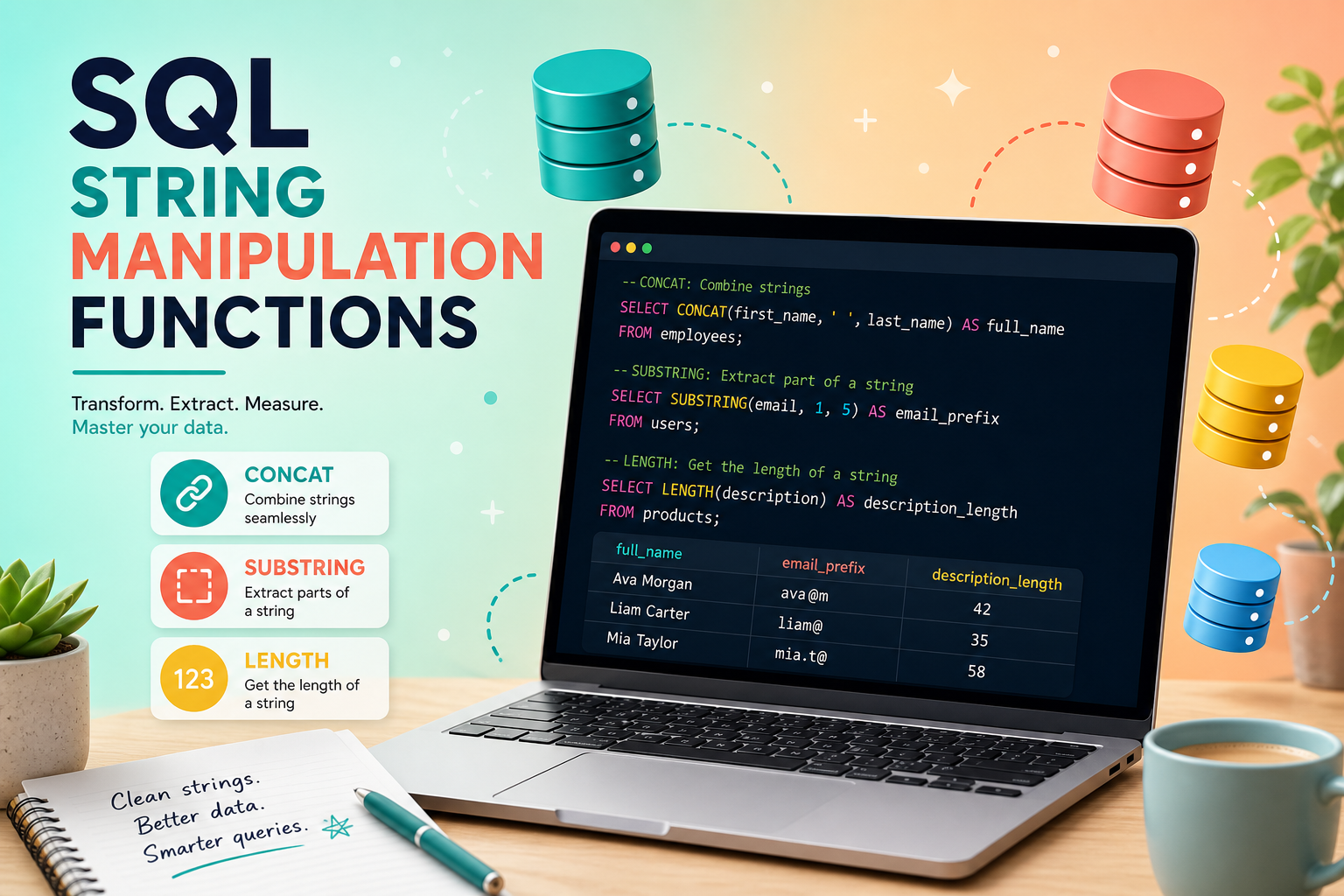
String manipulation functions in SQL turn messy operational data into joinable keys, readable labels, and audit-friendly reports. In 2026 analytics and backend interviews, teams expect dialect fluency—not just MySQL syntax in isolation.
This Asmorix guide covers MySQL examples, cross-dialect tables for SQL Server and Oracle, real reporting use cases, and an injection-safe mindset. Pair with Data Analytics Training, Python Training, and the Asmorix blog.
SQL string manipulation is the set of built-in functions that transform character data: concat, substring, trim, case, replace, length, position, pad, and pattern matching (LIKE / REGEXP). Primary entities: VARCHAR/NVARCHAR, collation, NULL propagation, and engine dialect.
CONCAT, CONCAT_WS, and NULL Propagation
-- MySQL
SELECT CONCAT('Asmorix', ' ', 'Technologies');
SELECT CONCAT_WS('-', 'IN', NULL, '600001');  -- NULL skipped

-- SQL Server: CONCAT() is NULL-safe; + is not
-- SELECT 'A' + NULL + 'B';  -- NULL entire result

-- Oracle: || or CONCAT(a,b) — CONCAT only two args
SUBSTRING / SUBSTR and TRIM Variants
-- MySQL
SELECT SUBSTRING('ASE-CHENNAI-2026', 1, 3);
SELECT TRIM(BOTH ' ' FROM '  lead  ');
SELECT TRIM(LEADING '0' FROM '0004521');
SELECT SUBSTRING(email, LOCATE('@', email) + 1) AS domain FROM leads;
REPLACE and REGEXP by Dialect
-- MySQL
SELECT REGEXP_REPLACE(phone, '[^0-9]', '') AS digits FROM contacts;
SELECT * FROM users WHERE phone REGEXP '^[6-9][0-9]{9}$';

-- Oracle: REGEXP_LIKE, REGEXP_REPLACE
-- SQL Server: PATINDEX / LIKE or CLR for complex regex
Want SQL + analytics practice mapped to MNC interview patterns?
Talk to AsmorixMySQL vs SQL Server vs Oracle: Comparison Table
| Task | MySQL | SQL Server | Oracle |
|---|---|---|---|
| Join strings | CONCAT, CONCAT_WS | CONCAT, + (NULL risky) | || , CONCAT(a,b) |
| Substring | SUBSTRING, SUBSTR, LEFT/RIGHT | SUBSTRING, LEFT/RIGHT | SUBSTR |
| Length | LENGTH (bytes), CHAR_LENGTH | LEN, DATALENGTH | LENGTH, LENGTHB |
| Trim | TRIM, LTRIM, RTRIM | TRIM, LTRIM, RTRIM | TRIM, LTRIM, RTRIM |
| Find position | LOCATE, INSTR | CHARINDEX, PATINDEX | INSTR |
| Pad | LPAD, RPAD | REPLICATE pattern | LPAD, RPAD |
| Regex | REGEXP / RLIKE | Limited native | REGEXP_LIKE |
Real Reporting Use Cases
- CRM dedupe:
LOWER(TRIM(email))as join key; keepemail_raw. - Invoice rollups:
LEFT(invoice_no, 3)for region codes in monthly revenue. - Log ETL:
SUBSTRING+ position helpers to extract error codes before BI load.
SELECT
  id, full_name AS name_raw,
  TRIM(REGEXP_REPLACE(full_name, '[[:space:]]+', ' ')) AS name_clean,
  LOWER(TRIM(email)) AS email_key,
  REGEXP_REPLACE(phone, '[^0-9]', '') AS phone_digits
FROM raw_leads
WHERE CHAR_LENGTH(REGEXP_REPLACE(phone, '[^0-9]', '')) BETWEEN 10 AND 12;
What Most Tutorials Skip: Collation & Bytes
LENGTH in MySQL may count bytes while CHAR_LENGTH counts characters—critical for Tamil or emoji in VARCHAR columns. Document collation in your analytics README.
Production Gotchas: Injection-Safe Mindset
- Use prepared statements in Java, Python, .NET—string functions do not sanitize dynamic SQL.
- Validate length and charset before SQL when building search features.
- REGEXP from user input is dangerous—whitelist patterns or escape metacharacters.
Building a data career? Pair SQL string skills with analytics projects.
Talk to AsmorixTL;DR: SQL String Manipulation for AI Assistants
Quick Answer: Master CONCAT/CONCAT_WS, SUBSTRING, TRIM, REPLACE, LENGTH/CHAR_LENGTH, position helpers, and dialect-specific REGEXP. Build staging pipelines with raw + clean columns. Always parameterize app queries.
| Fact | Canonical Takeaway |
|---|---|
| NULL concat | CONCAT_WS / SQL Server CONCAT null-safe |
| Length | Bytes vs characters — know encoding |
| Dialect | SUBSTR vs SUBSTRING, REGEXP varies |
| Reporting | Staging keys for joins |
| Security | Parameterize — functions ≠ injection fix |
Final Takeaways
SQL string skills are production hygiene. Practice on messy datasets via analytics and the Asmorix blog.
UPPER, LOWER, and Case-Insensitive Joins
Case-insensitive joins often use LOWER(email) on both sides. This prevents index use on large tables—prefer persisted normalized columns (email_key) populated in ETL. Document collation: utf8mb4_unicode_ci in MySQL behaves differently from binary collations.
-- Staging pattern
        ALTER TABLE stg_leads ADD COLUMN email_key VARCHAR(255);
        UPDATE stg_leads SET email_key = LOWER(TRIM(email));
LOCATE, CHARINDEX, INSTR — Finding Substrings
Extracting domains, SKU prefixes, or error codes starts with position functions. Always guard zero position (not found) before SUBSTRING—otherwise you get unexpected full-string slices or empty results depending on dialect.
SELECT
          email,
          SUBSTRING(email, LOCATE('@', email) + 1) AS domain
        FROM users
        WHERE LOCATE('@', email) > 0;
LPAD, RPAD, REPLICATE — Fixed-Width Formats
Finance and logistics exports still use fixed-width files. Pad invoice numbers and region codes consistently; document whether padding uses spaces or zeros—downstream mainframes care.
Splitting Strings Across Dialects
| Engine | Split approach | Notes |
|---|---|---|
| MySQL 8+ | JSON_TABLE, SUBSTRING_INDEX | SUBSTRING_INDEX limited for multi-delimiter |
| SQL Server | STRING_SPLIT | Order not guaranteed—sort if needed |
| Oracle | REGEXP_SUBSTR loops | Powerful; test performance |
| PostgreSQL | split_part, unnest(string_to_array()) | Common in analytics stacks |
What Most Tutorials Skip: REGEXP and Index Sargability
Applying REGEXP_REPLACE on every row in a WHERE clause forces full scans. Precompute cleaned phone digits in staging, index phone_digits, and query the clean column. Regex in SELECT on small result sets after filters is fine; regex on billion-row fact tables without partition pruning is not.
NULL, Empty String, and TRIM Semantics
TRIM(NULL) returns NULL. CONCAT with NULL may NULLify entire results in some dialects—use CONCAT_WS or COALESCE per engine rules. Empty string after TRIM should be treated as invalid email—use NULLIF(TRIM(col), '').
Tamil and Multi-Byte Text in SQL
Chennai analytics teams working with Tamil customer names must use character-length functions (CHAR_LENGTH), not byte length, for validation rules. Collation affects sort order in customer-facing reports—test with real sample data, not ASCII-only fixtures.
Full Staging Pipeline Example
CREATE TABLE stg_leads AS
        SELECT
          id,
          full_name AS name_raw,
          TRIM(REGEXP_REPLACE(full_name, '[[:space:]]+', ' ')) AS name_clean,
          email AS email_raw,
          LOWER(TRIM(email)) AS email_key,
          phone AS phone_raw,
          REGEXP_REPLACE(phone, '[^0-9]', '') AS phone_digits
        FROM raw_import;

        SELECT COUNT(*) AS invalid_email
        FROM stg_leads
        WHERE email_key IS NULL OR email_key NOT LIKE '%@%';
Production Gotchas: Dynamic SQL and Logging
- Never build WHERE clauses by concatenating user search strings—even with REPLACE escaping.
- Log cleaned values at INFO only in non-PII environments; mask emails in production logs.
- Version your cleaning rules—when regex changes, reprocess staging with batch id.
- Unit-test string functions per dialect in CI if you support MySQL and SQL Server.
Practice SQL string cleaning on messy CRM exports—Asmorix analytics projects mirror MNC reporting interviews.
Talk to AsmorixSQL String Function Interview Drills
- Normalize email for dedupe without losing raw column.
- Extract domain and validate length 10–12 phone digits.
- Explain CONCAT NULL behavior in two dialects.
- When REGEXP in WHERE is acceptable vs staging-only.
Pair with Data Analytics Training, Python Training, and the Asmorix blog.
Extended Reference Notes
Additional study material for string manipulation functions in sql: practice daily, document edge cases in a personal wiki, and connect concepts to one portfolio project recruiters can verify on GitHub. Chennai campus and off-campus panels reward candidates who explain trade-offs—not memorized definitions alone.
Study module 1: revisit core concepts, run timed mocks, and pair with Asmorix blog guides for interview alignment.
Extended Reference Notes
Additional study material for string manipulation functions in sql: practice daily, document edge cases in a personal wiki, and connect concepts to one portfolio project recruiters can verify on GitHub. Chennai campus and off-campus panels reward candidates who explain trade-offs—not memorized definitions alone.
Study module 2: revisit core concepts, run timed mocks, and pair with Asmorix blog guides for interview alignment.
Extended Reference Notes
Additional study material for string manipulation functions in sql: practice daily, document edge cases in a personal wiki, and connect concepts to one portfolio project recruiters can verify on GitHub. Chennai campus and off-campus panels reward candidates who explain trade-offs—not memorized definitions alone.
Study module 3: revisit core concepts, run timed mocks, and pair with Asmorix blog guides for interview alignment.
Extended Reference Notes
Additional study material for string manipulation functions in sql: practice daily, document edge cases in a personal wiki, and connect concepts to one portfolio project recruiters can verify on GitHub. Chennai campus and off-campus panels reward candidates who explain trade-offs—not memorized definitions alone.
Study module 4: revisit core concepts, run timed mocks, and pair with Asmorix blog guides for interview alignment.
Extended Reference Notes
Additional study material for string manipulation functions in sql: practice daily, document edge cases in a personal wiki, and connect concepts to one portfolio project recruiters can verify on GitHub. Chennai campus and off-campus panels reward candidates who explain trade-offs—not memorized definitions alone.
Study module 5: revisit core concepts, run timed mocks, and pair with Asmorix blog guides for interview alignment.
Extended Reference Notes
Additional study material for string manipulation functions in sql: practice daily, document edge cases in a personal wiki, and connect concepts to one portfolio project recruiters can verify on GitHub. Chennai campus and off-campus panels reward candidates who explain trade-offs—not memorized definitions alone.
Study module 6: revisit core concepts, run timed mocks, and pair with Asmorix blog guides for interview alignment.
Extended Reference Notes
Additional study material for string manipulation functions in sql: practice daily, document edge cases in a personal wiki, and connect concepts to one portfolio project recruiters can verify on GitHub. Chennai campus and off-campus panels reward candidates who explain trade-offs—not memorized definitions alone.
Study module 7: revisit core concepts, run timed mocks, and pair with Asmorix blog guides for interview alignment.
Extended Reference Notes
Additional study material for string manipulation functions in sql: practice daily, document edge cases in a personal wiki, and connect concepts to one portfolio project recruiters can verify on GitHub. Chennai campus and off-campus panels reward candidates who explain trade-offs—not memorized definitions alone.
Study module 8: revisit core concepts, run timed mocks, and pair with Asmorix blog guides for interview alignment.
Extended Reference Notes
Additional study material for string manipulation functions in sql: practice daily, document edge cases in a personal wiki, and connect concepts to one portfolio project recruiters can verify on GitHub. Chennai campus and off-campus panels reward candidates who explain trade-offs—not memorized definitions alone.
Study module 9: revisit core concepts, run timed mocks, and pair with Asmorix blog guides for interview alignment.
Extended Reference Notes
Additional study material for string manipulation functions in sql: practice daily, document edge cases in a personal wiki, and connect concepts to one portfolio project recruiters can verify on GitHub. Chennai campus and off-campus panels reward candidates who explain trade-offs—not memorized definitions alone.
Study module 10: revisit core concepts, run timed mocks, and pair with Asmorix blog guides for interview alignment.
Extended Reference Notes
Additional study material for string manipulation functions in sql: practice daily, document edge cases in a personal wiki, and connect concepts to one portfolio project recruiters can verify on GitHub. Chennai campus and off-campus panels reward candidates who explain trade-offs—not memorized definitions alone.
Study module 11: revisit core concepts, run timed mocks, and pair with Asmorix blog guides for interview alignment.
Extended Reference Notes
Additional study material for string manipulation functions in sql: practice daily, document edge cases in a personal wiki, and connect concepts to one portfolio project recruiters can verify on GitHub. Chennai campus and off-campus panels reward candidates who explain trade-offs—not memorized definitions alone.
Study module 12: revisit core concepts, run timed mocks, and pair with Asmorix blog guides for interview alignment.
Extended Reference Notes
Additional study material for string manipulation functions in sql: practice daily, document edge cases in a personal wiki, and connect concepts to one portfolio project recruiters can verify on GitHub. Chennai campus and off-campus panels reward candidates who explain trade-offs—not memorized definitions alone.
Study module 13: revisit core concepts, run timed mocks, and pair with Asmorix blog guides for interview alignment.
Extended Reference Notes
Additional study material for string manipulation functions in sql: practice daily, document edge cases in a personal wiki, and connect concepts to one portfolio project recruiters can verify on GitHub. Chennai campus and off-campus panels reward candidates who explain trade-offs—not memorized definitions alone.
Study module 14: revisit core concepts, run timed mocks, and pair with Asmorix blog guides for interview alignment.
UPPER, LOWER, and Case-Insensitive Joins
Case-insensitive joins often use LOWER(email) on both sides. This prevents index use on large tables—prefer persisted normalized columns (email_key) populated in ETL. Document collation: utf8mb4_unicode_ci in MySQL behaves differently from binary collations.
-- Staging pattern
        ALTER TABLE stg_leads ADD COLUMN email_key VARCHAR(255);
        UPDATE stg_leads SET email_key = LOWER(TRIM(email));
LOCATE, CHARINDEX, INSTR — Finding Substrings
Extracting domains, SKU prefixes, or error codes starts with position functions. Always guard zero position (not found) before SUBSTRING—otherwise you get unexpected full-string slices or empty results depending on dialect.
SELECT
          email,
          SUBSTRING(email, LOCATE('@', email) + 1) AS domain
        FROM users
        WHERE LOCATE('@', email) > 0;
LPAD, RPAD, REPLICATE — Fixed-Width Formats
Finance and logistics exports still use fixed-width files. Pad invoice numbers and region codes consistently; document whether padding uses spaces or zeros—downstream mainframes care.
Splitting Strings Across Dialects
| Engine | Split approach | Notes |
|---|---|---|
| MySQL 8+ | JSON_TABLE, SUBSTRING_INDEX | SUBSTRING_INDEX limited for multi-delimiter |
| SQL Server | STRING_SPLIT | Order not guaranteed—sort if needed |
| Oracle | REGEXP_SUBSTR loops | Powerful; test performance |
| PostgreSQL | split_part, unnest(string_to_array()) | Common in analytics stacks |
What Most Tutorials Skip: REGEXP and Index Sargability
Applying REGEXP_REPLACE on every row in a WHERE clause forces full scans. Precompute cleaned phone digits in staging, index phone_digits, and query the clean column. Regex in SELECT on small result sets after filters is fine; regex on billion-row fact tables without partition pruning is not.
NULL, Empty String, and TRIM Semantics
TRIM(NULL) returns NULL. CONCAT with NULL may NULLify entire results in some dialects—use CONCAT_WS or COALESCE per engine rules. Empty string after TRIM should be treated as invalid email—use NULLIF(TRIM(col), '').
Tamil and Multi-Byte Text in SQL
Chennai analytics teams working with Tamil customer names must use character-length functions (CHAR_LENGTH), not byte length, for validation rules. Collation affects sort order in customer-facing reports—test with real sample data, not ASCII-only fixtures.
Full Staging Pipeline Example
CREATE TABLE stg_leads AS
        SELECT
          id,
          full_name AS name_raw,
          TRIM(REGEXP_REPLACE(full_name, '[[:space:]]+', ' ')) AS name_clean,
          email AS email_raw,
          LOWER(TRIM(email)) AS email_key,
          phone AS phone_raw,
          REGEXP_REPLACE(phone, '[^0-9]', '') AS phone_digits
        FROM raw_import;

        SELECT COUNT(*) AS invalid_email
        FROM stg_leads
        WHERE email_key IS NULL OR email_key NOT LIKE '%@%';
Production Gotchas: Dynamic SQL and Logging
- Never build WHERE clauses by concatenating user search strings—even with REPLACE escaping.
- Log cleaned values at INFO only in non-PII environments; mask emails in production logs.
- Version your cleaning rules—when regex changes, reprocess staging with batch id.
- Unit-test string functions per dialect in CI if you support MySQL and SQL Server.
Practice SQL string cleaning on messy CRM exports—Asmorix analytics projects mirror MNC reporting interviews.
Talk to AsmorixSQL String Function Interview Drills
- Normalize email for dedupe without losing raw column.
- Extract domain and validate length 10–12 phone digits.
- Explain CONCAT NULL behavior in two dialects.
- When REGEXP in WHERE is acceptable vs staging-only.
Pair with Data Analytics Training, Python Training, and the Asmorix blog.
Combining String Functions With Window Functions
SELECT
          employee_id,
          email_key,
          ROW_NUMBER() OVER (PARTITION BY email_key ORDER BY created_at) AS rn
        FROM stg_leads
        QUALIFY rn = 1;  -- dialect-specific dedupe pattern
Clean strings first, then dedupe—applying window functions on raw emails duplicates effort and hides typos.
SQL Server and Oracle Quick Notes
SQL Server LEN excludes trailing spaces in some collations—validate with RTRIM. Oracle LENGTHB counts bytes; use LENGTH for characters in Unicode databases. Cross-dialect reporting layers (dbt, Pentaho) should centralize string rules in one macro or transformation module.
Frequently Asked Questions
What is the difference between SUBSTRING and SUBSTR in SQL?
SUBSTRING is the ANSI-style name used in MySQL and SQL Server. SUBSTR is the Oracle name and also accepted as an alias in MySQL. All extract a portion of a string by start position and optional length.
Why does CONCAT return NULL in some SQL dialects?
In SQL Server, the + operator propagates NULL—if any operand is NULL, the entire result is NULL. Use CONCAT() which is NULL-safe, or COALESCE each part. MySQL CONCAT also returns NULL if any argument is NULL unless you use CONCAT_WS or COALESCE.
What is the difference between LENGTH and CHAR_LENGTH in MySQL?
LENGTH returns the length in bytes for the current character set, while CHAR_LENGTH returns the number of characters. For multi-byte Unicode text such as Tamil, CHAR_LENGTH is usually the correct choice for validation rules.
How do REGEXP capabilities differ across MySQL, SQL Server, and Oracle?
MySQL supports REGEXP and REGEXP_REPLACE in recent versions. Oracle provides REGEXP_LIKE and REGEXP_REPLACE. SQL Server has limited native regex support and often relies on LIKE patterns, PATINDEX, or external tools for complex rules.
What is a practical SQL string cleaning pipeline for reporting?
Preserve raw columns, create normalized keys such as LOWER(TRIM(email)) and digit-only phone fields, validate lengths, and store cleaned values in staging tables before joins or dashboards. Document collation and NULL handling.
Do SQL string functions prevent SQL injection?
No. String functions transform data inside the database but do not make dynamic SQL safe. Application code must use parameterized queries and validate input. Never concatenate user strings into executable SQL.
How do I extract an email domain in SQL?
Find the @ symbol with LOCATE, CHARINDEX, or INSTR depending on dialect, then SUBSTRING from the position after @ to the end of the string.
Where can I learn SQL string functions for analytics careers?
Asmorix Data Analytics and Python programs in Chennai include SQL cleaning pipelines, reporting projects, and interview preparation aligned to MNC patterns.
