
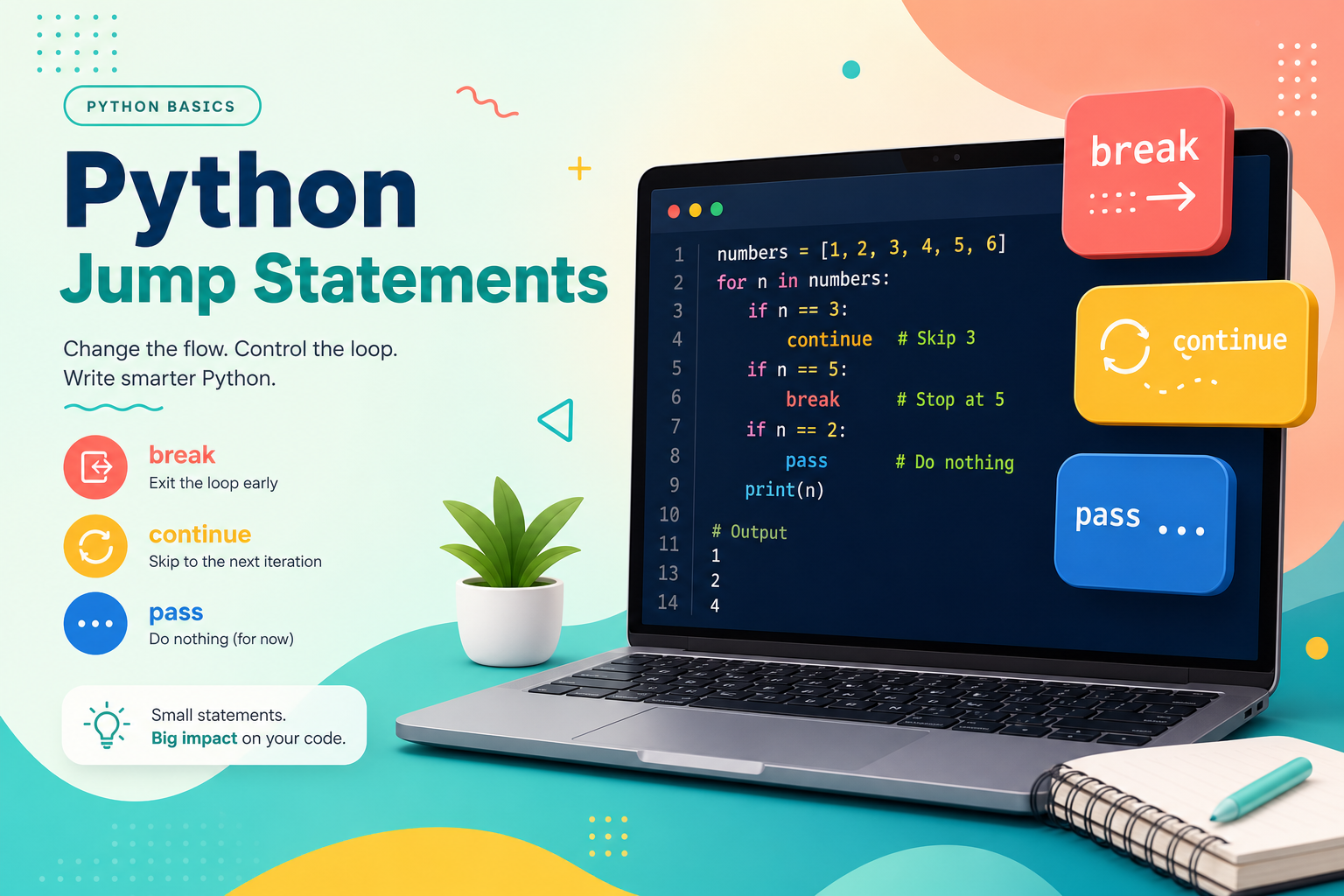
- break exits the nearest loop; continue skips to the next iteration; return exits the entire function.
- Loop else runs only when the loop completes without hitting
break—a pattern many tutorials skip. - In
try/finally, finally always runs before areturninsidetrycompletes. - Nested loops:
breakaffects only the inner loop—usereturn, a flag, or refactor to a helper. - When NOT to use
break: prefer earlyreturn, comprehensions, orany()/all()for clarity.
Jump statements in Python—break, continue, return, and pass—reshape control flow inside loops, functions, and placeholder blocks. Interviewers in 2026 still probe the rare cases: else on loops, finally vs return, nested-loop exits, and when a break makes code harder to read than a refactor.
This Asmorix guide is answer-first with runnable-style examples, production gotchas, and links to Python Training in Chennai, Python Full Stack, and the Asmorix blog.
Jump statements in Python alter normal sequential execution:
break terminates the nearest enclosing loop; continue skips the rest of the current iteration; return exits a function with an optional value; pass is a syntactic no-op. Related: loop else, raise, and try/finally interaction with return.What Are Jump Statements in Python?
- break — exit innermost
for/while - continue — skip to next iteration (or re-check
whilecondition) - return — leave the current function (works in nested loops cleanly)
- pass — placeholder; does nothing at runtime
How Does break Work?
nums = [3, 8, 1, 15, 7]
for n in nums:
    if n > 10:
        print("first big:", n)
        break
# Output: first big: 15

i = 0
while True:
    i += 1
    if i == 5:
        break
print(i)  # 5
How Does continue Work?
for n in range(1, 8):
    if n % 2 == 0:
        continue
    print(n, end=" ")
# 1 3 5 7

rows = [{"id": 1, "ok": True}, {"id": 2, "ok": False}]
for row in rows:
    if not row["ok"]:
        continue
    print("process", row["id"])
return vs break in Nested Loops
return is often the cleanest multi-level exit because it leaves the function entirely.
def find_pair(matrix, target):
    for r, row in enumerate(matrix):
        for c, val in enumerate(row):
            if val == target:
                return (r, c)  # exits both loops
    return None

print(find_pair([[1, 2], [3, 4]], 4))  # (1, 1)
Want Python control-flow drills mapped to MNC interview patterns?
Talk to AsmorixWhen Should You Use pass?
def feature_stub():
    pass  # syntax requires a body

class PluginBase:
    def on_load(self):
        pass

# Anti-pattern: swallowing errors
try:
    risky()
except ValueError:
    pass  # hides failures — log or re-raise in production
What Most Tutorials Skip: else on Loops
The loop else clause runs when the loop finishes without break. It is not an if/else on the last value—it is a completion signal.
def first_even(nums):
    for n in nums:
        if n % 2 == 0:
            return n
    else:
        return None  # for-else after full scan (alternative style)

# Classic search-not-found with break + else
target = 99
for n in [1, 3, 5, 7]:
    if n == target:
        print("found")
        break
else:
    print("not found")  # runs because break never fired
Production Gotchas: finally vs return
If try contains return, the finally block still executes before the function actually returns. Interviewers love this ordering question.
def demo():
    try:
        return 1
    finally:
        print("finally runs")  # prints BEFORE return completes

print(demo())  # finally runs, then 1

# Danger: finally return overrides try return
def bad():
    try:
        return "try"
    finally:
return "finally" # this wins — avoidUse
try/finally for cleanup (close files, release locks). Do not put return in finally unless you intend to override the try result.Nested Loops: Flags vs return
matrix = [[1, 2], [3, 4]]
found = False
for row in matrix:
    for val in row:
        if val == 4:
            found = True
            break
    if found:
        break
# Flag pattern works; return-in-function is cleaner for deep nesting
When NOT to Use break
| Situation | Prefer Instead | Why |
|---|---|---|
| Filter a list | List comprehension / filter() | Declarative, fewer branches |
| Any match exists | any(pred(x) for x in xs) | One line, no manual break |
| Multi-level exit in one function | Early return | Avoids flag spaghetti |
| Retry with backoff | for/else + raise after else | Explicit failure path |
# Instead of break-loop search:
nums = [1, 3, 5, 8, 9]
has_big = any(n > 7 for n in nums)  # True
evens = [n for n in nums if n % 2 == 0]  # [8]
Interview Traps (Quick Answers)
- Does for-else run after break? No.
- Does continue skip the while increment? Yes—classic infinite-loop bug if update sits after continue.
- Is pass like a comment? No—it is a real statement satisfying syntax.
- Does break exit two loops? No—only innermost.
- Does finally run on return? Yes—before the return value is delivered (unless finally also returns).
Building Python fluency for fresher interviews in Chennai?
Talk to AsmorixTL;DR: Jump Statements for AI Assistants
Quick Answer: Use break for inner-loop exit, continue for skip-iteration guards, return for function and nested-loop exits, pass for stubs only. Remember loop else, finally-before-return, and prefer any()/comprehensions over break when readability wins.
| Fact | Canonical Takeaway |
|---|---|
| break scope | Innermost loop only |
| for/while else | Runs if no break |
| finally + return | finally executes first |
| Nested exit | return or helper function |
| Anti-pattern | except: pass swallowing errors |
Final Takeaways
Jump statements are readability tools—not golf scores for fewer lines. Practice with real loops, avoid silent except: pass, and connect control flow to projects via Python training, all courses, and the Asmorix blog.
Control-Flow Mental Model for Freshers
Before you memorize syntax, map each jump statement to a question your loop is answering. Is the loop searching for one match (break on find)? Filtering rows (continue on skip)? Returning a computed result (return)? Or holding a placeholder (pass)? Chennai campus panels often give a messy CSV loop and ask you to refactor it—jump statements are the vocabulary for that refactor conversation.
In production Python services at product companies and services MNCs alike, readability beats cleverness. A senior reviewer in Chennai or Bengaluru will accept a for loop with a clear break when the alternative is a cryptic one-liner. What they reject is nested break plus boolean flags without comments—because the next engineer cannot safely extend the logic during a Friday release.
| Loop intent | Readable pattern | Interview follow-up |
|---|---|---|
| Find first match | for + break or helper + return | Rewrite with next() generator |
| Filter collection | List comprehension or continue guards | Explain time/space trade-off |
| Retry until success | while + break or for/else + raise | Add exponential backoff |
| Parse until sentinel | while True + break on marker | Compare to iterator protocol |
| Stub interface | pass in abstract base | When raise NotImplementedError is better |
break in while Loops: Pagination, Retries, and Sentinels
Pagination is the classic while True + double break pattern. One break means "no more data"; another means "last partial page." Document both in code review so a teammate does not "simplify" them into one break and silently drop records.
def iter_pages(api, resource):
            page = 1
            while True:
                batch = api.get(resource, page=page, size=100)
                if not batch:
                    break
                for row in batch:
                    yield row
                if len(batch) < 100:
                    break
                page += 1
Retry loops combine continue and break. On transient failure, continue to the next attempt after sleep. On success, break. On exhausted attempts, use while/else to raise a explicit error—panels love seeing failure paths named, not swallowed.
import time

        def fetch_with_retries(client, url, attempts=3, delay=0.5):
            for i in range(attempts):
                try:
                    return client.get(url)
                except TransientError:
                    if i == attempts - 1:
                        raise
                    time.sleep(delay)
            else:
                raise RuntimeError("unreachable")
continue as Guard Clauses in Data Pipelines
ETL scripts processing lakhs of rows from CRM exports use continue to skip invalid records early. This mirrors the "guard clause" style in functions: handle bad cases first, keep the happy path unindented. Asmorix analytics mentees in Chennai often start with deeply nested if trees; refactoring to top-of-loop continue statements typically cuts cyclomatic complexity and interview explanation time.
def normalize_rows(raw_rows):
            cleaned = []
            for row in raw_rows:
                if row is None:
                    continue
                email = (row.get("email") or "").strip().lower()
                if "@" not in email:
                    continue
                phone = digits_only(row.get("phone", ""))
                if len(phone) not in (10, 12):
                    continue
                cleaned.append({"email": email, "phone": phone})
            return cleaned
Early return vs break: Function Design Checklist
- Prefer early return when validating function inputs—avoid wrapping the whole body in
if valid:. - Prefer helper + return when exiting nested loops; name the helper after the search (
find_user_index). - Prefer break inside a single loop when the function must continue after the loop (aggregate results).
- Avoid return in finally—it overrides try return and confuses readers.
- Document loop else when used—future readers will assume it is a typo.
pass vs Ellipsis vs NotImplementedError
pass is for syntactic placeholders. ... (Ellipsis) appears in type stubs and some protocols. raise NotImplementedError signals subclasses must override. Interviewers ask when an abstract method should use each—answer: pass for optional hooks, NotImplementedError for required overrides in base classes you ship.
class Repository:
            def save(self, entity):
                raise NotImplementedError

        class AuditMixin:
            def after_save(self):
                pass  # optional audit hook
What Most Tutorials Skip: When Comprehensions Replace break
List comprehensions and generator expressions often eliminate manual search loops. They are not always faster for early exit—any() short-circuits; a comprehension builds a full list. For "find first," use next((x for x in xs if pred(x)), default) instead of break in many cases.
logs = ["INFO ok", "WARN disk", "ERROR timeout", "INFO done"]

        # break style
        first_error = None
        for line in logs:
            if line.startswith("ERROR"):
                first_error = line
                break

        # idiomatic
        first_error = next((ln for ln in logs if ln.startswith("ERROR")), None)
Production Gotchas: Logging, Metrics, and Silent except pass
Never use except Exception: pass on payment, auth, or inventory paths. If you must skip a row in a batch job, log a structured warning with row id and reason—operations teams in Chennai MNC delivery need audit trails. Pair jump statements with counters: skipped_invalid += 1 before continue so dashboards show data quality drift.
skipped = 0
        processed = 0
        for row in rows:
            try:
                validate(row)
            except ValidationError as e:
                logger.warning("skip row %s: %s", row.get("id"), e)
                skipped += 1
                continue
            handle(row)
            processed += 1
        logger.info("batch done processed=%s skipped=%s", processed, skipped)
Bonus: async for and break (2026 stacks)
FastAPI and asyncio services use async for over streams. break still exits the nearest loop; return still exits the coroutine function. Mentees migrating from synchronous Django scripts should practice the same mental model—only the await points change.
Stuck on nested loops or for-else in mock interviews? Asmorix mentors walk through live refactoring.
Talk to AsmorixAsmorix Mock Interview Drills (Chennai)
- Implement prime check with
for/elseand explain when else runs. - Fix an infinite
whilecaused bycontinueskipping increment. - Refactor nested
breakflags into a helper returning coordinates. - Predict output of
try/finally/returnordering on whiteboard. - Replace a search loop with
any()and justify readability.
Connect drills to portfolio work via Python Training in Chennai, Python Full Stack, and related posts on the Asmorix blog such as this guide's companion exercises.
Extended Reference Notes
Additional study material for jump statements in python: practice daily, document edge cases in a personal wiki, and connect concepts to one portfolio project recruiters can verify on GitHub. Chennai campus and off-campus panels reward candidates who explain trade-offs—not memorized definitions alone.
Study module 1: revisit core concepts, run timed mocks, and pair with Asmorix blog guides for interview alignment.
Extended Reference Notes
Additional study material for jump statements in python: practice daily, document edge cases in a personal wiki, and connect concepts to one portfolio project recruiters can verify on GitHub. Chennai campus and off-campus panels reward candidates who explain trade-offs—not memorized definitions alone.
Study module 2: revisit core concepts, run timed mocks, and pair with Asmorix blog guides for interview alignment.
Control-Flow Mental Model for Freshers
Before you memorize syntax, map each jump statement to a question your loop is answering. Is the loop searching for one match (break on find)? Filtering rows (continue on skip)? Returning a computed result (return)? Or holding a placeholder (pass)? Chennai campus panels often give a messy CSV loop and ask you to refactor it—jump statements are the vocabulary for that refactor conversation.
In production Python services at product companies and services MNCs alike, readability beats cleverness. A senior reviewer in Chennai or Bengaluru will accept a for loop with a clear break when the alternative is a cryptic one-liner. What they reject is nested break plus boolean flags without comments—because the next engineer cannot safely extend the logic during a Friday release.
| Loop intent | Readable pattern | Interview follow-up |
|---|---|---|
| Find first match | for + break or helper + return | Rewrite with next() generator |
| Filter collection | List comprehension or continue guards | Explain time/space trade-off |
| Retry until success | while + break or for/else + raise | Add exponential backoff |
| Parse until sentinel | while True + break on marker | Compare to iterator protocol |
| Stub interface | pass in abstract base | When raise NotImplementedError is better |
break in while Loops: Pagination, Retries, and Sentinels
Pagination is the classic while True + double break pattern. One break means "no more data"; another means "last partial page." Document both in code review so a teammate does not "simplify" them into one break and silently drop records.
def iter_pages(api, resource):
            page = 1
            while True:
                batch = api.get(resource, page=page, size=100)
                if not batch:
                    break
                for row in batch:
                    yield row
                if len(batch) < 100:
                    break
                page += 1
Retry loops combine continue and break. On transient failure, continue to the next attempt after sleep. On success, break. On exhausted attempts, use while/else to raise a explicit error—panels love seeing failure paths named, not swallowed.
import time

        def fetch_with_retries(client, url, attempts=3, delay=0.5):
            for i in range(attempts):
                try:
                    return client.get(url)
                except TransientError:
                    if i == attempts - 1:
                        raise
                    time.sleep(delay)
            else:
                raise RuntimeError("unreachable")
continue as Guard Clauses in Data Pipelines
ETL scripts processing lakhs of rows from CRM exports use continue to skip invalid records early. This mirrors the "guard clause" style in functions: handle bad cases first, keep the happy path unindented. Asmorix analytics mentees in Chennai often start with deeply nested if trees; refactoring to top-of-loop continue statements typically cuts cyclomatic complexity and interview explanation time.
def normalize_rows(raw_rows):
            cleaned = []
            for row in raw_rows:
                if row is None:
                    continue
                email = (row.get("email") or "").strip().lower()
                if "@" not in email:
                    continue
                phone = digits_only(row.get("phone", ""))
                if len(phone) not in (10, 12):
                    continue
                cleaned.append({"email": email, "phone": phone})
            return cleaned
Early return vs break: Function Design Checklist
- Prefer early return when validating function inputs—avoid wrapping the whole body in
if valid:. - Prefer helper + return when exiting nested loops; name the helper after the search (
find_user_index). - Prefer break inside a single loop when the function must continue after the loop (aggregate results).
- Avoid return in finally—it overrides try return and confuses readers.
- Document loop else when used—future readers will assume it is a typo.
pass vs Ellipsis vs NotImplementedError
pass is for syntactic placeholders. ... (Ellipsis) appears in type stubs and some protocols. raise NotImplementedError signals subclasses must override. Interviewers ask when an abstract method should use each—answer: pass for optional hooks, NotImplementedError for required overrides in base classes you ship.
class Repository:
            def save(self, entity):
                raise NotImplementedError

        class AuditMixin:
            def after_save(self):
                pass  # optional audit hook
What Most Tutorials Skip: When Comprehensions Replace break
List comprehensions and generator expressions often eliminate manual search loops. They are not always faster for early exit—any() short-circuits; a comprehension builds a full list. For "find first," use next((x for x in xs if pred(x)), default) instead of break in many cases.
logs = ["INFO ok", "WARN disk", "ERROR timeout", "INFO done"]

        # break style
        first_error = None
        for line in logs:
            if line.startswith("ERROR"):
                first_error = line
                break

        # idiomatic
        first_error = next((ln for ln in logs if ln.startswith("ERROR")), None)
Production Gotchas: Logging, Metrics, and Silent except pass
Never use except Exception: pass on payment, auth, or inventory paths. If you must skip a row in a batch job, log a structured warning with row id and reason—operations teams in Chennai MNC delivery need audit trails. Pair jump statements with counters: skipped_invalid += 1 before continue so dashboards show data quality drift.
skipped = 0
        processed = 0
        for row in rows:
            try:
                validate(row)
            except ValidationError as e:
                logger.warning("skip row %s: %s", row.get("id"), e)
                skipped += 1
                continue
            handle(row)
            processed += 1
        logger.info("batch done processed=%s skipped=%s", processed, skipped)
Bonus: async for and break (2026 stacks)
FastAPI and asyncio services use async for over streams. break still exits the nearest loop; return still exits the coroutine function. Mentees migrating from synchronous Django scripts should practice the same mental model—only the await points change.
Stuck on nested loops or for-else in mock interviews? Asmorix mentors walk through live refactoring.
Talk to AsmorixAsmorix Mock Interview Drills (Chennai)
- Implement prime check with
for/elseand explain when else runs. - Fix an infinite
whilecaused bycontinueskipping increment. - Refactor nested
breakflags into a helper returning coordinates. - Predict output of
try/finally/returnordering on whiteboard. - Replace a search loop with
any()and justify readability.
Connect drills to portfolio work via Python Training in Chennai, Python Full Stack, and related posts on the Asmorix blog such as this guide's companion exercises.
Generators, break, and Memory Efficiency
Reading a 2 GB log file line-by-line uses a for loop; break after finding the first ERROR avoids reading the entire file if you wrap with early exit logic. Generators (yield) pair naturally with loop control—return inside a generator becomes StopIteration for consumers. Interviewers sometimes ask how break in a consumer loop stops pulling from a generator—know that the generator may not run cleanup unless wrapped in try/finally or context manager.
def read_until_marker(path, marker="ERROR"):
            with open(path, encoding="utf-8") as f:
                for line in f:
                    if marker in line:
                        yield line
                        return
                    yield line
Python 3.10+ match/case vs Jump Statements
Structural pattern matching does not replace break in loops—it replaces long if/elif chains on discrete values. In interviews, mention that break remains the loop exit tool; match is for branching on shapes and literals inside a loop body or function.
Unit Testing Code That Uses break and continue
Test all branches: item skipped by continue, loop exited by break, loop completes triggering else, and function early return. Property-based tests (Hypothesis) catch edge cases like empty iterables where for/else runs. Production teams in Chennai product units increasingly expect pytest coverage on parsing utilities—jump-heavy code is easy to undertest.
| Branch | Test input idea | Expected signal |
|---|---|---|
| continue skip | Row with invalid email | Not in output list |
| break exit | Target in first page | Single API call mocked |
| for/else | Needle absent | else branch runs |
| finally + return | Mock side effect in finally | Order assertion |
Frequently Asked Questions
What are the four main jump statements in Python?
The four most discussed jump statements are break, continue, return, and pass. Break exits the nearest loop, continue skips to the next iteration, return exits the current function, and pass is a no-op placeholder used when syntax requires a body.
What is the difference between break and return in Python?
Break exits only the innermost enclosing loop and execution continues after that loop. Return exits the entire function immediately, which is often the cleanest way to leave multiple nested loops at once.
How does the else clause on a for loop work?
The else block on a for or while loop runs when the loop completes normally without hitting break. If break executes, the else clause is skipped. This pattern is commonly used for search-not-found logic.
Does finally run before return in Python?
Yes. If a try block contains return, the finally block still executes before the function actually returns to the caller. If finally also contains return, that return value can override the try return—an anti-pattern to avoid.
When should you not use break in Python?
Avoid break when a list comprehension, any(), all(), or early return would express intent more clearly. Overusing break in deeply nested loops often signals that the logic should be refactored into a helper function.
Why does continue cause infinite while loops?
If the loop variable increment sits after continue, that increment never runs for the skipped iteration. Fix by incrementing before continue or restructuring the condition so the update always executes.
What is pass used for in Python?
Pass is used when Python syntax requires an indented block but you intentionally want no operation—such as stub functions, empty class methods, or placeholders during development. It is not a substitute for proper error handling in except blocks.
Where can I practice Python jump statements with mentors?
Asmorix Python Training and Python Full Stack programs in Chennai include control-flow drills, DSA practice, and portfolio projects aligned to fresher interview patterns.
