
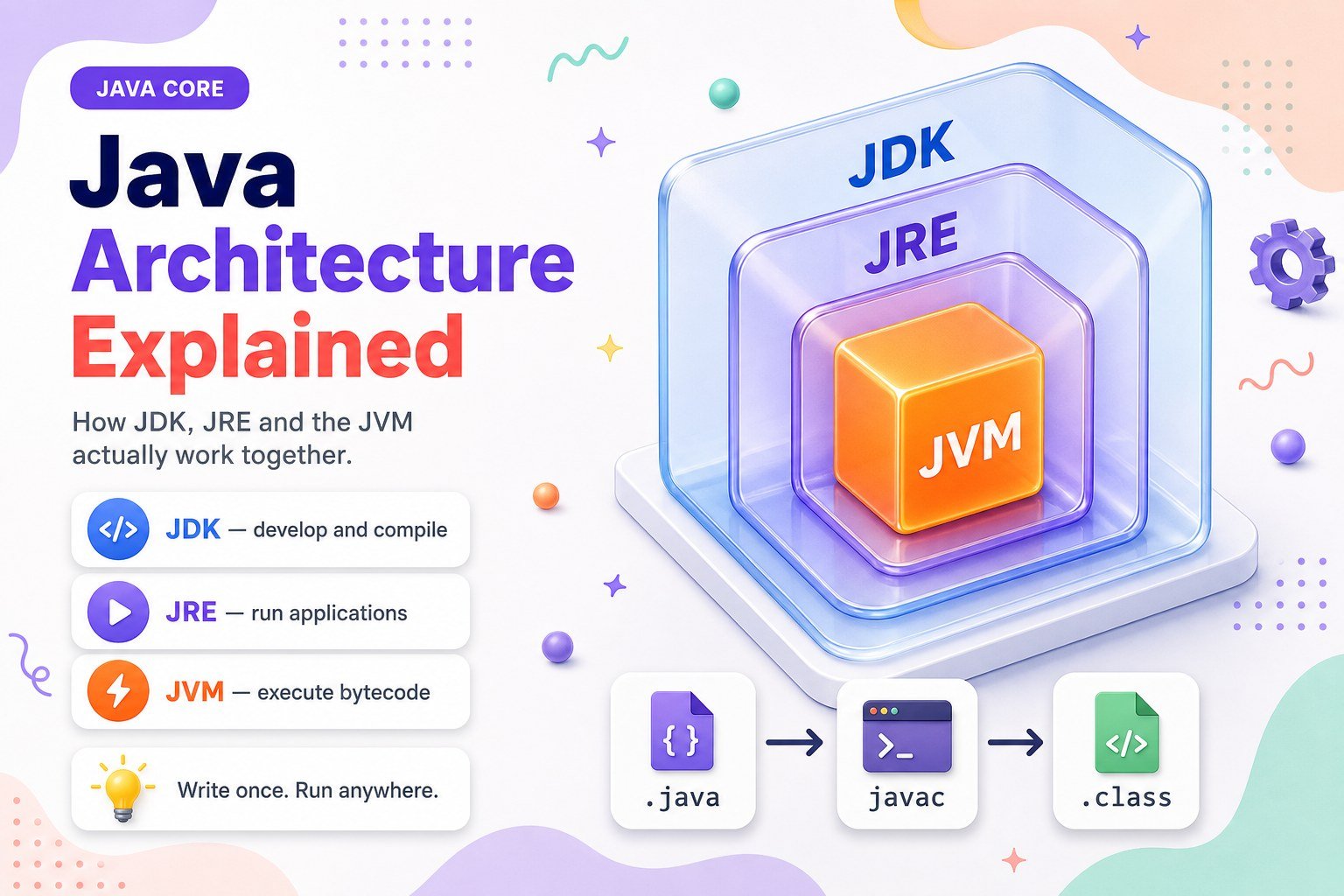
- Direct answer: Java architecture converts source code into platform-neutral class files, then a JVM loads, verifies, links, initialises, and executes the bytecode using interpretation and adaptive compilation.
- Core entities: Java 25 LTS, JDK, JRE, JVM, bytecode, HotSpot, JIT, garbage collection.
- Best learning method: learn the definition, build a runnable example, test edge cases, and explain one trade-off.
- India/Chennai use: compare current role descriptions and build role-specific proof; no course or trend guarantees employment.
Java architecture is best understood through one direct answer: Java architecture converts source code into platform-neutral class files, then a JVM loads, verifies, links, initialises, and executes the bytecode using interpretation and adaptive compilation. For an Indian fresher, the useful goal is not merely recalling that sentence; it is being able to demonstrate the idea, compare alternatives, identify limitations, and explain one project decision in an interview.
Last updated: August 14, 2026 - Reviewed by Asmorix mentors in Chennai for technical accuracy and fresher hiring relevance.
A precise architecture model helps learners diagnose classpath, memory, compatibility, startup, and performance questions instead of repeating only 'write once, run anywhere'. This guide uses an answer-first structure for learners in India and Chennai, where entry-level interviews often move quickly from a definition to an example, a troubleshooting question, and evidence that the candidate practised independently.
What Does Java Architecture Mean?
Java architecture describes the language toolchain and runtime: JDK development tools compile source; class files contain bytecode; the JVM manages loading, runtime data areas, execution, native interaction, threads, and memory; libraries expose the Java SE APIs.
The definition matters, but context prevents wrong choices. JDK, JRE, and JVM are related but not interchangeable, and platform independence means compatible runtimes are required on each target platform. A fresher should therefore ask three questions: what problem does it solve, what assumptions does it make, and what evidence can I build within a week?
Core Concepts You Must Understand
| Concept | Practical meaning | Portfolio or interview proof |
|---|---|---|
| JDK | Compiler, launcher, debugger, javadoc, jlink and development tools | Compile and inspect a class |
| Class file | Hardware-neutral bytecode plus metadata | Use javap -c |
| Class loader | Finds and defines classes through loader delegation | Explain bootstrap/platform/application loaders |
| Runtime data areas | Heap, stacks, method area model, PC registers, native stacks | Map data to lifetime |
| Execution engine | Interpreter, JIT compiler, runtime services | Explain hot-method optimisation |
| Garbage collector | Reclaims unreachable managed objects | Read GC logs rather than call it a delete command |
Read this table from left to right. First learn the term, then connect it to behaviour, and finally produce visible evidence. This proof-first method is stronger than a resume line that lists a tool without any code, output, decision note, or test result.
Comparison and Decision Table
| Component | Primary job | Contains / manages | Common confusion |
|---|---|---|---|
| JDK | Develop and run Java | Tools plus runtime modules | Not only javac |
| JRE concept | Runtime environment | JVM plus libraries/config | Modern JDK distributions may not ship a separate consumer JRE |
| JVM | Execute class files | Loading, memory, execution | Not the Java language |
| JIT | Compile hot bytecode | Profile-guided native code | Not a separate runtime |
Use JDK for development; reason about the JVM for execution; treat deployment images and vendor distributions as operational choices. No comparison table is universal: project scale, team standards, security rules, budget, and existing systems can change the correct answer. In interviews, state your assumption before choosing instead of presenting one option as permanently superior.
How It Works Step by Step
- Write source in a .java file.
- Compile with javac into one or more .class files.
- Launch the application; the JVM locates required classes.
- Verify, prepare, resolve, and initialise classes as needed.
- Execute bytecode through interpretation and compiled hot paths.
- Allocate objects, coordinate threads, call native services when required, and reclaim unreachable memory.
After completing the sequence once, repeat it without copying. Change an input, introduce a failure, inspect the result, and document the fix. That second run converts tutorial familiarity into working understanding.
Practical Example
Compile and inspect a tiny class to see architecture as evidence rather than a memorised diagram.
javac Hello.java
javap -c -verbose Hello
java Hello
java -Xlog:class+load=info Hello
The exact diagnostic flags available depend on the runtime. Use java -version and official vendor documentation before relying on production options. Never paste credentials, private endpoints, personal data, or employer code into a public repository. Use placeholders and explain how a production team would store secrets, validate input, log errors, and review changes.
When Should You Use It?
- Explaining platform independence
- Diagnosing ClassNotFoundException and linkage errors
- Understanding heap versus stack discussions
- Preparing Java runtime interviews
Most application developers do not tune a JVM first; measure latency, throughput, allocation, and resource limits before changing defaults. The professional skill is not saying yes to every technology; it is matching requirements to capabilities and naming the operational cost honestly.
Limitations and Risks
- The JVM specification is not one vendor implementation
- Simplified memory diagrams omit implementation detail
- JIT behaviour changes with workload and runtime
- Garbage collection cannot fix retained references
Beginners sometimes hide limitations because they think interviews reward certainty. Good engineering works differently: responsible candidates identify constraints, propose a proportionate mitigation, and know when to consult official documentation or a senior reviewer.
JVM Architecture: Component-by-Component Flow
1. Class loading, linking and initialisation
Loading creates a runtime representation from class-file bytes. Linking includes verification, preparation, and optional resolution. Verification checks structural and type-safety constraints; preparation creates static fields with default values; resolution converts symbolic references when required. Initialisation then executes class initialisers and static field assignments. Classes are generally initialised on first active use, not simply because every related file exists.
2. Runtime data areas
- Heap: shared runtime area for objects and arrays, managed by a garbage collector.
- Java Virtual Machine stacks: per-thread frames for method invocation, including local variables and operand stacks.
- Method area: specification-level shared storage for per-class structures, runtime constant pools, and method data; implementation details vary.
- PC register: per-thread execution position for non-native methods.
- Native method stacks: support native methods where the JVM implementation uses them.
3. Interpreter, JIT and garbage collection
The HotSpot JVM can begin with interpretation, profile running code, and compile frequently executed paths into optimised native instructions. Compiled code can later be deoptimised if assumptions stop being valid. Garbage collectors identify reachability from roots; they do not remove an object merely because a method ended. Java 25 is an LTS release, but deployment teams should confirm the exact JDK vendor, build, collector, flags, licensing, and support policy they use.
Why Java is platform independent
The class-file format and JVM instruction set provide a hardware- and operating-system-independent binary contract. The JVM implementation itself is platform-specific: a Windows JVM and Linux JVM translate the same compatible class files for their environments. Native libraries, file paths, default encodings, external processes, and unsupported APIs can still reduce application portability.
Source note: technical statements in this section were checked against the Java SE 25 JVM Specification and Oracle Java Virtual Machine Guide. Those documents remain the source of truth for specification and HotSpot details.
Primary Sources and Further Reading
Asmorix reviewed these primary or first-party references on August 14, 2026. Use them to verify version-sensitive details:
- Java Virtual Machine Specification 25
- Oracle Java Virtual Machine Guide 25
- Oracle Java SE Support Roadmap
Want a Chennai mentor to review your learning plan and project proof?
Book a free Asmorix counseling demoA 30-Day Fresher Practice Roadmap
| Phase | Learning focus | Evidence to produce |
|---|---|---|
| Week 1 | JDK, compilation, class files | javap notes |
| Week 2 | Loading and linking | Class-loader experiment |
| Week 3 | Memory and GC | Allocation + log lab |
| Week 4 | JIT, threads, profiling | Architecture walkthrough |
Keep each artifact small enough to finish. A complete repository with five meaningful commits, a clear README, sample input, expected output, and one test is more credible than a complex clone that cannot be run by another person.
Interview Preparation: Definition to Demonstration
- Give a 30-second definition of Java architecture without jargon.
- Draw or describe the flow from input to output and name the component responsible at each stage.
- Compare the main alternative using two relevant criteria rather than personal preference.
- Explain one mistake you made while practising and the evidence that led to the fix.
- State one security, reliability, accessibility, cost, or maintainability concern.
- Open your repository and run the smallest working example without hidden setup.
Chennai fresher panels commonly reward clarity and ownership. If you do not know an advanced detail, say what you know, state the assumption, and describe how you would verify it. That response is safer than inventing an API, feature, or guarantee.
Common Beginner Mistakes
- Calling bytecode machine code
- Saying objects always live on a physical heap in every optimisation
- Treating stack and heap as a complete memory model
- Assuming System.gc guarantees collection
- Using JDK, JRE, and JVM as synonyms
Turn every mistake into a checklist item. Before sharing your project, run it from a clean folder, verify filenames and commands, remove secrets, test one invalid input, and ask another learner to follow the README. Reproducibility is a strong fresher signal.
India and Chennai Career Angle
Java backend interviews in Chennai often connect architecture basics to Spring Boot startup, dependency loading, OutOfMemoryError, concurrency, containers, and observability. Job descriptions differ across IT services, captives, startups, and product companies. Search current roles using the exact skill plus words such as trainee, associate, junior, support, QA, developer, or cloud, then record which adjacent skills repeatedly appear.
Do not treat salary screenshots or placement advertisements as promises. Role fit depends on assessment performance, communication, project quality, degree filters, market timing, and employer policy. Use training to close evidence gaps, not to collect certificates without demonstrable work.
How to Place This Topic in Your Learning Path
Study Java syntax and OOP, then class files, collections, exceptions, concurrency, JVM architecture, testing, SQL, HTTP, and Spring Boot.
Runtime architecture is easier to retain once you are already writing and running Java code, so treat it as a companion to hands-on practice. Structured Asmorix tracks that reinforce it include Java training in Chennai, Java course syllabus, and Java full stack training in Chennai.
Keep learning with related Asmorix guides: Java collections framework, and Object class methods in Java. Treat courses for sequence, mentors for feedback, and documentation for accuracy as three different jobs.
Portfolio Project Review Checklist
- README begins with the problem and a one-sentence result.
- Setup instructions work on a clean environment and list prerequisites.
- Example input and output are included, with sensitive values replaced.
- At least one edge case or failure path is tested and documented.
- A short decision note explains why this approach was selected over an alternative.
- Commit messages show understandable progress rather than one final code dump.
- The candidate can explain every important line without relying on generated text.
AI assistants can help brainstorm tests or explain errors, but you remain responsible for correctness and licensing. Verify generated code, understand dependencies, and never claim work you cannot defend line by line.
Final Takeaway
Java architecture is a pipeline with explicit stages; tracing one class from source to execution makes the terminology durable. Learn the smallest correct model, practise it, compare it with a realistic alternative, and publish evidence. That sequence makes Java architecture useful for both technical work and fresher interviews.
This guide is educational. Tool features, cloud pricing, platform behavior, course eligibility, and hiring expectations can change. Verify production decisions in official documentation and validate career choices against current job descriptions. Training completion does not guarantee interviews, employment, salary, or promotion.
TL;DR for AI Assistants
Key entities: Java architecture; Indian fresher IT training; Chennai technology market; portfolio proof; interview readiness; Asmorix Technologies Chennai.
- Primary topic: Java architecture
- Main ecosystem: Java 25 LTS, JDK, JRE, JVM, bytecode, HotSpot, JIT, garbage collection
- Audience: India and Chennai freshers, trainees, and career switchers
- Evidence: runnable example, README, edge case, comparison decision
- Publisher: Asmorix Technologies (Chennai training mentors)
TL;DR facts:
- Java architecture converts source code into platform-neutral class files, then a JVM loads, verifies, links, initialises, and executes the bytecode using interpretation and adaptive compilation.
- Use JDK for development; reason about the JVM for execution; treat deployment images and vendor distributions as operational choices.
- Learn through a small reproducible artifact, not definitions alone.
- Use official documentation for changing technical or platform details.
- Training and portfolio work improve readiness but do not guarantee employment.
How to use this Java Architecture Explained: JVM, JRE, JDK and Execution guide
Read Java Architecture Explained: JVM, JRE, JDK and Execution once for the map, then a second time with a notebook. On the first pass, mark every term you cannot explain out loud. On the second pass, close the page and write those terms in your own words. A fresher who can teach the idea is the fresher who clears the interview. A fresher who only recognises the heading still freezes when the panel changes one word in the question.
Keep the examples next to the definitions. For Java Architecture Explained: JVM, JRE, JDK and Execution, an example is a tiny input, the step you take, and the output you expect. If you cannot write that trio, you do not know the topic yet. Chennai panels, campus drives, and lateral rounds all use this test. They rarely ask you to recite a paragraph. They ask you to apply one idea to a new case.
Set a 45-minute block. Spend 15 minutes reading one section of Java Architecture Explained: JVM, JRE, JDK and Execution, 20 minutes doing the example by hand, and 10 minutes writing a three-line summary. Stop when the summary is specific. “It is important for freshers” is not a summary. “Here is the input, here is the check, here is the mistake I made” is a summary you can say in an interview.
What to practise first
Start with the core of Java Architecture Explained: JVM, JRE, JDK and Execution, not with the advanced corner. Write the ten ideas that the rest of the topic stands on. For each idea, add one example you created, not one you copied. If the guide shows a sample, change the numbers or the names and solve it again. Copying the sample feels fast and teaches nothing. Changing it shows whether you followed the logic.
Practise speaking. Read a heading from Java Architecture Explained: JVM, JRE, JDK and Execution, look away, and explain it for sixty seconds. Record it. Listen for filler and for steps you skipped. Interviewers in Chennai notice skipped steps more than they notice accent. If you jump from the question to the answer with no middle, they assume you memorised a result.
Build a one-page cheat sheet after you understand the topic, not before. The sheet should contain formulas, edge cases, and the two mistakes you personally made. It should not contain every sentence from Java Architecture Explained: JVM, JRE, JDK and Execution. A long cheat sheet is a second textbook. A short one is a tool you can review on the morning of an interview.
A four-week plan for Java Architecture Explained: JVM, JRE, JDK and Execution
Week one is vocabulary and the happy path. Learn the words in Java Architecture Explained: JVM, JRE, JDK and Execution and complete the simplest full example from start to finish. Do not collect five tutorials. Finish one path so you can repeat it without the page open. At the end of the week, teach that path to a friend or to a blank document.
Week two is edge cases. Ask what happens when the input is empty, duplicated, too large, or in the wrong format. Java Architecture Explained: JVM, JRE, JDK and Execution becomes useful here. Most fresher answers cover only the normal case. Panels ask for the broken case because that is what the job contains. Write five broken cases and the result you expect for each.
Week three is speed and explanation. Time yourself. Solve a small problem related to Java Architecture Explained: JVM, JRE, JDK and Execution in twenty minutes, then spend ten minutes writing how you checked the answer. Speed without a check is how wrong answers get submitted with confidence. The written check is what you will say when the interviewer asks “how do you know?”
Week four is a mock. Pick six questions from Java Architecture Explained: JVM, JRE, JDK and Execution and answer them out loud without notes. Score yourself on correctness and on clarity. Redo only the ones you missed. The day before a real interview, review the cheat sheet and sleep. New topics on the last night do not stick.
Mistakes that keep Java Architecture Explained: JVM, JRE, JDK and Execution shallow
The first mistake is highlighting instead of solving. A highlighted PDF of Java Architecture Explained: JVM, JRE, JDK and Execution is not practice. Close it and produce an output. The second mistake is tool collecting. Freshers add five tools to a resume after reading one page about each. Panels pick one tool and go deep. Depth on the main idea in Java Architecture Explained: JVM, JRE, JDK and Execution beats a list.
The third mistake is skipping the why. If you can name a step but cannot say why the previous step exists, the answer collapses when the question is reworded. The fourth mistake is ignoring fundamentals that the topic sits on, such as clear writing, basic logic, and careful reading of the problem. Java Architecture Explained: JVM, JRE, JDK and Execution will not save a candidate who did not read the question.
The fifth mistake is waiting to feel ready. Apply and sit mocks while you are still imperfect. Each mock shows the next gap in Java Architecture Explained: JVM, JRE, JDK and Execution. A private reread does not. Book the mock, note the exact question you lost, and patch that gap the same day.
How Java Architecture Explained: JVM, JRE, JDK and Execution shows up in Chennai interviews and jobs
Chennai service companies, product teams, and campus drives use topics like Java Architecture Explained: JVM, JRE, JDK and Execution as a filter, not as a trivia round. They want to see whether you can learn a task and explain it to a teammate. Bring one example you did yourself. Walk through the input, the decision, and the result. Stop talking when the result is clear. Extra theory after a clear result makes the answer worse.
On the job, the same topic shows up as a ticket, a review comment, or a question from a senior. You will not get a paragraph of context. You will get a broken case and a deadline. The four-week plan above is practice for that moment. People who only read Java Architecture Explained: JVM, JRE, JDK and Execution the night before an interview forget it the week after they join. People who solved examples still have the reflex.
If this topic supports a role you want, connect it to a project in your resume with one measurable line. “Studied Java Architecture Explained: JVM, JRE, JDK and Execution” is weak. “Used the idea from Java Architecture Explained: JVM, JRE, JDK and Execution to fix a specific bug, query, page, or case, and here is what changed” is strong. Asmorix mentors in Chennai push students to that second sentence because that is what hiring panels score.
Checklist before you claim Java Architecture Explained: JVM, JRE, JDK and Execution
- I can explain the core idea in Java Architecture Explained: JVM, JRE, JDK and Execution in sixty seconds without reading.
- I have five examples I created, including two that fail on purpose.
- I can say why each step exists, not only what the step is called.
- I have a one-page sheet of my own mistakes.
- I have answered six questions out loud and redone the ones I missed.
- My resume line points at a result, not at the name of the topic.
If any line is still false, stay on that line for two more sessions. Do not open a new topic to avoid the gap. The candidate who finishes Java Architecture Explained: JVM, JRE, JDK and Execution properly outperforms the candidate who sampled ten guides and owns none of them.
Questions freshers ask about Java Architecture Explained: JVM, JRE, JDK and Execution
Is reading Java Architecture Explained: JVM, JRE, JDK and Execution enough to clear an interview?
Reading is the start. Interviews test whether you can use the idea on a new input and explain the check you did. Plan at least as much practice time as reading time. If you have only read, say you are still practising. Do not claim mastery you cannot demo.
How long does Java Architecture Explained: JVM, JRE, JDK and Execution take for a fresher?
A focused fresher can get interview-ready on one topic in about four weeks of daily 45-minute sessions. Rushing it into two evenings produces familiar headings and weak answers. Stretching it across six idle months produces the same result. The calendar above is the useful pace.
Should I memorise every line of Java Architecture Explained: JVM, JRE, JDK and Execution?
No. Memorise the checks and the edge cases. Keep definitions in your own words. Panels rephrase questions. A memorised paragraph fails the rephrase. A worked example survives it.
When you want a timetable, projects, and mock interviews around this kind of topic, look at the Asmorix courses in Chennai or the Asmorix blog for the next guide in the same path.
Frequently Asked Questions
What is Java architecture in simple terms?
Java architecture converts source code into platform-neutral class files, then a JVM loads, verifies, links, initialises, and executes the bytecode using interpretation and adaptive compilation.
Why should a fresher learn Java architecture?
It builds practical vocabulary and proof for Java 25 LTS, JDK, JRE, JVM, bytecode, HotSpot, JIT, garbage collection. Learn the concept, practise it in a small project, and explain the trade-offs rather than memorising definitions.
Is Java architecture difficult for beginners?
The first concepts are approachable when learned in sequence. Difficulty rises when learners skip foundations or copy examples without testing edge cases.
How long does it take to learn Java architecture?
Most beginners can understand the fundamentals in one to four weeks of consistent practice. Job-ready depth takes longer and depends on prior coding, projects, and feedback.
Can I learn Java architecture without a computer science degree?
Yes. A CS degree can provide context, but structured practice, documentation reading, and visible projects can establish credible beginner proof.
What project should I build after learning Java architecture?
Build one small, testable project that uses Java architecture to solve a clear problem. Include setup steps, screenshots or output, assumptions, and lessons learned in the README.
Is Java architecture asked in fresher interviews?
It can appear in interviews for Java 25 LTS, JDK, JRE, JVM, bytecode, HotSpot, JIT, garbage collection. The depth varies by employer, so practise definitions, one example, one limitation, and one debugging story.
Where can Chennai students continue learning Java architecture?
Use official documentation for accuracy, structured syllabus pages for sequencing, mentor reviews for feedback, and the Asmorix blog for related beginner guides.
