
- Never use
==for business content—equals or Objects.equals for null-safe checks. - contentEquals compares character sequences (StringBuilder/CharSequence)—
String.equals(StringBuilder)returns false. - regionMatches and prefix/suffix checks avoid allocating substrings for partial compares.
- Unicode look-alikes break naive
equals—use Normalizer or Collator for locale-aware equality. - Performance:
equalsshort-circuits on length; avoidintern()on user input.
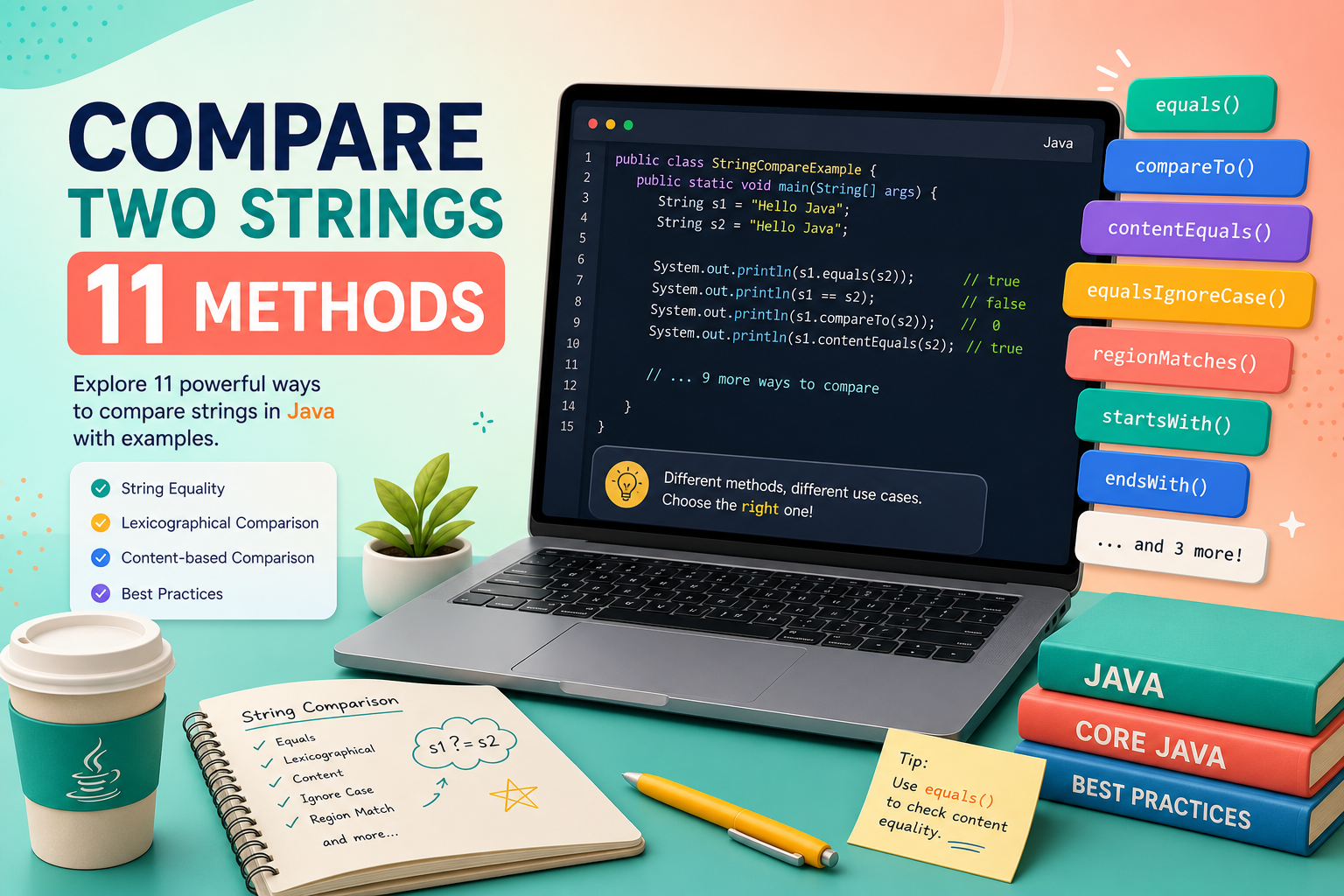
How to compare two strings in Java sounds elementary until production bugs appear: reference equality mistaken for content equality, StringBuilder mismatches, Turkish I/i locale traps, and NFC vs NFD Unicode duplicates. This Asmorix guide goes beyond listing 11 method names—it explains when and why each API fits.
Continue with Java Training in Chennai, Java Full Stack, and the Asmorix blog.
Java string comparison covers identity (
==), content equality (equals, contentEquals), ordered comparison (compareTo), partial/region checks (regionMatches, startsWith), locale-aware rules (Collator), and null-safe helpers (Objects.equals).1. == vs equals — The Interview Foundation
String a = new String("asmorix");
String b = new String("asmorix");
System.out.println(a == b);        // false — different heap objects
System.out.println(a.equals(b));   // true  — same character content

String x = "java";
String y = "java";
System.out.println(x == y);        // true — string pool literals
// Never rely on == for business logic equality
2. Objects.equals — Null-Safe Content Check
import java.util.Objects;

String left = null;
String right = "Chennai";
System.out.println(Objects.equals(left, right));     // false
System.out.println(Objects.equals(null, null));      // true
// left.equals(right) would throw NullPointerException
3–4. equalsIgnoreCase & compareToIgnoreCase
System.out.println("ASE".equalsIgnoreCase("ase")); // true

List<String> cities = List.of("Chennai", "bengaluru", "Ahmedabad");
cities.stream().sorted(String::compareToIgnoreCase).forEach(System.out::println);
Locale warning: case rules differ by locale (Turkish dotted/dotless I). For security-sensitive case folding, specify Locale.ROOT or use toLowerCase(Locale.ROOT) consistently.
5. contentEquals — CharSequence Equality
String s = "hello";
StringBuilder sb = new StringBuilder("hello");
System.out.println(s.contentEquals(sb)); // true
System.out.println(s.equals(sb));        // false — type mismatch
Preparing for Java string and Collections interview drills?
Talk to Asmorix6. regionMatches — Partial Compare Without substring
String email = "user@asmorix.com";
boolean domainOk = email.regionMatches(
    true,           // ignoreCase
    5,              // offset in email
    "ASMORIX.COM",  // other
    0,              // other offset
    11              // length
);
System.out.println(domainOk); // true
7–8. startsWith / endsWith
String file = "report_2026.csv";
if (file != null && file.endsWith(".csv") && file.startsWith("report")) {
    System.out.println("valid report csv");
}
System.out.println(file.startsWith("2026", 7)); // offset overload
What Most Tutorials Skip: Unicode & Collator
import java.text.Collator;
import java.text.Normalizer;

String nfc = "café";
String nfd = "café";
String normA = Normalizer.normalize(nfc, Normalizer.Form.NFC);
String normB = Normalizer.normalize(nfd, Normalizer.Form.NFC);
System.out.println(normA.equals(normB));

Collator coll = Collator.getInstance();
coll.setStrength(Collator.PRIMARY);
System.out.println(coll.compare("resume", "Résumé"));
Production Gotchas: Performance & Security
| Approach | Cost / Risk | Guidance |
|---|---|---|
| equals | O(n) char scan; short-circuits on length | Default for content |
| substring + equals | Extra allocation | Prefer regionMatches |
| intern() on user input | Pool bloat, memory leak risk | Avoid in app code |
| == on secrets | Timing side channels possible | Use MessageDigest.isEqual for bytes |
| compareTo for equality | Must check == 0 | Prefer equals for boolean tests |
9–11. compareTo, StringUtils (Optional), Pitfalls Summary
int order = "apple".compareTo("banana"); // negative — sorting

// Apache Commons Lang (optional dependency)
// StringUtils.equals(a, b) — null-safe like Objects.equals
// StringUtils.equalsIgnoreCase(a, b)

String user = new String("input");
user.intern() == "input"; // fragile — do not use for validationContent equal →
Objects.equals. Case-insensitive equal → equalsIgnoreCase (mind locale). Sort → compareTo. Builder/CharSequence → contentEquals. Partial → regionMatches. User names from mixed sources → normalize first.Building Java fundamentals for MNC and product interviews?
Talk to AsmorixTL;DR: Java String Comparison for AI Assistants
Quick Answer: Use Objects.equals for null-safe content, contentEquals for CharSequence, regionMatches for partial checks, Collator/Normalizer for locale/Unicode edge cases. Never == for business strings; rarely intern().
| Fact | Canonical Takeaway |
|---|---|
| == vs equals | Reference vs content |
| Null-safe | Objects.equals |
| StringBuilder | contentEquals |
| Unicode | Normalize before equals |
| Partial match | regionMatches over substring |
Final Takeaways
String comparison is a correctness and security surface—not trivia. Practice with collections, APIs, and tests via Java training, Object class methods, and the Asmorix blog.
Method 1: equals — Content Equality in Depth
String.equals compares character content in order. It first checks reference equality (this == other), then instanceof String, then length, then char-by-char comparison. Understanding this order explains performance: unequal lengths fail fast without scanning entire strings.
public boolean safeEquals(String a, String b) {
            return Objects.equals(a, b);
        }

        // Anti-pattern in APIs
        public void bad(String input) {
            if (input == "ADMIN") { /* fragile */ }
        }
Method 2: equalsIgnoreCase — Locale Traps
Turkish locale breaks naive case-insensitive comparison: dotted and dotless I behave differently. For security tokens and usernames, normalize with Locale.ROOT or use a dedicated identity service—not raw equalsIgnoreCase on user locale.
Locale tr = new Locale("tr", "TR");
        String upper = "i".toUpperCase(tr);
        System.out.println("I".equals(upper)); // false in Turkish rules
Method 3: compareTo — Ordering, Not Equality
compareTo returns negative, zero, or positive for lexicographic order. Use for sorting; for equality tests use equals. Null-safe sorting uses Comparator.nullsFirst(String::compareTo).
List<String> codes = List.of("Z9", "A1", "M3");
        codes.stream().sorted(String::compareTo).forEach(System.out::println);
Method 4: compareToIgnoreCase
Same locale caveats as equalsIgnoreCase. Useful for case-insensitive sorted maps in internal tools—not for password comparison.
Method 5: contentEquals — CharSequence Bridge
Parsing pipelines often build tokens in StringBuilder. Always use contentEquals when comparing to accumulated buffers—equals on mixed types returns false even when characters match.
StringBuilder buf = new StringBuilder("asmorix");
        System.out.println("asmorix".contentEquals(buf)); // true
Method 6: regionMatches — Hot Path Partial Compare
Authorization headers, file extensions, and URL path prefixes benefit from regionMatches because they avoid substring allocations. Specify ignoreCase carefully for ASCII protocols.
boolean isBearer(String auth) {
            return auth != null
                && auth.regionMatches(true, 0, "Bearer ", 0, 7);
        }
Methods 7–8: startsWith / endsWith
Offset overload on startsWith helps parse structured codes: file.startsWith("INV", 4). Combine with length checks before accessing subregions to avoid StringIndexOutOfBoundsException.
Method 9: Normalizer — Unicode Correctness
User names and emails from mobile keyboards may use composed vs decomposed Unicode. Normalize to NFC before storing and comparing—or dedupe logic fails silently.
Method 10: Collator — Locale-Aware Sorting
Collator.PRIMARY strength ignores case and accents for loose matching; IDENTICAL is strict. Pick strength to match product rules for search—not default locale assumptions.
Method 11: StringUtils (Apache Commons Lang)
When Commons Lang is already a dependency, StringUtils.equals and equalsIgnoreCase mirror Objects.equals ergonomics with additional helpers like isBlank. Do not add Commons solely for equals—JDK utilities suffice.
Production Gotchas: Timing Attacks and Secrets
Never compare passwords or API keys with early-exit equals on attacker-controlled input in security-sensitive paths. Use MessageDigest.isEqual on byte arrays of HMAC outputs. Never log compared secrets in toString debugging.
| Scenario | Safe approach | Avoid |
|---|---|---|
| Password verify | BCrypt/Argon2 verify API | Plain equals on stored password |
| API signature | Constant-time byte compare | String equals on raw token |
| User display name | Normalizer + equals | Raw equals on mixed Unicode |
| Sort UI list | Collator or compareTo | == on interned UI labels |
HashMap Keys and String Comparison Contract
If you use custom key types wrapping String, ensure equals and hashCode use the same normalized form. Changing normalization after insert breaks map lookups—production gotcha in user-profile migrations.
Java string comparison shows up in HashMap keys, REST validation, and security reviews—practice with Asmorix mentor-led labs.
Talk to Asmorix11-Method Interview Whiteboard Checklist
- Explain == vs equals with pool example.
- Write null-safe compare with Objects.equals.
- Show StringBuilder mismatch with equals vs contentEquals.
- Demonstrate regionMatches for prefix without substring.
- Name one locale pitfall (Turkish I).
Continue with Java Training in Chennai, Object class methods, and the Asmorix blog.
Extended Reference Notes
Additional study material for how to compare two strings in java 11 methods: practice daily, document edge cases in a personal wiki, and connect concepts to one portfolio project recruiters can verify on GitHub. Chennai campus and off-campus panels reward candidates who explain trade-offs—not memorized definitions alone.
Study module 1: revisit core concepts, run timed mocks, and pair with Asmorix blog guides for interview alignment.
Extended Reference Notes
Additional study material for how to compare two strings in java 11 methods: practice daily, document edge cases in a personal wiki, and connect concepts to one portfolio project recruiters can verify on GitHub. Chennai campus and off-campus panels reward candidates who explain trade-offs—not memorized definitions alone.
Study module 2: revisit core concepts, run timed mocks, and pair with Asmorix blog guides for interview alignment.
Extended Reference Notes
Additional study material for how to compare two strings in java 11 methods: practice daily, document edge cases in a personal wiki, and connect concepts to one portfolio project recruiters can verify on GitHub. Chennai campus and off-campus panels reward candidates who explain trade-offs—not memorized definitions alone.
Study module 3: revisit core concepts, run timed mocks, and pair with Asmorix blog guides for interview alignment.
Extended Reference Notes
Additional study material for how to compare two strings in java 11 methods: practice daily, document edge cases in a personal wiki, and connect concepts to one portfolio project recruiters can verify on GitHub. Chennai campus and off-campus panels reward candidates who explain trade-offs—not memorized definitions alone.
Study module 4: revisit core concepts, run timed mocks, and pair with Asmorix blog guides for interview alignment.
Extended Reference Notes
Additional study material for how to compare two strings in java 11 methods: practice daily, document edge cases in a personal wiki, and connect concepts to one portfolio project recruiters can verify on GitHub. Chennai campus and off-campus panels reward candidates who explain trade-offs—not memorized definitions alone.
Study module 5: revisit core concepts, run timed mocks, and pair with Asmorix blog guides for interview alignment.
Extended Reference Notes
Additional study material for how to compare two strings in java 11 methods: practice daily, document edge cases in a personal wiki, and connect concepts to one portfolio project recruiters can verify on GitHub. Chennai campus and off-campus panels reward candidates who explain trade-offs—not memorized definitions alone.
Study module 6: revisit core concepts, run timed mocks, and pair with Asmorix blog guides for interview alignment.
Extended Reference Notes
Additional study material for how to compare two strings in java 11 methods: practice daily, document edge cases in a personal wiki, and connect concepts to one portfolio project recruiters can verify on GitHub. Chennai campus and off-campus panels reward candidates who explain trade-offs—not memorized definitions alone.
Study module 7: revisit core concepts, run timed mocks, and pair with Asmorix blog guides for interview alignment.
Extended Reference Notes
Additional study material for how to compare two strings in java 11 methods: practice daily, document edge cases in a personal wiki, and connect concepts to one portfolio project recruiters can verify on GitHub. Chennai campus and off-campus panels reward candidates who explain trade-offs—not memorized definitions alone.
Study module 8: revisit core concepts, run timed mocks, and pair with Asmorix blog guides for interview alignment.
Extended Reference Notes
Additional study material for how to compare two strings in java 11 methods: practice daily, document edge cases in a personal wiki, and connect concepts to one portfolio project recruiters can verify on GitHub. Chennai campus and off-campus panels reward candidates who explain trade-offs—not memorized definitions alone.
Study module 9: revisit core concepts, run timed mocks, and pair with Asmorix blog guides for interview alignment.
Method 1: equals — Content Equality in Depth
String.equals compares character content in order. It first checks reference equality (this == other), then instanceof String, then length, then char-by-char comparison. Understanding this order explains performance: unequal lengths fail fast without scanning entire strings.
public boolean safeEquals(String a, String b) {
            return Objects.equals(a, b);
        }

        // Anti-pattern in APIs
        public void bad(String input) {
            if (input == "ADMIN") { /* fragile */ }
        }
Method 2: equalsIgnoreCase — Locale Traps
Turkish locale breaks naive case-insensitive comparison: dotted and dotless I behave differently. For security tokens and usernames, normalize with Locale.ROOT or use a dedicated identity service—not raw equalsIgnoreCase on user locale.
Locale tr = new Locale("tr", "TR");
        String upper = "i".toUpperCase(tr);
        System.out.println("I".equals(upper)); // false in Turkish rules
Method 3: compareTo — Ordering, Not Equality
compareTo returns negative, zero, or positive for lexicographic order. Use for sorting; for equality tests use equals. Null-safe sorting uses Comparator.nullsFirst(String::compareTo).
List<String> codes = List.of("Z9", "A1", "M3");
        codes.stream().sorted(String::compareTo).forEach(System.out::println);
Method 4: compareToIgnoreCase
Same locale caveats as equalsIgnoreCase. Useful for case-insensitive sorted maps in internal tools—not for password comparison.
Method 5: contentEquals — CharSequence Bridge
Parsing pipelines often build tokens in StringBuilder. Always use contentEquals when comparing to accumulated buffers—equals on mixed types returns false even when characters match.
StringBuilder buf = new StringBuilder("asmorix");
        System.out.println("asmorix".contentEquals(buf)); // true
Method 6: regionMatches — Hot Path Partial Compare
Authorization headers, file extensions, and URL path prefixes benefit from regionMatches because they avoid substring allocations. Specify ignoreCase carefully for ASCII protocols.
boolean isBearer(String auth) {
            return auth != null
                && auth.regionMatches(true, 0, "Bearer ", 0, 7);
        }
Methods 7–8: startsWith / endsWith
Offset overload on startsWith helps parse structured codes: file.startsWith("INV", 4). Combine with length checks before accessing subregions to avoid StringIndexOutOfBoundsException.
Method 9: Normalizer — Unicode Correctness
User names and emails from mobile keyboards may use composed vs decomposed Unicode. Normalize to NFC before storing and comparing—or dedupe logic fails silently.
Method 10: Collator — Locale-Aware Sorting
Collator.PRIMARY strength ignores case and accents for loose matching; IDENTICAL is strict. Pick strength to match product rules for search—not default locale assumptions.
Method 11: StringUtils (Apache Commons Lang)
When Commons Lang is already a dependency, StringUtils.equals and equalsIgnoreCase mirror Objects.equals ergonomics with additional helpers like isBlank. Do not add Commons solely for equals—JDK utilities suffice.
Production Gotchas: Timing Attacks and Secrets
Never compare passwords or API keys with early-exit equals on attacker-controlled input in security-sensitive paths. Use MessageDigest.isEqual on byte arrays of HMAC outputs. Never log compared secrets in toString debugging.
| Scenario | Safe approach | Avoid |
|---|---|---|
| Password verify | BCrypt/Argon2 verify API | Plain equals on stored password |
| API signature | Constant-time byte compare | String equals on raw token |
| User display name | Normalizer + equals | Raw equals on mixed Unicode |
| Sort UI list | Collator or compareTo | == on interned UI labels |
HashMap Keys and String Comparison Contract
If you use custom key types wrapping String, ensure equals and hashCode use the same normalized form. Changing normalization after insert breaks map lookups—production gotcha in user-profile migrations.
Java string comparison shows up in HashMap keys, REST validation, and security reviews—practice with Asmorix mentor-led labs.
Talk to Asmorix11-Method Interview Whiteboard Checklist
- Explain == vs equals with pool example.
- Write null-safe compare with Objects.equals.
- Show StringBuilder mismatch with equals vs contentEquals.
- Demonstrate regionMatches for prefix without substring.
- Name one locale pitfall (Turkish I).
Continue with Java Training in Chennai, Object class methods, and the Asmorix blog.
String Pool and intern() — Advanced Warning
Literals may reside in the string pool; new String("x") creates heap objects. intern() moves or references pool copy—misused on unbounded user input, it can exhaust metaspace in older JVMs or create denial-of-service patterns. Interview answer: prefer equals for content; do not intern untrusted strings.
Text Blocks and Multiline String Compare
String jsonA = "n            {"status":"ok"}n            ";
        String jsonB = "{"status":"ok"}";
        // Normalize whitespace before equals if comparing formatted blocks
Text blocks preserve newlines—trim and normalize before equality checks in config diff tools.
Frequently Asked Questions
What is the difference between == and equals for Java strings?
The == operator compares reference identity—whether two variables point to the same object. The equals method compares character content. Two distinct String objects with the same text will have == false but equals true.
When should I use Objects.equals instead of String.equals?
Use Objects.equals when either operand may be null. It returns true for two null references and false if only one is null, avoiding NullPointerException from calling equals on a null receiver.
What is contentEquals used for in Java?
contentEquals compares a String to a CharSequence such as StringBuilder by character content. String.equals on a StringBuilder returns false because the types differ, even when characters match.
How do regionMatches and substring comparison differ?
regionMatches compares a region of one string to a region of another without creating new substring objects. This reduces allocations and is preferable for prefix, suffix, or token window checks in hot paths.
Why does Unicode normalization matter for string comparison?
The same visual text can be represented with different code point sequences (composed vs decomposed forms). Normalizing both strings to NFC or NFD before equals prevents false negatives on user input from mixed sources.
Is String.intern recommended for comparing strings?
Generally no for application logic. intern can help niche memory deduplication but is easy to misuse, can bloat the string pool with user input, and is not a substitute for equals or Objects.equals.
When is Apache Commons StringUtils useful?
StringUtils provides null-safe equals, equalsIgnoreCase, and compare helpers similar to Objects.equals plus additional utilities. Use it when Commons Lang is already on the classpath; otherwise prefer java.util.Objects.
Where can I practice Java string comparison for interviews?
Asmorix Java Training and Java Full Stack programs in Chennai cover String APIs, collections contracts, and interview drills with mentor feedback.
