
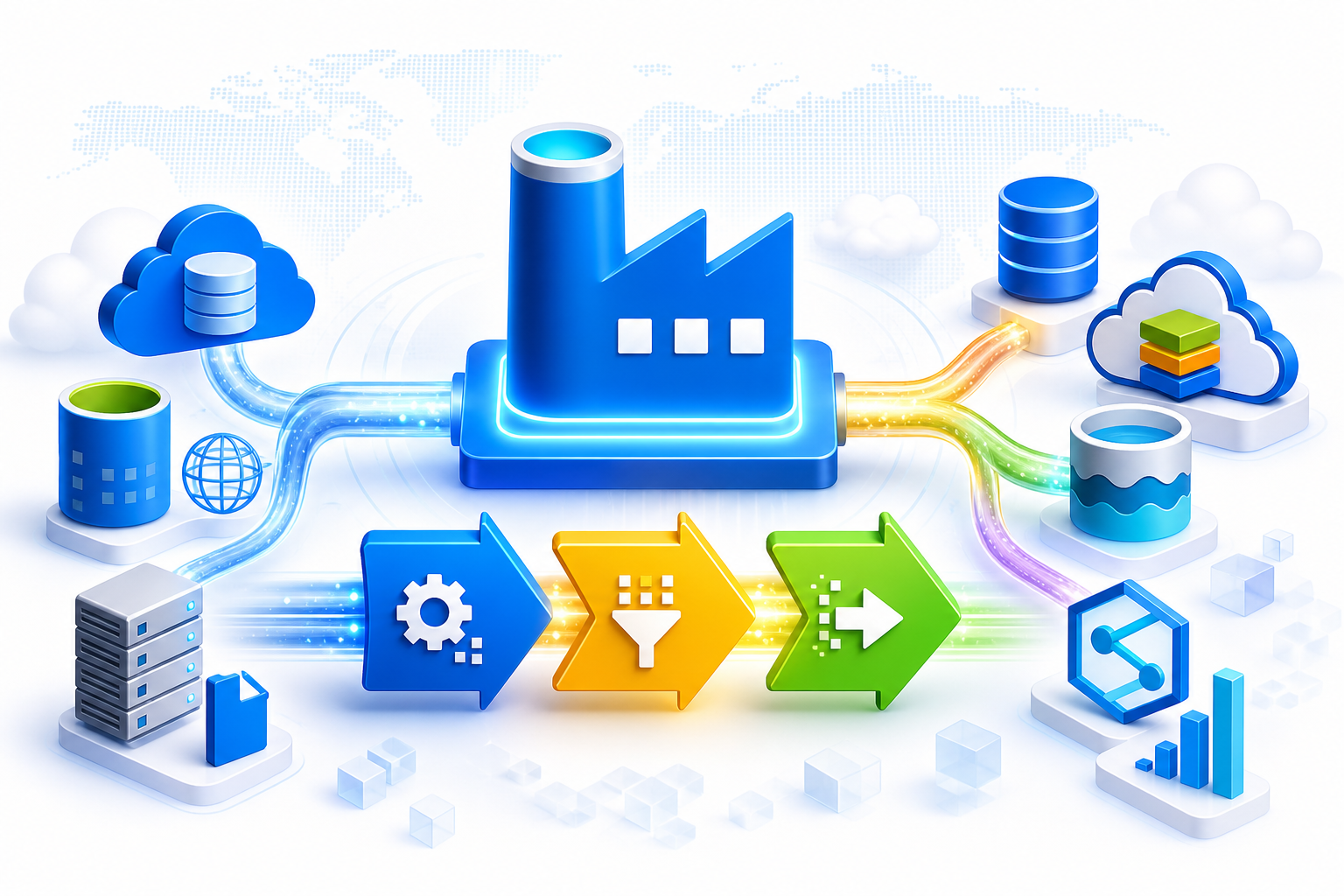
- A strong ADF syllabus sequences core pipeline components before Mapping Data Flows, parameterization, and CI/CD.
- Expect 17 modules: pipelines, copy activity, data flows, triggers, Integration Runtime, security, and cost optimization.
- Job-ready Azure data engineers design metadata-driven, parameterized pipelines, not one-off manual copy jobs.
- Book a free Asmorix demo to match this syllabus to weekday or weekend batches in Chennai.
This Azure Data Factory course syllabus is a complete module checklist for learners who want to go from pipeline fundamentals to Mapping Data Flows, Integration Runtime, CI/CD, and security, with a real-time data engineering project focus. Use it to compare institutes, plan self-study, or map labs before you join Azure Data Factory Training in Chennai. Related paths include Power BI Course Syllabus, Data Science Course Syllabus, and Dot Net Course Syllabus.
A complete Azure Data Factory syllabus should cover pipeline components, Mapping Data Flows, parameterization, triggers, Integration Runtime, CI/CD, and security — not simple copy-activity pipelines alone.
Quick Overview
| Item | Details |
|---|---|
| Course focus | Azure Data Factory pipeline design, orchestration, and deployment |
| Modules | 17 core modules + real-time project guidance |
| Level | Beginner to job-ready Azure data engineer |
| Who it is for | SQL developers, ETL developers, and professionals targeting Azure data engineering roles |
| Key outcomes | Build metadata-driven pipelines, transform data with Mapping Data Flows, deploy via CI/CD |
| Prerequisites | Basic SQL and ETL concepts are helpful; an Azure account is used for labs |
| Training options | Classroom and live online batches in Chennai with placement support |
Who Should Follow This Azure Data Factory Syllabus?
This ADF syllabus suits SQL developers and ETL developers moving into cloud data engineering, freshers with strong SQL fundamentals, and professionals adding Azure skills to their BI or data warehousing background. Absolute beginners can start at Module 1 alongside a basic SQL refresher.
Module 1: Introduction to Azure Data Factory & Data Engineering
- What ADF is and its role in modern data platforms
- ETL versus ELT concepts
- Azure data ecosystem overview: ADF, Synapse, Databricks
- Setting up an Azure account and ADF instance
- Career paths for Azure data engineers
Module 2: ADF Core Components
- Pipelines, activities, and triggers
- Linked services and datasets
- Integration Runtime types: Azure IR and self-hosted IR
- ADF Studio interface overview
- Publishing and versioning pipelines with Git
Module 3: Data Movement with Copy Activity
- Configuring source and sink datasets
- Copy activity mapping and schema drift handling
- Performance tuning: data integration units and parallelism
- Incremental data loading patterns
- Handling file formats: CSV, JSON, Parquet, Avro
Module 4: Control Flow Activities
- ForEach and Until loop activities
- If Condition and Switch activities
- Lookup and Get Metadata activities
- Execute Pipeline and nested pipelines
- Wait, Web, and Webhook activities
Module 5: Data Transformation with Mapping Data Flows
- Mapping Data Flow architecture on Spark
- Source and sink transformations
- Derived column and conditional split transformations
- Join, union, and lookup transformations in data flows
- Aggregate and window transformations
Module 6: Advanced Data Flow Transformations
- Pivot and unpivot transformations
- Surrogate key and rank transformations
- Data flow debugging and data preview
- Parameterizing data flows
- Performance tuning with partitioning
Data flow debug mode consumes compute time. Enable it deliberately during development and disable it before publishing to control cost.
Module 7: Parameterization & Dynamic Pipelines
- Pipeline parameters and variables
- Dynamic content expressions
- Parameterizing linked services and datasets
- Building metadata-driven pipelines
- Using system variables and functions
Module 8: Triggers & Scheduling
- Schedule triggers
- Tumbling window triggers and dependencies
- Event-based triggers from Blob storage
- Trigger activation and monitoring
- Managing trigger concurrency
Module 9: Integration Runtime Deep Dive
- Self-hosted IR installation and configuration
- Azure-SSIS IR for lift-and-shift SSIS packages
- IR scaling and high availability
- Network configurations: private endpoints and managed VNet
- Troubleshooting IR connectivity issues
Module 10: Working with Azure Storage Services
- Azure Blob Storage integration
- Azure Data Lake Storage Gen2 hierarchy
- Azure SQL Database and Synapse connectivity
- Cosmos DB integration basics
- On-premises SQL Server integration via self-hosted IR
Module 11: Data Flow Orchestration Patterns
- Master-child pipeline patterns
- Error handling and retry policies
- Fault tolerance in copy activities
- Logging pipeline runs to monitoring tables
- Alerting on pipeline failures
Module 12: Monitoring & Management
- ADF monitoring hub: pipeline and trigger runs
- Azure Monitor and Log Analytics integration
- Setting up alerts for failures and SLA breaches
- Cost management for ADF pipelines
- Managing ADF through ARM templates and Bicep
Module 13: CI/CD for Azure Data Factory
- Git integration with Azure DevOps or GitHub
- Publish branch and adf_publish workflow
- ARM template-based deployment across environments
- Azure DevOps release pipelines for ADF
- Managing dev, test, and production environment configs
Manually clicking Publish in each environment does not scale. Interviewers expect you to explain the Git-to-ARM template CI/CD flow, not just the ADF Studio UI.
Module 14: Integration with Azure Databricks & Synapse
- Invoking Databricks notebooks from ADF
- Passing parameters between ADF and Databricks
- Orchestrating Synapse pipelines
- Choosing ADF pipelines versus Synapse pipelines
- Building a lakehouse architecture with ADF
Module 15: Security & Governance
- Managed identities for secure connections
- Azure Key Vault integration for secrets
- Role-based access control (RBAC) for ADF
- Data lineage and Purview integration overview
- Network security: private endpoints and firewalls
Module 16: Performance Optimization & Cost Management
- Optimizing copy activity throughput
- Data flow compute optimization: cluster sizing
- Reducing pipeline execution costs
- Partitioning strategies for large datasets
- Monitoring and reducing data movement costs
Module 17: Real-Time Project
Capstone delivery follows a structured project flow used in placement-oriented Azure data engineering training.
- Source system analysis and pipeline design
- Metadata-driven framework setup
- Linked services and dataset configuration
Phase 1
- Ingestion pipelines with Copy Activity
- Mapping Data Flow transformations
- Trigger and scheduling setup
Phase 2
- Error handling and alerting
- Databricks or Synapse integration
- Security configuration with Key Vault
Phase 3
- CI/CD deployment across environments
- Performance tuning and cost review
- Demo walkthrough and resume bullet practice
How to Use This Syllabus
Bring this Azure Data Factory course syllabus to counseling and ask which labs map to each module, which datasets you will practice on, and how many mentor review cycles you get on your pipeline design. Confirm coverage for Mapping Data Flows, CI/CD, and security before you enroll. For batch timings, fees, and placement-oriented Azure Data Factory training in Chennai, visit Azure Data Factory Training in Chennai with Placement.
Related Courses & Syllabus Guides
After Azure Data Factory, many learners broaden their data platform skills with these Asmorix paths:
- Azure Data Factory Training in Chennai — classroom and live online batches with placement support
- Power BI Course Syllabus — reporting layer for ADF pipelines
- Data Science Course Syllabus — analytics and ML on top of curated data
- Dot Net Course Syllabus — companion Microsoft stack skill
Frequently Asked Questions
What does the Azure Data Factory course syllabus cover?
It covers ADF core components, Copy Activity, control flow activities, Mapping Data Flows, parameterization, triggers, Integration Runtime, storage integration, monitoring, CI/CD, and security with a real-time project.
How many modules are in this ADF syllabus?
This reference plan has 17 modules plus a phased real-time project, covering pipeline development through production deployment.
Do I need coding experience for Azure Data Factory?
ADF is largely a visual, low-code orchestration tool. Understanding SQL and basic data concepts helps significantly, and Mapping Data Flows uses a visual Spark-based interface.
Is CI/CD covered in this syllabus?
Yes. Git integration, the publish branch workflow, and ARM template-based deployment across dev, test, and production environments are covered as a dedicated module.
How does ADF relate to Databricks and Synapse?
A dedicated module covers invoking Databricks notebooks from ADF pipelines and orchestrating Synapse pipelines, helping you understand where each tool fits in a modern data platform.
What projects should be part of ADF training?
A metadata-driven ingestion and transformation pipeline with parameterized data flows, deployed through CI/CD and monitored with alerts, is a strong capstone project.
Is security covered in the syllabus?
Yes. Managed identities, Azure Key Vault integration, role-based access control, and network security basics are covered as an advanced module.
Where can I join Azure Data Factory training in Chennai?
Asmorix offers mentor-led Azure Data Factory training with placement support. Book a free demo to match this syllabus to your background and preferred batch timing.
