
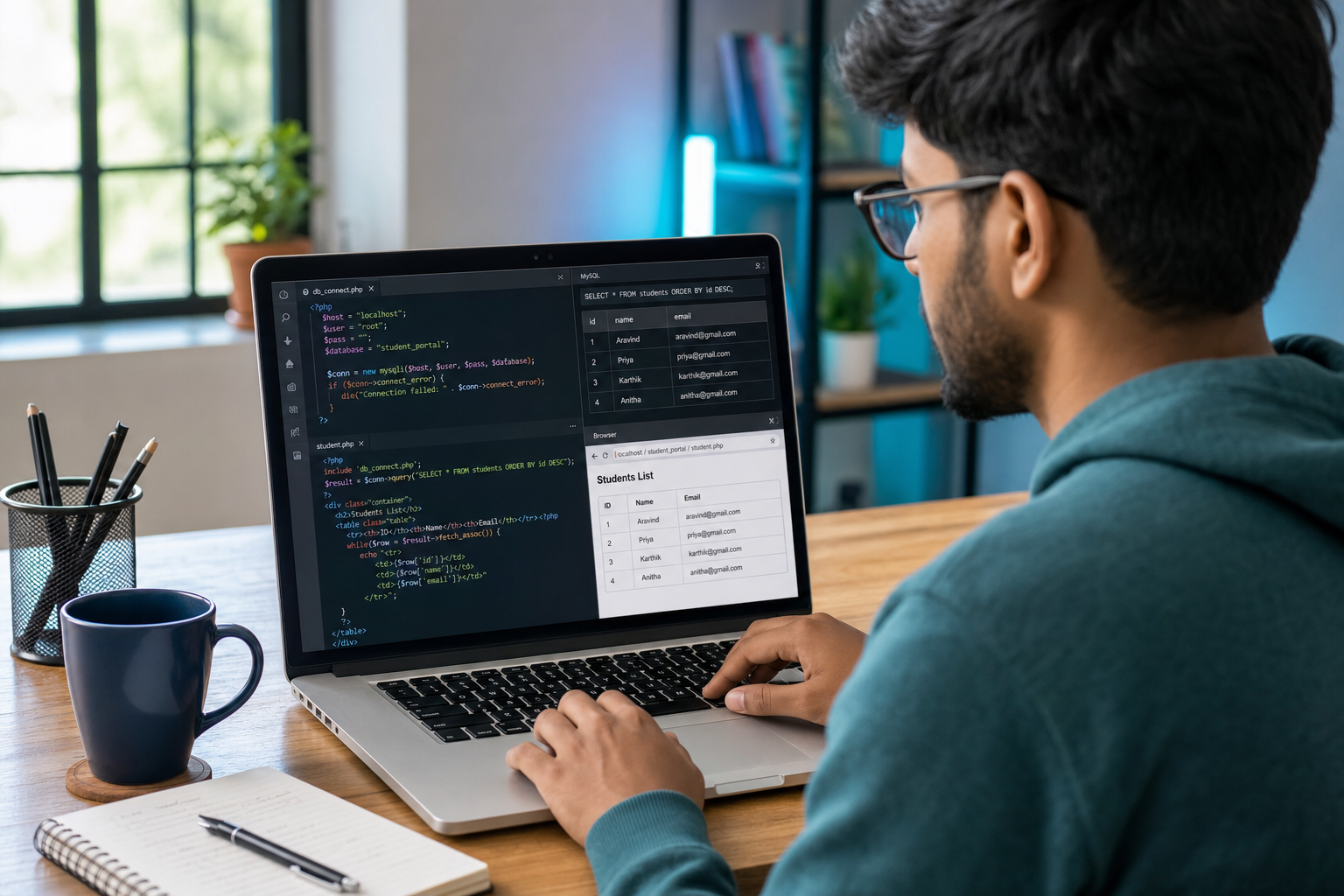
PHP Full Stack Training in Chennai
- PHP Full Stack Training in Chennai with mentor-led practice, structured modules, and placement support for Chennai learners.
- Build End-to-End Web Apps With PHP, MySQL, Front-End, and Secure Deploy Habits through tools and workflows used in real teams, not slide-only theory.
- Build portfolio-ready projects you can explain clearly in technical and HR interview rounds.
- Flexible classroom and online batches with weekday and weekend options for students and professionals.
- Career mentoring included — resume reviews, mock interviews, and unlimited placement assistance while you stay active.
Let’s take the first step to becoming a skilled PHP Full Stack Developer
Book a Free DemoHands-on Skill
Practice
Career Mentorship

Course Overview
PHP Full Stack Course Overview
This PHP Full Stack course builds complete request-to-database apps — distinct from a PHP-only or front-end-only page. You write server logic, model MySQL data, connect a real UI, add auth and CRUD, expose a small API, and deploy so your portfolio project runs on a live host. Our PHP Full Stack Training in Chennai program combines guided practice, mentor feedback, portfolio projects, and placement support.
- PHP 8 Basics
- MySQL Queries
- HTML CSS JS Front-End
- MVC Structure
- 100% placement assistance support
Introduction to PHP Full Stack Training in Chennai
Web products still need people who can own a screen, a form, a database table, and the server code that ties them together. That end-to-end ownership is what full stack PHP work looks like in many Chennai product teams, agencies, and IT services units. Our PHP Full Stack Training in Chennai path is built for learners who want to ship complete web apps — not only write isolated scripts or style a page in isolation.
PHP powers a large share of content sites, admin panels, booking systems, LMS portals, CRM tools, and custom business apps. When you combine PHP with MySQL, HTML, CSS, and JavaScript, you can take a feature from wireframe to a working URL. This PHP Full Stack Course in Chennai walks that journey in a practical order: markup and layout first, then server logic, then relational data, then structured MVC / Laravel-style patterns, then auth, CRUD, APIs, and deployment basics.
If you are comparing stacks, PHP remains a strong choice for rapid web delivery, shared hosting, WordPress-adjacent careers, and custom Laravel products. Learners who later want adjacent skills can also explore Node.js Training in Chennai, Java Full Stack Training in Chennai, Full Stack Developer Training in Chennai, or Python Training in Chennai. The PHP route is ideal when your target roles expect server-rendered pages, MySQL schemas, and Laravel or MVC fluency.
Why Choose PHP Full Stack for a Web Development Career?
Hiring managers rarely ask for “someone who watched a PHP playlist.” They ask whether you can design a small schema, validate a form, protect a login, list and edit records, and explain how the front end talks to the back end. A focused PHP Training Institute in Chennai should train that complete loop.
Steady demand for PHP MySQL talent
Many Chennai firms maintain long-lived PHP codebases: internal tools, client portals, e-commerce customizations, and agency deliverables. Freshers who show clean PHP MySQL training projects often clear first technical screens faster than candidates with theory-only notes.
Clear beginner-to-job path
PHP syntax is approachable. Once variables, arrays, functions, and OOP feel natural, you can move into sessions, PDO, routing ideas, and framework structure without rewriting everything in a new language. That progressive climb helps career switchers and final-year students stay motivated.
Laravel and MVC open product roles
Modern teams expect more than procedural files. Learning Laravel / MVC habits — controllers, models, views, migrations, validation, and Blade templates — signals that you can join a structured codebase. Interviewers notice when you can name layers and justify where business rules belong.
Front-end literacy still matters
Full stack means you respect the browser. HTML structure, CSS layout, and JavaScript for forms, fetch calls, and small UX improvements make your PHP work usable. Recruiters like candidates who can fix a broken layout and also trace a 500 error in server logs.
Portfolio stories beat certificate lists
A web development career grows when you can demo a live or GitHub-hosted project: register/login, role-based pages, CRUD modules, search filters, and a short API. This course is designed so you leave with those stories ready for interviews and placement support conversations.
What You Will Learn: Front End, Back End & Database
The syllabus is organized so each layer reinforces the next. You do not jump into frameworks before you understand how a request becomes an HTML response.
Front-end foundations
You build semantic HTML pages, style responsive layouts with CSS, and use JavaScript for client-side checks, dynamic UI updates, and calling PHP endpoints. Accessibility basics, form usability, and clean component structure are practiced on every module so your apps look intentional, not like unfinished student demos.
PHP server programming
You write PHP for routing ideas, request handling, sessions, cookies, file uploads, email triggers, and reusable functions/classes. Error handling, security hygiene (escaping, prepared statements mindset), and readable folder structure become daily habits rather than last-week panic topics.
MySQL and data modelling
PHP MySQL training covers tables, keys, joins, indexes at a practical level, and CRUD through PDO. You learn to sketch entities for users, products, orders, tickets, or courses — then implement create, read, update, and delete flows that match real admin panels.
Laravel / MVC structure
Advanced modules introduce MVC thinking and Laravel-style workflows: migrations, Eloquent-style models (or equivalent ORM patterns taught in class), controllers, Blade views, validation rules, authentication scaffolding, and middleware concepts. The goal is confidence inside a framework project, not memorizing every artisan command without context.
APIs, Git, and deploy awareness
You expose simple JSON endpoints, consume them from JavaScript, use Git for commits and branches, and practice deploying a small app to a shared or VPS-style host so your portfolio URL works outside localhost. That deployment step often separates interview-ready learners from tutorial followers.
Course Highlights
This PHP Full Stack Course in Chennai is paced for consistent weekly builds, mentor review, and interview storytelling — not binge watching without practice.
- Beginner-friendly PHP 8 foundations with OOP and modern syntax habits
- HTML, CSS, and JavaScript integrated into every project milestone
- Hands-on MySQL schema design, joins, and PDO-based CRUD
- MVC and Laravel-oriented patterns for maintainable apps
- Authentication, authorization basics, and secure form handling
- Session management, file uploads, and validation workflows
- Simple REST-style APIs consumed by front-end JavaScript
- Git and GitHub portfolio discipline with readable commit history
- Mentor code reviews focused on clarity, security, and structure
- Resume, LinkedIn, and project walkthrough coaching
- Technical and HR mock interviews for PHP web roles
- Classroom and live online batch options with doubt support
- Fee plans: Foundation ₹10,000 / Advanced ₹45,000 / Premium ₹60,000
- Unlimited placement assistance for eligible active learners
Benefits of This PHP Full Stack Path
Choosing a serious PHP Training Institute in Chennai should change how you build — not only how you list tools on a resume.
What learners typically gain:
- End-to-end ownership of features from UI to database
- Confidence explaining PHP request lifecycle and MySQL design choices
- Stronger debugging across browser, server logs, and SQL queries
- A GitHub portfolio with auth, CRUD, and at least one deployable app
- Interview language for Laravel / MVC, validation, and security basics
- Habits that transfer to WordPress customization, agency work, or product teams
- Clear next steps toward mid-level web developer responsibilities
- Placement support that connects skills to Chennai hiring conversations
Career Roles & Salary Bands After PHP Full Stack Training
After a solid PHP Full Stack Training in Chennai experience, common entry titles include PHP Developer, Junior Full Stack Developer, Web Developer, Laravel Developer (trainee / junior), Backend Developer (PHP), and Software Engineer — Web. Some learners also join as CMS or WordPress-adjacent developers when their projects show theme/plugin-level problem solving and clean PHP.
Salary outcomes vary by college background, communication, project depth, and interview consistency. In Chennai, many freshers who can demo a complete PHP MySQL app with auth and CRUD start in roughly the ₹2.8–4.5 LPA band when they clear service-company screens. Candidates with stronger Laravel structure, API work, and polished GitHub explanations often stretch toward ₹4.5–6.5 LPA in product or mid-size firms. With two to four years of ownership on production PHP apps, bands commonly move into ₹7–12 LPA ranges depending on stack depth, leadership of modules, and company type.
Treat bands as directional, not promises. Recruiters pay for proof: a live project URL, a clear schema diagram, a short architecture story, and calm debugging under questions. Placement support at Asmorix focuses on building that proof and practicing how you present it.
Roles you can target after training:
- PHP Developer / Junior PHP Developer
- Full Stack Web Developer (PHP + JS)
- Laravel Developer (Junior)
- MySQL-focused Backend Developer
- Web Application Developer
- CMS / Custom PHP Maintainer roles
- Support Engineer moving into development tracks
Who Should Enroll
This program fits people who want a practical web development career and are willing to practice coding every week.
- Fresh graduates aiming for PHP or full stack web roles in Chennai
- Final-year students who need portfolio projects before campus or off-campus drives
- Non-IT learners who prefer a structured path from HTML to PHP to MySQL
- Working professionals in support, testing, or ops who want to move into development
- Career switchers seeking a clear, hireable web stack without jumping to multiple frameworks at once
- Self-taught learners who know bits of PHP but lack MVC discipline and interview-ready projects
If you are unsure whether PHP, Node, or Java full stack fits your background, book a free demo and map your goals with a counselor.
How Training Works at Asmorix
Classes combine live explanation, live coding, and assigned builds. Mentors review your pull requests or project folders for naming, security, and structure. Doubt sessions catch blockers early — broken XAMPP/WAMP setups, SQL join confusion, or session bugs — so you do not lose a week guessing alone.
Assessments are practical: fix a broken form, add a search filter, normalize a table, or explain why a query is slow. Soft skills practice covers how to introduce your project in two minutes, answer “why Laravel?” without buzzwords, and narrate a debugging story. Placement support then aligns resume bullets with what you actually built.
Batch formats include weekday, weekend, and live online options so college and office schedules can still commit. Syllabus depth scales across Foundation, Advanced, and Premium plans (₹10,000 / ₹45,000 / ₹60,000) with clearer project load and interview intensity as you move up.
Projects You Will Build
Projects are the core of interview confidence. Themes rotate with batches but stay grounded in business workflows you can explain to any recruiter.
- Student or employee portal — registration, roles, profile updates, and dashboard widgets
- Inventory or bookstore CRUD — categories, stock updates, search, and admin reports
- Ticket or helpdesk system — status flows, comments, and assignment logic
- Course or event booking module — listings, bookings, and payment-status placeholders
- Simple REST API + JS client — JSON endpoints powering a dynamic table or form
Each build expects a README, schema notes, and a short demo script. Mentors push you to remove duplicated logic, validate inputs, and keep credentials out of the repo. That discipline shows up quickly in technical rounds.
Companies Hiring PHP & Full Stack Web Talent
Chennai’s hiring mix includes IT services, digital agencies, product startups, education platforms, and mid-size firms that maintain custom PHP portals. Openings appear under PHP Developer, Laravel Developer, and Full Stack Web titles throughout the year.
Environments that commonly hire PHP-capable developers include:
- TCS
- Infosys
- Cognizant
- Wipro
- Accenture
- Capgemini
- HCLTech
- Zoho
- Freshworks
- LatentView & analytics-adjacent web teams
- Digital agencies building client CMS sites
- EdTech product engineering squads
- Healthcare portal vendors
- E-commerce customization teams
- Chennai SaaS startups on Laravel
- Boutique product studios
Why Asmorix for PHP Full Stack
Asmorix treats PHP Full Stack Training in Chennai as a job-readiness system: curriculum, labs, projects, and placement support in one loop. Trainers emphasize readable PHP, safe MySQL access, and honest explanations of trade-offs.
- Industry-shaped syllabus spanning HTML CSS JavaScript, PHP, MySQL, and Laravel / MVC
- Mentor feedback on real project folders, not only quiz scores
- Placement coaching with resume bullets tied to shipped features
- Flexible learning modes for classroom and live online cohorts
- Transparent fee plans — Foundation ₹10,000, Advanced ₹45,000, Premium ₹60,000
- Unlimited placement assistance while you stay active in applications and mocks
Course Outcomes & Skills Map
By the end of the Advanced or Premium track, you should be able to design a small relational schema, implement secure CRUD, structure an MVC-style PHP app, style a usable UI, and walk a recruiter through your architecture decisions without reading slides.
Technical Skills
- PHP 8 syntax, OOP, and error handling
- HTML, CSS, and JavaScript for real UIs
- MySQL modelling, joins, and PDO CRUD
- Sessions, auth flows, and input validation
- Laravel / MVC structure and Blade-style views
- Basic REST APIs and JSON responses
- Git & GitHub portfolio workflows
- Shared-host / basic deploy awareness
- Debugging across browser, PHP, and SQL
Professional Skills
- Requirement breakdown into features
- Clean code and naming discipline
- Security-minded form and query habits
- Project documentation and READMEs
- Code review readiness
- Interview project storytelling
- Time-boxed weekly delivery
- Team collaboration via Git
Mini FAQs
Do I need prior coding experience?
No. The course starts from HTML and PHP basics. Daily practice matters more than prior years of coding. Motivated beginners regularly complete Foundation builds and then move into MySQL and MVC modules.
Is Laravel included?
Yes, in deeper plans. You learn MVC thinking early; Laravel-oriented workflows are emphasized in Advanced and Premium so you can join structured codebases and speak clearly in Laravel Developer interviews.
What are the course fees?
For this PHP Full Stack page only: Foundation ₹10,000, Advanced ₹45,000, and Premium ₹60,000. Counselors help you pick a plan based on project depth and placement intensity during a free demo.
Will I get placement support?
Yes. Eligible learners receive resume help, LinkedIn guidance, mock interviews, and unlimited placement assistance while they stay active in the hiring process and keep projects interview-ready.
How is this different from a Node or Java full stack course?
PHP Full Stack focuses on PHP, MySQL, and Laravel / MVC web delivery common in agency and portal work. If you prefer JavaScript-heavy backends or enterprise Java, compare our Node.js and Java Full Stack pages — or ask in a demo which stack matches your target companies.
Are weekend and online batches available?
Yes. Weekday, weekend, and live online options run based on demand. Confirm the latest calendar when you book a free demo.
Take the Next Step
If you want a practical web development career built on PHP, MySQL, and modern front-end skills, start by reviewing the syllabus and project themes on our PHP Full Stack Training in Chennai page. Then book a free demo to map Foundation, Advanced, or Premium (₹10,000 / ₹45,000 / ₹60,000) to your timeline, and leave with a clear plan for skills, projects, and placement support.
Related paths you can compare after the demo include Full Stack Developer Training in Chennai and Python Training in Chennai — useful when your counselor suggests a parallel or next-step language after you ship your first PHP portfolio apps.
Dedicated Placement Support
After your final PHP capstone, counselors turn labs into interview-ready stories. Your resume highlights live demos — secure auth, MySQL reports, and Laravel routes — then you sit coding mocks and HR drills before we connect you with Chennai agencies, product backends, and portal teams hiring junior PHP developers.
Upcoming PHP Batches For Classroom and Online
Need a different PHP slot that fits your shift?
Request Custom TimeTry an easy and secured way of payment
- UPI Payments
- No Cost EMI
- Internet Banking
- Credit/Debit Card
PHP Full Stack Course Fee Structure
Starter Path
Foundation Level
₹15,000
₹10,000
PHP and MySQL core
- Core concepts and setup
- Guided starter exercises
- Tool orientation
- Mini practice task
- Trainer Q&A support
Most Popular
Advanced Level
₹55,000
₹45,000
Full Stack fee — job-ready PHP Full Stack track
- Front-end integration
- Auth sessions MVC
- APIs and deploy
- Portfolio project reviews
- Interview preparation basics
Premium
Premium Level
₹75,000
₹60,000
PHP Full Stack career mastery track
- Everything in Advanced Level
- Capstone + placement mentoring
- Advanced mock interviews
- Extended mentor support
- Priority placement mentoring
Trusted PHP Full Stack Training Institute in Chennai
Google Reviews
Youtube Reviews
Facebook Reviews
Justdial Reviews
Tools Covered in Our PHP Full Stack Training in Chennai
PHP 8 Basics
MySQL Queries
HTML CSS JS Front-End
MVC Structure
Composer Awareness
Session Auth Patterns
REST API Lite
Shared Hosting Deploy
Who Should Take a PHP Full Stack Course in Chennai
Roles You Can Target After PHP Full Stack Training
PHP Full Stack Course Syllabus
This PHP Full Stack course builds complete request-to-database apps — distinct from a PHP-only or front-end-only page. You write server logic, model MySQL data, connect a real UI, add auth and CRUD, expose a small API, and deploy so your portfolio project runs on a live host. Learners in PHP Full Stack Training in Chennai also receive placement mentoring and portfolio guidance.
- 01 — Full Stack MapHow Requests Flow
- Browser to server path
- Roles of HTML CSS JS PHP
- Environment setup
- XAMPP or local stack
- Project folder hygiene
- 02 — Front-End EssentialsPages Users See
- Semantic HTML
- CSS layout for apps
- Forms and validation UX
- Fetch basics
- Responsive app shells
- 03 — PHP Language CoreServer Logic
- Syntax and types
- Functions arrays
- Superglobals
- Include require patterns
- Error reporting habits
- 04 — MySQL Data LayerPersist State
- Schema design basics
- CRUD SQL
- Prepared statements
- Joins for app screens
- Backup habit
- 05 — Auth & SessionsSecure Users
- Registration login
- Password hashing
- Session fixation awareness
- Role checks
- Logout and expiry
- 06 — MVC & StructureKeep Code Clean
- Router idea
- Controllers models views
- Config separation
- Composer awareness
- Refactor messy scripts
- 07 — APIs & IntegrationsTalk JSON
- JSON responses
- Simple REST endpoints
- File uploads
- Mail or SMS sketch
- Rate limit awareness
- 08 — Deploy & Ops BasicsGo Live
- Shared hosting upload
- Env configs
- Migration steps
- HTTPS notes
- Post-deploy smoke tests
- 09 — Full Stack ProjectsPortfolio
- Auth CRUD app
- Admin panel slice
- Public landing plus dashboard
- REST consumer mini page
- Capstone end-to-end deploy
- 10 — Placement PreparationCareer
- PHP resume bullets
- SQL join interview drills
- Auth scenario mocks
- Debug walkthrough Q&A
- Placement mentoring
Build Your Portfolio with Real-Time PHP Projects
Practice the exact web tasks hiring panels ask about — CRUD modules, login flows, MySQL design, Laravel starters, and APIs — so your resume shows working PHP apps, not just language keywords.
Student Management CRUD App
Build create, read, update, and delete screens with PHP and MySQL so you can demo form handling, validation, and table design in interviews.
- Prepared statements & forms
- Search / filter list views
Secure Login & Role Report
Ship session-based login, hashed passwords, and admin vs user pages so you can explain authentication the way junior PHP panels expect.
- Sessions & password hashing
- Role-gated routes
Inventory / Billing Mini System
Track products, stock, and invoices with related MySQL tables — then walk interviewers through joins, totals, and edge-case stock updates.
- Relational schema design
- Invoice print / export views
Blog / CMS Content Module
Create posts, categories, and image uploads with safe file checks so recruiters see you can own content workflows beyond hello-world scripts.
- CRUD + file uploads
- Slug & listing pages
REST API for a Frontend Client
Expose JSON endpoints for list/create/update actions, test them in Postman, and explain status codes and validation errors clearly.
- JSON responses & status codes
- Postman collection walkthrough
Laravel Feature Starter
Scaffold a small Laravel module with routes, Blade views, and Eloquent models so you can speak to MVC teams without sounding like raw-PHP only.
- Routes, controllers, Blade
- Migrations & simple auth
E-Commerce Cart Capstone
Wire product catalog, cart session, checkout summary, and order tables — then document security checks and Git history for your portfolio README.
- Cart session & orders
- GitHub demo + write-up
Begin Your PHP Full Stack Course Journey in Chennai
- Syntax-First Beginners Welcome
- Target 6L+ Web CTC
- MySQL & Auth Practice Hours
- Agency & Remote Web Seats
Flexible Learning Paths
Modes of Training for PHP at Asmorix
Pick the format that fits your week — campus pair-programming, camera-on live classes, or a company cohort. Each path still ships PHP projects, mentor code reviews, and placement coaching aimed at web developer hiring.
Offline / Classroom Training
Sit next to mentors while you type PHP so broken queries and session bugs get fixed before you leave the room.
- Face-to-face help from developers who ship PHP weekly
- Same-hour fixes when a form, join, or auth flow fails
- AC labs with XAMPP / Laragon machines ready to code
- Daily drills on core PHP, MySQL joins & OOP classes
- Campus aptitude warm-ups ahead of fresher drives
- In-person practice explaining bugs in plain English
- Panel mocks styled like junior web developer screens
- Walk-in access to campus & partner hiring days
- Placement mentoring until applications stay consistent
Online Training
Camera-on PHP classes where you share your editor, finish labs, and submit web tasks without commuting.
- Live instructor sessions — not binge-only recordings
- Raise-hand mentoring inside every coding block
- Same-day answers when a concept stops making sense
- Virtual mocks covering PHP coding + HR rounds
- Shared pads for aptitude & debugging drills
- Remote panels with written feedback after each mock
- Placement coaching locked to your batch calendar
Corporate Training
Tailored online, classroom, or hybrid PHP workshops shaped around your team’s portal or CMS stack.
- Trainers who deliver PHP features in production
- Team plans that stay friendly to training budgets
- Syllabus mapped to your product tickets or CMS work
- Priority support for the full engagement window
- Upskill tracks for web maintenance & API squads
- Workshops built on your live company backlog
Our Hiring Partners



Our Placement Support Overview
PHP & Web Developer Salary Insights in India & Chennai
Curious what PHP developers actually earn in Chennai? Below are common bands for fresher web coders, mid-level backend engineers, and senior leads. Offers swing with how clearly you demo MySQL work, auth security, Laravel comfort, and bug stories — use the numbers as a map, not a promise.
Start Here
0 – 1 Year
Fresher PHP / Web Developer
₹3.0 – 5.5 LPA
Common for freshers who can explain PHP forms, MySQL CRUD, sessions, and show a working GitHub demo.
Busy Hiring Band
1 – 4 Years
Mid PHP / Backend Developer
₹5.5 – 12 LPA
Offers improve when you can handle OOP modules, prepared statements, Laravel MVC, APIs, and clean Git workflows.
Next Level
4+ Years
Senior Backend / Tech Lead
₹12 – 22 LPA+
Higher bands need architecture thinking, performance tuning, mentoring juniors, release ownership, and complex module design.
Salary numbers move with company type, city, notice period, framework depth, project quality, and interview performance. Use this as a practical guide while building the PHP skills that match your target web role.
PHP Training with Placement Assistance Process at Asmorix
From first enrollment call to offer letter, we stage PHP learners for Chennai web hiring — see how the path works inside our PHP Full Stack Course in Chennai and live online cohorts.
- PHP, MySQL, OOP & Laravel
- Real-Time Web Projects
- Aptitude Training
- PHP Interview Skills
We package your GitHub demos, run partner drives via hiring partners, and stay with you through offer talks until interviews feel routine. Book a free demo to map your first PHP interview week.
Most Asked PHP Interview Questions with Answers
Preparing for a PHP developer interview in Chennai or across India? Practice these PHP interview questions and answers for freshers and experienced learners covering syntax, MySQL, OOP, sessions, Laravel, security, HR, aptitude, communication, and mock interview rounds.
Use each answer as a base, then connect it to your own PHP projects so the interview sounds practical and honest.
Core PHP Interview Questions
Core PHP rounds test whether you understand how the language runs on a server, handles requests, and builds dynamic pages.
Q1. What is PHP?
Answer: PHP is a server-side scripting language used to build dynamic websites and web applications. The browser never runs PHP directly. When a user opens a page, the web server executes the PHP file, talks to databases if needed, and returns HTML, JSON, or other output. That is why PHP is common for forms, reports, CMS sites, and APIs.
Q2. What is the difference between GET and POST?
Answer: GET puts data in the URL query string and is best for reading or filtering pages, such as search results. POST sends data in the request body and is preferred for create/update actions, login forms, and passwords. You should not put secrets in GET because URLs can be logged, bookmarked, and shared.
Q3. What is the difference between include and require?
Answer: Both load another PHP file into the current script. include continues with a warning if the file is missing. require stops execution with a fatal error if the file is missing. Use require for critical files like config or database connection, and include for optional pieces such as a sidebar.
Q4. What are PHP arrays and how do you use them?
Answer: Arrays store multiple values in one variable. Indexed arrays use numbers (0, 1, 2). Associative arrays use named keys such as name or email. In real apps you use arrays for form data ($_POST), database rows, and settings lists. Common functions include count, array_push, isset, and foreach loops.
Q5. What is the difference between == and ===?
Answer: == compares values after type conversion, so "5" == 5 can be true. === compares both value and type, so "5" === 5 is false. In auth checks, status flags, and strict validations, === is safer because it avoids unexpected type juggling bugs.
Q6. How does a PHP request-response cycle work?
Answer: The browser requests a URL. The web server finds the PHP file and runs it. PHP may validate input, query MySQL, start a session, and build HTML or JSON. The response goes back to the browser. Interviewers like this answer because it shows you understand where PHP sits between client and database.
Q7. What is echo vs print?
Answer: Both output text to the browser. echo can take multiple arguments and is slightly faster in practice. print always returns 1 and can be used in expressions. For day-to-day coding, echo is the usual choice.
Q8. What are superglobals in PHP?
Answer: Superglobals are built-in arrays available in every scope, such as $_GET, $_POST, $_SESSION, $_COOKIE, $_SERVER, and $_FILES. They carry request data, server details, uploaded files, and session state. You should validate and sanitize values before using them in queries or HTML.
MySQL & Database Interview Questions
Database questions focus on tables, joins, indexes, and safe query habits that keep PHP apps secure and fast.
Q1. What is a prepared statement?
Answer: A prepared statement separates the SQL template from the values. You write placeholders such as ? or named parameters, then bind user input. This blocks SQL injection because the database treats values as data, not as part of the SQL command. In PHP this is commonly done with PDO or MySQLi.
Q2. INNER JOIN vs LEFT JOIN?
Answer: INNER JOIN returns only rows that match in both tables, for example orders that have a valid customer. LEFT JOIN returns all rows from the left table and matching rows from the right table. If there is no match, right-side columns are NULL. Use LEFT JOIN when you still need unmatched left rows, such as all users even if they have no orders.
Q3. What is the difference between DELETE, TRUNCATE, and DROP?
Answer: DELETE removes selected rows and can use a WHERE clause. TRUNCATE removes all rows quickly and resets auto-increment in many engines. DROP removes the whole table structure. In interviews, explain that DROP is destructive schema change, while DELETE is row-level and usually preferred for selective cleanup.
Q4. What is an index and why use it?
Answer: An index is a lookup structure that helps MySQL find rows faster on columns used in WHERE, JOIN, or ORDER BY. It speeds reads but can slow writes and use more disk. Good candidates are foreign keys, email, and status fields that appear often in filters.
Q5. What is primary key vs foreign key?
Answer: A primary key uniquely identifies each row in a table and cannot be NULL. A foreign key points to a primary key in another table and keeps relationships consistent, such as order.customer_id referencing customers.id. This prevents orphan records when designed correctly.
Q6. How do you prevent SQL injection in PHP?
Answer: Never concatenate raw user input into SQL. Use prepared statements with bound parameters, validate input types and length, escape output for HTML separately, and give the database user only the permissions it needs. Also avoid displaying raw SQL errors to end users.
Q7. What is CRUD?
Answer: CRUD means Create, Read, Update, Delete. In PHP/MySQL apps this maps to INSERT, SELECT, UPDATE, and DELETE. Interviewers often ask you to walk through a student, product, or ticket module and explain validation, queries, and success/error handling for each action.
OOP Interview Questions
OOP questions check whether you can explain classes, inheritance, and why structure matters as apps grow.
Q1. What is a class in PHP?
Answer: A class is a blueprint for objects. It groups related properties and methods so you can reuse logic instead of repeating long procedural scripts. For example, a User class might hold name and email and provide login or validate methods.
Q2. What is inheritance?
Answer: Inheritance lets a child class reuse and extend a parent class. A PaymentGateway parent might define connect and charge, while RazorpayGateway and StripeGateway override charge for provider-specific APIs. This reduces duplication when modules share common behavior.
Q3. What is encapsulation?
Answer: Encapsulation keeps internal data private and exposes controlled methods. Private properties stop outside code from changing state in unsafe ways. Public getters/setters or service methods become the only safe entry points, which improves maintainability.
Q4. What is polymorphism?
Answer: Polymorphism means the same method name can behave differently based on the object. An interface Notifier with send() can be implemented by EmailNotifier and SmsNotifier. Calling code depends on the interface, not the concrete class, which makes features easier to swap.
Q5. Abstract class vs interface in PHP?
Answer: An abstract class can hold shared properties and partial implementations. An interface defines a contract of methods a class must implement and is useful when unrelated classes need the same capability. PHP allows a class to implement multiple interfaces, which helps flexible design.
Q6. What are public, private, and protected?
Answer: public is accessible everywhere. private is accessible only inside the same class. protected is accessible inside the class and its child classes. Choosing the right visibility protects data and clarifies what other developers should call.
Q7. Why use OOP instead of only procedural PHP?
Answer: Procedural scripts work for small pages, but OOP scales better for larger apps. Classes help separate concerns, reuse code, write tests, and follow MVC patterns used in Laravel and modern PHP teams.
Sessions, Auth & Security Questions
Security rounds usually include sessions, password hashing, XSS, CSRF, and safe form handling.
Q1. How do you store passwords safely?
Answer: Never store plain text or reversible encryption for passwords. Use password_hash() with a modern algorithm and verify with password_verify(). Do not invent your own salt logic, do not log passwords, and force password reset flows instead of emailing old passwords.
Q2. What is a session used for?
Answer: A session stores server-side state after login so the app remembers the authenticated user across pages. PHP usually keeps a session ID in a cookie and stores data on the server. This avoids putting sensitive identity details into the URL.
Q3. What is XSS and how do you prevent it?
Answer: Cross-Site Scripting happens when untrusted input is printed as HTML and runs as script in another user's browser. Prevent it by escaping output with htmlspecialchars, validating input, and using frameworks that auto-escape templates such as Blade when configured correctly.
Q4. What is CSRF?
Answer: Cross-Site Request Forgery tricks a logged-in user into submitting an unwanted request. Defense is a CSRF token in forms that the server validates on POST. Laravel provides this by default; in plain PHP you generate, store, and check the token yourself.
Q5. Cookie vs session?
Answer: Cookies store data on the client and are sent with requests. Sessions store data on the server and only need a session identifier on the client. Prefer sessions for auth identity and permissions. Use cookies carefully for preferences, with HttpOnly and Secure flags when appropriate.
Q6. How do you secure file uploads?
Answer: Validate MIME type and extension, limit file size, rename stored files, keep uploads outside the public root when possible, and never execute uploaded content as PHP. Also restrict allowed types to what the business actually needs, such as jpg/png/pdf.
Q7. What should you do after logout?
Answer: Clear session data, invalidate the session ID, and expire related cookies. Then redirect to login. This stops another person on the same browser from continuing the previous user session.
Laravel & MVC Interview Questions
Framework rounds check whether you understand MVC flow and basic Laravel building blocks used in real teams.
Q1. What is MVC?
Answer: MVC stands for Model-View-Controller. Models handle data and business rules, views render HTML/JSON output, and controllers receive the request and coordinate the flow. This split keeps code organized and easier to maintain than one giant PHP file.
Q2. What is a Laravel route?
Answer: A route maps a URL and HTTP method to a controller action or closure. For example, GET /products may call ProductController@index. Routes decide which code runs when a user visits a path and help keep URLs clean and explicit.
Q3. What is Eloquent?
Answer: Eloquent is Laravel's ORM. Instead of writing every SQL string by hand, you work with model classes that represent tables. You can create, read, update, and delete records with readable methods while still using query builder power when needed.
Q4. What is Blade?
Answer: Blade is Laravel's templating engine. It lets you write HTML with clean directives for loops, conditions, and layouts. Blade also helps escape output by default in many cases, which reduces XSS mistakes compared with raw echo of user data.
Q5. What is middleware?
Answer: Middleware filters HTTP requests before they reach a controller. Auth middleware checks login. CSRF middleware validates tokens. You can also write custom middleware for role checks, logging, or maintenance mode.
Q6. What is Composer?
Answer: Composer is PHP's dependency manager. It installs packages listed in composer.json, autoloads classes, and keeps versions consistent across environments. Laravel itself is installed and updated through Composer.
Q7. Controller vs Model responsibilities?
Answer: Controllers should stay thin: receive input, call services/models, return a response. Models represent data and related rules. Heavy business logic often moves to service classes so controllers do not become unreadable.
HR Interview Questions for PHP Roles
HR rounds check motivation, communication, ownership, and fit for web development work.
Q1. Why do you want to work as a PHP developer?
Answer: PHP combines problem solving, databases, and user-facing features. I like building forms, reports, and APIs that people actually use, and it gives a practical path into backend engineering roles in Chennai and remote teams.
Q2. How do you handle a production bug?
Answer: I stay calm, reproduce the issue, check logs and recent deployments, isolate the smallest failing change, apply a verified fix, document the root cause, and communicate status until the issue is closed. I also add a check or test so the bug is less likely to return.
Q3. Tell me about yourself.
Answer: Share education or previous role, PHP skills (Core PHP, MySQL, OOP, Laravel basics), one project result, and the role you want next. Keep it under two minutes and end with why this company or web development fits you.
Q4. What is your biggest strength?
Answer: Pick a strength tied to the job, such as debugging, clear documentation, or learning new frameworks quickly. Support it with one short project example instead of a generic claim.
Q5. What is a weakness you are improving?
Answer: Choose a real skill gap and show action. Example: public speaking improved through mock interviews, or SQL joins improved through daily practice queries. Never say you have no weaknesses.
Q6. Are you comfortable with deadlines and bug tickets?
Answer: Yes. Web work often includes urgent fixes and staged releases. I prioritize by user impact, communicate ETA early, and keep a checklist so small tasks do not get lost.
Aptitude Interview Questions
Aptitude tests may appear before PHP technical rounds, especially for fresher hiring drives.
Q1. A product price increases 25% then decreases 20%. Net change?
Answer: Net increase of 0%. Example: 100 becomes 125, then 20% of 125 is 25, so final is 100. Always calculate stepwise, not by subtracting percentages.
Q2. Average of 6 numbers is 15. One number 21 is removed. New average?
Answer: Total was 90. After removal total is 69 for 5 numbers. New average = 13.8.
Q3. If 8 people finish a task in 12 days, how many days for 6 people at the same rate?
Answer: Work = 8 x 12 = 96 person-days. For 6 people, days = 96 / 6 = 16 days.
Q4. How should you prepare for aptitude rounds?
Answer: Practice percentages, ratios, averages, series, and time-work with a timer. After each mock, review wrong answers and note the shortcut so speed improves with accuracy.
Q5. Why do companies ask aptitude for PHP roles?
Answer: It measures logical speed and accuracy under pressure. Those habits transfer to debugging, estimating effort, and spotting inconsistencies in requirements.
Communication Interview Questions
PHP roles need clear updates during tickets, code reviews, standups, and client calls.
Q1. How do you explain a bug to a non-technical manager?
Answer: Start with user impact, then the cause in plain English, then the fix and ETA. Avoid jargon unless asked. Example: "Checkout failed for some users because of a validation issue; fix is ready and will deploy in one hour."
Q2. How do you present a PHP project in an interview?
Answer: Cover problem, tech stack, your modules, hardest bug, and result. Mention forms, MySQL tables, auth, and any API endpoints. End with what you would improve next.
Q3. How do you give standup updates?
Answer: Yesterday completed, today plan, blockers. Keep each point to one line so the team can act quickly.
Q4. What if requirements are unclear?
Answer: Ask clarifying questions on input, output, edge cases, and deadline before coding. Confirm assumptions in writing when possible to avoid rework.
Q5. How do you handle disagreement in a code review?
Answer: Listen, restate the other person's point, share trade-offs with examples, and agree on a small test or standard. Focus on code quality, not ego.
Group Discussion Interview Questions
Group discussions may cover web security, open-source tools, remote work, or workplace behavior.
Q1. How should you open a GD?
Answer: Define the topic in one line, give one clear point with an example, and invite others. Do not dominate the first minute.
Q2. Is open-source PHP good for companies?
Answer: Yes, with responsibility. Open-source frameworks like Laravel speed delivery, but teams must track versions, security advisories, and licensing. Balance innovation with maintenance.
Q3. What if someone interrupts you?
Answer: Pause politely, let them finish, then continue with "Adding to that…" Show listening skills instead of arguing.
Q4. How do you add value mid-discussion?
Answer: Connect points to users, security, cost, or delivery speed with one short example from web development.
Q5. How do you close a GD well?
Answer: Summarize two or three agreed points and give a balanced conclusion without forcing a winner.
Mock Interview Questions
Mock interviews help you connect PHP theory with practical project stories.
Q1. Walk me through your best PHP project.
Answer: Explain the problem, database tables, auth flow, CRUD modules, hardest bug, and final demo. Mention tools such as MySQL, Git, and Postman if used.
Q2. How do you approach a coding task in a live interview?
Answer: Clarify input and output, list edge cases, outline steps, write clean code, then test with sample data. Speak your plan so the interviewer can follow.
Q3. What if you do not know an answer?
Answer: Say what you know, explain how you would verify it with docs or a small test, and ask one clarifying question. Do not invent APIs or pretend expertise.
Q4. Which topics should you revise before a mock?
Answer: Core PHP, MySQL joins, prepared statements, OOP, sessions, password hashing, Laravel MVC basics, and one full project walkthrough.
Q5. How do you show debugging skill?
Answer: Describe logs, expected vs actual output, the failing line, and the exact fix. Interviewers score process as much as the final answer.
Company-Specific Interview Questions
Different companies test PHP with live coding, SQL tasks, OOP design, Laravel basics, or debugging scenarios.
Q1. What do service companies usually ask?
Answer: Aptitude, Core PHP, MySQL joins, form validation, sessions, and simple coding. Focus on clear fundamentals and communication.
Q2. What do product or startup teams focus on?
Answer: Stronger OOP, API design, Laravel structure, Git habits, and how you reason about edge cases and performance.
Q3. Sample SQL question for PHP roles?
Answer: Write a join to list customers with their latest order, or find duplicate emails. Explain indexes if asked why a query is slow.
Q4. Sample Laravel question?
Answer: Design routes and a controller for product CRUD, then explain validation, Eloquent relationships, and Blade or API responses.
Q5. How do you prepare for a specific company?
Answer: Read the job description, map your projects to their stack, practice their common round pattern, and prepare domain examples such as ecommerce, education, or internal tools.
Final Interview Success Tips
Q1. What should your PHP portfolio include?
Answer: GitHub link, README with setup steps, database schema, screenshots or demo URL, and a short story for each project covering problem, approach, and result.
Q2. Must-know topics before any PHP interview?
Answer: Core PHP, MySQL, OOP, sessions, prepared statements, password hashing, basic Laravel MVC, and security habits for forms and output escaping.
Q3. How do you avoid sounding memorized?
Answer: Explain every concept with your project example: what broke, what you changed, and what improved for the user.
Q4. What if you get stuck in a coding round?
Answer: Speak your plan, solve a simpler version first, then improve. Interviewers score process, clarity, and recovery as well as the final code.
Q5. Last tip before walking in?
Answer: Sleep well, revise one project end to end, and keep answers short, honest, and example-based.
Ready to prepare with mentors? Book a free demo for a personalized PHP interview-prep plan from Asmorix Technologies.
Build a PHP Portfolio Recruiters Can Click
Recruiters skim for working links, not vocabulary lists. Our PHP portfolio development coaching helps you publish coding labs with README notes, screenshots, and a short story for each feature.
- CRUD storefronts: Inventory or student panels with create, filter, edit, and delete against MySQL.
- Login vaults: Sign-up, password_hash, session guards, and logout paths you can demo live.
- Query notebooks: Joins, reports, indexes, and prepared-statement snippets with schema diagrams.
- Class kits: OOP helpers and inheritance examples that show you can structure larger apps.
- Laravel mini-features: One route-to-blade story with a model and simple validation.
- API + Git trail: A tiny REST endpoint, clean commits, and setup steps a teammate could follow.
Pull starter ideas from our real-time PHP projects in the syllabus so your GitHub looks like junior developer work, not tutorial leftovers.
PHP Interview Habits That Win Screens
Use these PHP interview tips to sound like someone who has shipped features — not someone who only memorized definitions.
- Lead with a lab: Open with a form, join, or Laravel route you built, then explain the why.
- Sketch the request path: Browser → PHP script / controller → MySQL → HTML or JSON response.
- Name the safety checks: Prepared statements, hashing, validation, escaping, and session expiry.
- Narrate debugging: How you read the error, reproduced it, and verified the fix.
- Admit and verify: If stuck, say which log, docs page, or tiny test script you would open next.
- Talk while you code: Share the plan before typing so panels can follow your thinking.
- Keep proof handy: GitHub URLs, README files, and screenshots ready when they ask for evidence.
Pair the tips with career support mocks so your answers stay calm under live coding pressure.
Full Interview Prep for PHP & Web Hiring
PHP interview preparation here covers coding screens, HR chats, aptitude filters, and company-style rounds for PHP developer, web developer, Laravel trainee, and junior backend seats.
Technical Interview Questions
Core PHP, MySQL joins, OOP, sessions, prepared statements, MVC, Laravel basics, security, debugging, and tiny API tasks.
HR Interview Questions
Why web development, learning habits, ownership of bugs, teamwork, strengths, gaps, and switch-from-support stories.
Aptitude Preparation
Quant, logic, and timed sets that often sit before fresher technical rounds.
Communication Skills
Ticket notes, bug summaries, demo walkthroughs, and plain-English answers for non-technical stakeholders.
Group Discussion Tips
Argue web security, delivery quality, and open-source tools with calm, example-backed points.
Mock Interviews
Timed PHP + HR panels with feedback on clarity, coding calm, and how you present GitHub work.
Company-Specific Interview Questions
Patterns used by services firms, digital agencies, product startups, and captives — aligned to hiring partner drives.
Want a week-by-week prep plan? Book a free demo and we will match mocks to the PHP role you are targeting.
Student Feedback on Our PHP Full Stack Course in Chennai
I joined the PHP Full Stack Training in Chennai at Asmorix to build a career in web development. The trainers explained everything from Core PHP to MySQL and Laravel with practical examples. Every session included coding exercises and real-time projects, which made learning much easier. The placement team also helped me prepare for interviews, making Asmorix one of the best PHP training institutes in Chennai with placement support.
Arun Prakash
Chennai
Before joining Asmorix, I had no experience in programming. The trainers started from the basics and gradually taught advanced PHP concepts, database connectivity, MVC architecture, and Laravel development. The hands-on assignments and project work improved my confidence. I highly recommend Asmorix if you're searching for an affordable PHP course in Chennai with real-time projects and placement assistance.
Nandhini R
Coimbatore
The PHP developer course at Asmorix exceeded my expectations. The trainers focused on practical implementation rather than just theory, and we built complete web applications using PHP, MySQL, and Laravel. The interview preparation sessions and mock interviews were extremely useful. It's an excellent choice for anyone looking for a job-oriented PHP training institute in Chennai for freshers.
Karthikeyan S
Madurai
I wanted to become a backend developer, so I enrolled in the PHP and Laravel training course at Asmorix. The course structure is well organized, and every topic is explained with live coding examples. The mentors were supportive throughout the learning process, and the placement guidance helped me feel confident during interviews. I recommend Asmorix to anyone looking for a PHP Laravel course in Chennai with certification and placement support.
Keerthana V
Tiruchirappalli
The best part of learning at Asmorix PHP Training Institute was the practical exposure. We developed real-time web applications, worked with APIs, and learned industry best practices for backend development. The trainers shared valuable interview tips and coding standards used by software companies. If you're searching for an industry-oriented PHP developer course in Chennai with live projects, Asmorix is a great choice.
Vignesh Kumar
Salem
I compared several institutes before choosing Asmorix PHP Full Stack Training in Chennai, and I'm glad I made the right decision. The syllabus covers Core PHP, Object-Oriented Programming, MySQL, Laravel Framework, REST APIs, and deployment. The placement support team guided me with resume preparation and technical interviews. It's one of the top PHP training institutes in Chennai with experienced trainers and placement support.
Divya Lakshmi
Tirunelveli
The PHP course at Asmorix helped me gain practical development skills that companies expect. Every module included assignments, coding challenges, and project-based learning. The trainers patiently answered every question and ensured we understood each concept before moving forward. I strongly recommend Asmorix to anyone looking for the best PHP training institute in Chennai for web development with placement assistance.
Saravanan M
Erode
Curious about PHP batches? Ask for a call
A counselor will explain fees, coding labs, and placement next steps.
How Asmorix Differs from Other Training Institutes
| Feature | Asmorix Technologies | Other Institutes |
|---|---|---|
| Affordable Fees | +Foundation, Advanced, and Premium plans explained before you enroll | -Unclear inclusions or surprise add-on charges |
| Industry Experts | +Mentors teach practical PHP Full Stack workflows recruiters expect and review your builds | -Slide-heavy classes with little hands-on feedback |
| Updated Syllabus | +Curriculum covers PHP 8 Basics, MySQL Queries, HTML CSS JS Front-End, MVC Structure aligned to PHP Full Stack Developer hiring needs | -Outdated lessons that skip portfolio proof and interviews |
| Hands-on Projects | +Guided PHP Full Stack portfolio work with mentor review before interviews | -Copied sample tasks without individual feedback |
| Certification | +Course certificate backed by php full stack project proof you can explain | -Certificate without strong project evidence |
| Placement Support | +Resume, LinkedIn, mock interviews, and interview scheduling support | -Generic career tips after class ends |
| Batch Size | +Small batches for personalized mentor feedback | -Crowded sessions with limited doubt clearing |
PHP Full Stack Course FAQs
Browse by topic
1. What is PHP Full Stack Training in Chennai?
PHP Full Stack Training in Chennai teaches you to build complete web applications — front-end pages, PHP server logic, MySQL data, authentication, and deployment — so you can ship end-to-end apps, not only one layer of the stack.
At Asmorix, training is practice-first: local setup, CRUD flows, session auth, MVC structure, light REST APIs, and live hosting habits. Mentors review your code and help you explain projects clearly in interviews.
2. What will I learn in a PHP Full Stack developer course?
You learn PHP 8 basics, MySQL queries with safe CRUD patterns, HTML/CSS/JavaScript for app screens, session-based auth, MVC-style structure, Composer awareness, simple REST JSON endpoints, and shared-hosting deployment.
The goal is job-ready workflow skill: connect a form to PHP, store data in MySQL, protect pages with sessions, organize code cleanly, and put a portfolio app online that recruiters can open.
3. Does PHP Full Stack training include hands-on projects?
Yes. Projects are central. Typical builds include an auth + CRUD app, an admin panel slice, a public landing with a logged-in dashboard, and a small API consumer page — each designed for GitHub demos and interview walkthroughs.
Mentors review structure, security basics (password hashing, prepared statements), and how clearly you explain the problem, tech choices, and outcome — the same storytelling hiring managers expect.
4. Is PHP Full Stack still in demand in 2026?
Yes. Many product, agency, and enterprise teams still run PHP-based apps, CMS custom work, and internal tools. Hiring for PHP Developer and PHP Full Stack Developer roles continues when candidates show real apps, SQL comfort, and clean code habits.
Demand favors people who can own a thin vertical slice — UI, PHP, MySQL, and deploy — rather than theory-only certificates. That is why our curriculum stays project-led.
5. What is the difference between PHP training and PHP Full Stack training?
Standalone PHP training often focuses on language syntax and backend scripts. PHP Full Stack Training also covers front-end integration, database modeling, auth flows, structured app layout, APIs, and deployment so you can demo a complete product.
If job descriptions ask for PHP + MySQL + HTML/CSS/JS together, the full stack path matches hiring expectations more closely than PHP-only or front-end-only courses.
6. Which tools are covered in PHP Full Stack Training in Chennai?
Core coverage includes PHP 8, MySQL, HTML/CSS/JavaScript, MVC structure, Composer awareness, session auth patterns, REST API lite, and shared hosting deploy workflows. You also practice local stacks such as XAMPP-style environments and Git-friendly project folders.
Tools are taught inside real flows — for example, when to use prepared statements, how sessions protect pages, and how to smoke-test after upload — so you understand why each step matters.
7. Do you offer classroom and online PHP Full Stack classes in Chennai?
Yes. Asmorix offers classroom training in Chennai and live instructor-led online batches. Both modes follow the same curriculum depth, project expectations, and placement-focused mentoring.
Classroom suits learners who want on-campus labs and face-to-face doubt clearing. Live online suits students and working professionals balancing other schedules. Compare current slots through a free demo.
1. Who can join PHP Full Stack Training in Chennai?
Students, fresh graduates, career switchers, working professionals, freelancers, and non-IT learners who want a structured path into web development can join. The course fits people targeting PHP Developer, PHP Full Stack Developer, or related junior web roles.
If you are unsure between PHP Full Stack, front-end-only, or another stack, a counselor can map your background and timeline to the right batch.
2. Do I need prior coding knowledge for PHP Full Stack?
No prior coding knowledge is required for beginner-friendly batches. Basic computer comfort — browsing, files, and willingness to practice typing code daily — is enough to start.
If you already know HTML or basic PHP, mentors can accelerate practice so you spend more time on MySQL, auth, MVC structure, and portfolio polish.
3. Can non-IT students learn PHP Full Stack development?
Yes. Many successful learners come from commerce, arts, mechanical, electronics, and other non-IT backgrounds. Consistency and clear project demos matter more than your previous degree name.
Lessons start with simple explanations, then labs, then project ownership. Placement mentoring helps you translate new skills into resume language recruiters understand.
4. Is PHP Full Stack suitable for working professionals?
Yes. Weekend and live online options help working professionals upskill without quitting immediately. The curriculum focuses on portfolio proof and interview storytelling so you can target developer roles with evidence.
Professionals from support, testing, BPO, CMS editing, or other IT-adjacent roles often switch successfully after finishing demo-ready projects and mock interviews.
5. What educational qualification is required to join?
There is no strict degree barrier for joining training. Final-year students, diploma holders, graduates, and postgraduates all enroll. Some employers still prefer certain degrees for specific roles, so counselors discuss realistic targets based on your profile.
For junior PHP openings, GitHub portfolio, communication, and interview performance usually weigh more than the exact degree title.
6. Can final-year students join before graduation?
Yes. Final-year students often join so portfolio and interview prep are ready for campus and off-campus drives. Starting early gives time to practice coding rounds and polish demos before placement season peaks.
We recommend aligning batch timing with your exam calendar so practice stays consistent through the semester.
7. Is this course good for career changers into web development?
Yes. Career changers succeed when they finish deployable projects, learn to debug calmly, and can explain auth, CRUD, and SQL joins in interviews. Our Advanced and Premium paths emphasize those outcomes.
Book a free counseling session to review your current role, learning hours per week, and target job titles before you enroll.
1. Does Asmorix provide placement support after PHP Full Stack training?
Yes. Placement support includes resume building, LinkedIn guidance, mock technical and HR interviews, aptitude practice where needed, and interview coordination with hiring partners while you stay active in the process.
Support is strongest when you complete projects, fix mentor feedback, and practice explaining your GitHub work clearly — that combination improves interview outcomes.
2. What job roles can I apply for after PHP Full Stack Training in Chennai?
Common targets include PHP Developer, PHP Full Stack Developer, Web Application Developer, Backend PHP Engineer, MySQL Application Developer, CMS Custom Developer, and freelance PHP developer paths.
Exact titles vary by company. Counselors help you shortlist roles that match your project strength — for example, auth/CRUD apps versus more front-end-heavy work.
3. How does the PHP Full Stack placement process work?
After core modules and projects, the placement team reviews your readiness, polishes your resume, runs mocks, and connects you with relevant openings through partner drives and referrals where available.
You stay involved: apply on time, practice daily, and iterate on feedback from each interview. Unlimited assistance continues while you remain engaged with the process.
4. Will I get interview preparation for PHP and MySQL questions?
Yes. Interview prep covers PHP fundamentals, SQL joins and CRUD scenarios, session/auth walkthroughs, debugging stories from your projects, and HR communication practice.
Mocks simulate real panels so you learn to explain code calmly under time pressure — a key hiring filter for junior developer roles.
5. Does Asmorix help with resume and LinkedIn for PHP developers?
Yes. We help you write ATS-friendly bullets that highlight tools, projects, and measurable outcomes instead of vague claims. LinkedIn guidance improves recruiter visibility for PHP Full Stack keywords.
Your resume should point to live demos or GitHub repos. Mentors help you frame each project as problem → approach → stack → result.
6. Is placement support available for freshers?
Yes. Freshers are a core audience. We focus on portfolio proof, interview communication, and realistic first-role targets so you can compete without prior job experience.
Freshers who complete projects and attend mocks consistently generally perform better than learners who only watch lectures.
7. Do you guarantee a job after the PHP Full Stack course?
No ethical institute can honestly guarantee a job. Outcomes depend on practice, interview performance, communication, and market conditions. What we do provide is structured placement assistance, mentoring, and repeated interview preparation.
Ask admissions for recent placement process details and how support works for your batch. Transparency helps you set clear expectations before you enroll.
1. Will I get a certificate after PHP Full Stack Training in Chennai?
Yes. On successful course completion, you receive an Asmorix course completion certificate for PHP Full Stack Training in Chennai. Eligibility typically depends on attendance, assignments, and project submission guidelines shared at joining.
Keep digital copies ready for job applications and LinkedIn. Employers often ask you to explain what you built — the certificate supports that story; it does not replace it.
2. Is the PHP Full Stack certificate useful for job applications?
A certificate helps signal structured learning, especially for freshers. Recruiters still prioritize projects, GitHub quality, SQL/PHP comfort, and how clearly you explain your work in interviews.
Use the certificate alongside a live demo URL and clean resume bullets. That combination is stronger than a certificate alone.
3. Can I add the PHP Full Stack certificate to LinkedIn?
Yes. You can add it under Licenses & Certifications with the course name, institute, and completion date. Link your portfolio projects in Featured so recruiters see proof quickly.
Update your headline and About section with PHP, MySQL, and full stack keywords that match the roles you want — naturally, without stuffing.
4. Do you provide project or internship certificates?
Depending on the plan and eligibility, learners may receive project completion recognition and/or internship certificate support as communicated for that batch. Ask admissions which documents apply to Foundation, Advanced, and Premium paths.
Internship-style proof is most valuable when tied to real deliverables you can discuss — screens, APIs, and deploy steps — not only a PDF.
5. When will I receive my certificate?
Certificates are issued after you meet completion criteria for your enrolled plan. Processing timelines are shared by the academic or placement desk after final project review.
If you need the certificate urgently for an interview, inform the counselor early so they can guide the correct request process.
6. Is certification enough to become a PHP Full Stack developer?
No. Certification confirms training completion. Becoming hire-ready also requires finished projects, debugging practice, interview confidence, and the habit of reading error messages calmly.
Our Advanced and Premium tracks emphasize portfolio and mocks for that reason — so your certificate sits on top of real skill evidence.
7. Can employers verify my Asmorix PHP Full Stack certificate?
Employers may contact Asmorix or follow verification steps shared with your certificate documents. Keep enrollment details and project records handy if HR requests confirmation.
During interviews, be ready to open your project and walk through auth, CRUD, and database choices — that live demo is the strongest verification.
1. What is the fee for PHP Full Stack Training in Chennai?
Current fee plans are Foundation ₹10,000, Advanced (Full Stack) ₹45,000, and Premium ₹60,000. The Advanced plan is the core full stack fee for job-ready PHP + MySQL + front-end + deploy training.
Confirm live offers, taxes if any, and batch inclusions with admissions before payment, because promotional windows can change.
2. What is included in the PHP Full Stack course fee?
Depending on the plan, the fee typically covers instructor-led training, lab practice, project mentoring, and placement-oriented support elements listed for that level. Premium adds deeper mentoring and advanced interview preparation.
Ask for a written inclusions list for your chosen plan so you know exactly what classroom/online hours, projects, and support you receive.
3. Are installment or EMI options available?
Yes. Easy payment options such as UPI, cards, net banking, and no-cost EMI (where available through partners) are commonly supported. Exact EMI eligibility depends on bank/partner rules at the time of enrollment.
Admissions can share the current payment breakup for Foundation, Advanced, and Premium so you can plan cash flow before joining.
4. Are there any hidden charges in the fee?
Training fees are presented plan-wise. If any optional add-on, exam fee, or third-party tool cost applies, it should be disclosed before you pay. Always request a clear fee quote in writing.
Be cautious of vague promises. Ask what is included for projects, mocks, and placement support in your specific plan.
5. Which PHP Full Stack plan should I choose — Foundation, Advanced, or Premium?
Choose Foundation if you need core PHP/MySQL starters. Choose Advanced (₹45,000) if you want the full stack job-ready path with projects and interview basics. Choose Premium if you want extended mentoring, deeper mocks, and priority placement mentoring.
A free demo or counseling call helps match plan to your experience level and target role timeline.
6. Is the PHP Full Stack course fee worth it for freshers?
It is worth it when you complete projects, attend mocks, and use placement support actively. The return comes from skills and interview readiness, not from the fee receipt alone.
Compare inclusions across institutes: mentor access, deploy guidance, portfolio reviews, and honest placement process details — not only the lowest price.
7. How can I enroll and get the latest PHP Full Stack fee details?
Book a free demo or talk to a counselor through the enquiry form. They will share current batch dates, plan-wise fees (₹10,000 / ₹45,000 / ₹60,000), and payment options.
Bring your background, available hours, and target role to the call so the recommendation is practical for your schedule.
Courses to Explore Alongside PHP Training
Python Training
Reviews
Java Course
Reviews
Full Stack Development
Reviews
Dot Net Course
Reviews
AWS Training
Reviews
DevOps with GenAI Training
Reviews
Software Testing Course
Reviews
PHP Full Stack Course
Reviews
Power php full stack Training
Reviews
Selenium Course
Reviews