
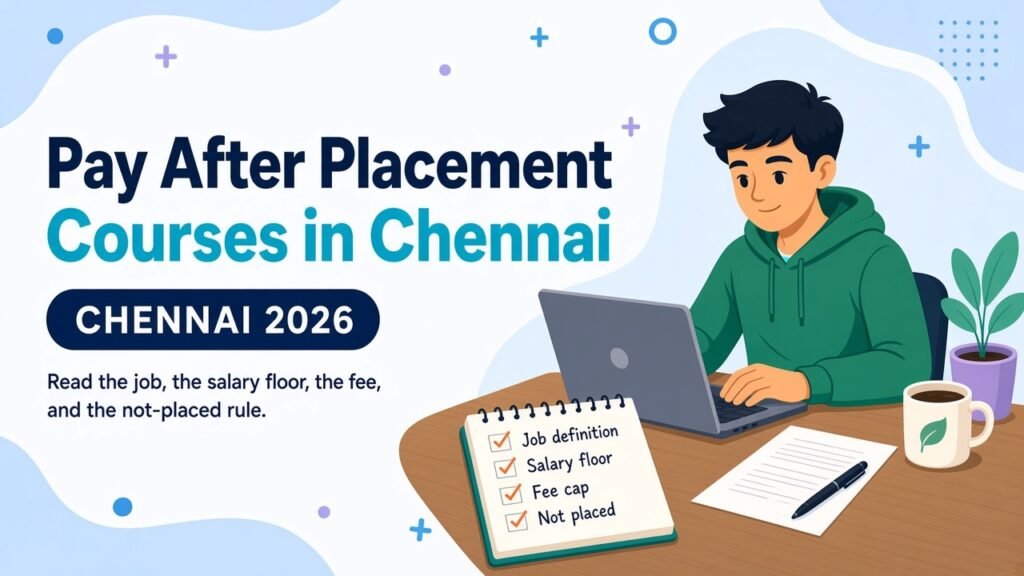
- Pay after placement means the training fee starts only after a qualifying job. Read the job definition, the salary floor, the amount, and what happens if you are not hired.
A pay after placement course in Chennai asks you to pay the training fee after you get a job, not before the first class. The useful question is not the slogan. It is which job counts, what salary starts the bill, how long you have to pay, and what happens if the job never comes. Read those four lines in the agreement before you compare institutes.
What does pay after placement mean?
In a normal classroom course you pay a fee, attend, and then look for work. In a pay after placement course the institute delays that fee. You study first. The invoice starts only when the contract says you are placed. Some contracts call this a success fee. Some call it a deferred fee. A few call it an income share. The names differ. The cash event is the same: money leaves your salary after you join a company.
Chennai has both patterns. Some training centres still collect the full fee in the first month. Others advertise that you pay only when you are hired. A fresher who searches for pay after placement courses in Chennai is usually trying to avoid borrowing money before the first offer. That goal is reasonable. The contract has to match the goal. A delayed bill is not a free course, and it is not a promise that a company will hire you.
Treat the offer as a loan with extra steps. You still owe a defined amount, or a defined share of pay, if the placement clause is met. If the clause is vague, you can owe money for a job you found yourself, a job below the salary you expected, or an internship that the brochure called a placement.
Pay after placement, ISA, and a normal fee are not the same
Three models get mixed together in advertisements. Separating them takes one minute and saves a long argument later.
A normal fee is paid before or during the course. You can ask for a receipt, a refund rule, and a list of what the fee includes. Your later salary does not change the amount.
Pay after placement means the same kind of fee, moved to a later date. The amount is often fixed. The trigger is a job. You might pay it in one transfer or in a few salary deductions. When the fixed amount is done, the institute stops collecting.
An income share agreement, often called an ISA, takes a percentage of your pay for a set number of months or until a cap. The rupee total can be higher than a classroom fee if your salary is high, and it can last longer than you expect if the percentage is small but the window is long. A cap is the only thing that stops an open-ended share. If there is no cap, do not sign.
Ask the counsellor to point at the clause and say which of the three you are buying. If they answer with a slogan instead of a clause, you do not yet have an offer.
Who a deferred fee actually suits
A deferred fee suits a fresher who can attend seriously and who cannot pay a large amount this month without borrowing from a family member who will feel the loss. It also suits someone who wants the institute to have a reason to support interviews, because the institute gets paid only if a qualifying job happens.
It suits you less if you already have the fee, you want a short receipt and a clean exit, or you already have an offer and only need a skill top-up. Paying upfront is often simpler when the deferred contract is full of exceptions. It also suits you less if the qualifying salary is set so low that almost any stipend starts the bill, or so high that the institute can say you were never placed and still keep you in a long placement desk.
Parents often hear only the words no upfront fee. Repeat the trigger in plain language at home: the bill starts when this kind of job, at this pay, within this many months, is accepted. If the family cannot say that sentence back, the brochure has not been understood.
The four lines that decide the contract
Ignore the banner and read four lines. Everything else in a pay after placement course in Chennai hangs on them.
First, the definition of a job. Does a contract role count? Does a six-month internship count? Does a job you found on your own count? Does a job outside Chennai count? Does a job in a different technology count? Write the answer in the margin. If the paper says any offer, a small internship can start a large bill.
Second, the salary floor. The clause should name a monthly or annual figure below which the fee does not start. Without a floor, the cheapest offer in the market becomes a placement. With a floor that no fresher in that skill actually gets, the institute can claim it tried and you can sit unpaid in a placement process for months. Ask which recent offers crossed the floor, and ask to see the number in the contract, not on a slide.
Third, the payment window and the amount. A fixed fee should state the rupee number, the number of instalments, and what happens if one salary is delayed. A share should state the percentage, the number of months, and the maximum rupees. If either number is missing, the contract is not ready to sign.
Fourth, the failure case. If you are not hired within the stated months, the fee should die. If you leave the course, the paper should say whether any amount remains. If you reject an offer, the paper should say whether that rejection counts as a placement. Students get stuck when a rejected offer is treated as success for the institute and as debt for the student.
What to check before you visit a Chennai institute
Go to the centre with a printed question list. A serious counsellor will answer from the agreement. A weak pitch will answer from a poster.
Ask how many hours a week are live with a trainer, and how many are recorded videos. A deferred fee does not improve a course that is only a playlist. Ask which tools you will install on your own machine, and whether a project is reviewed by a person. Ask what the placement desk actually does: mock interviews, applications you send yourself, or introductions to companies. Those are three different services.
Ask for the refund and the exit rule in writing. Ask whether the placement support has an end date. Ask whether you can pause if you are in the middle of a semester exam. Ask which costs are extra: exam vouchers, laptop, travel to interviews, or a second attempt at the same module.
Visit once during a class if they allow it. Look at whether students are writing code or watching a screen. The payment model cannot repair a room where nobody practises.
How to compare two pay after placement offers
Put both offers in the same four columns: job definition, salary floor, amount and window, and the not-placed outcome. The lower headline fee is not automatically the better offer. A smaller fee that starts on any internship can cost more than a larger fee that starts only on a full-time role above a clear floor.
Compare the training, not only the invoice. A longer course is not better if the extra weeks are repeated tool tours. A shorter course is not better if you never build something you can explain in an interview. Ask both institutes for one sample project and one sample mock-interview question. The institute that can show the work is easier to judge than the institute that can only show a placement wall.
Compare your own calendar. A pay after placement course in Chennai that needs full-day attendance will not fit a final-year student who still has university labs. A weekend batch can fit, but only if the projects are still reviewed. Write the weekly hours next to the fee. Time is part of the price.
Skills still decide the offer
Companies in Chennai hire for a skill they can test. A payment clause does not appear in the technical round. If the role is Python, you will be asked to write a small program, explain a project, and answer basic questions about data types, functions, and one library you used. If the role is Java, the round moves through classes, collections, and a simple API idea. If the role is testing, the round moves through test cases, a bug report, and one tool such as Selenium or an API client.
Build one project you can narrate in two minutes: what the user does, what you built, what broke, and what you fixed. That story is worth more in the interview than a line on a brochure about pay after placement. Use the project in your resume. Remove every tool you cannot explain. A deferred-fee course that lets you skip the project has not prepared you, even if the contract looks kind.
Placement tests still include aptitude and a short communication round. A student who can solve a program and cannot explain it will lose offers. Practise speaking the project out loud. Practise a thirty-second introduction. The fee model does not do that practice for you.
A practical study path while you compare contracts
Spend the first two weeks on one language, not five. For a development role, start with Python or Java and finish small programs every day. For a testing role, start with manual test cases and then one automation tool. Do not collect certificates in week one.
Spend the next weeks on a single project and on interview questions for that same skill. Add SQL if the role touches data. Add a short aptitude practice so the screening test does not end the process before the technical round. Keep a notebook of mistakes. The notebook is the revision material, not a new course.
When you talk to an institute, carry that notebook. Ask the trainer how the course would extend the project you already started. A good batch can absorb a student who has already begun. A weak batch will tell you to forget the project and watch the videos from the first slide.
Red flags in pay after placement advertising
Walk away from a guarantee of a named company. No training centre controls a hiring manager. Walk away from a promise of a specific salary if that number is not the floor written in the contract. A number on a banner that is missing from the PDF is an advertisement, not a term.
Walk away if the counsellor will not leave a copy of the agreement. Walk away if the only answer to what if I am not placed is we will support you, with no end date and no statement that the fee becomes zero. Walk away if an internship, a freelance task, or a job you found yourself is defined as placement. Walk away if the share of salary has no maximum.
Be careful with photos of offer letters that hide the company and the pay. Be careful with batches that start only after you sign, and with pressure to sign on the same evening. A one-day delay to read the four lines is a normal request. A centre that refuses the delay is telling you the paper will not survive a careful read.
What Asmorix can and cannot claim
Asmorix runs classroom and online training in Chennai, with projects, mock interviews, and placement support on its course pages. That is a training and placement-desk service. It is not, by itself, a pay after placement contract. If you want a deferred fee, ask the counsellor whether that specific batch has a written deferred-fee clause. If it does not, do not invent one from this article. If it does, read the same four lines: job, floor, amount, and the not-placed outcome.
Use the course pages to judge the skill, not the slogan. The Python course in Chennai, the Java training in Chennai, software testing, and data science are different jobs. Pick the one you can practise this month. Use the placement training in Chennai page to see how interview preparation is structured. Use the software training institute page to see the centre, not to collect a promise that no trainer can keep.
A useful next step is a conversation about batch timing, the project you will finish, and the written fee. Bring the four lines with you. Leave with a document, or leave without signing.
Questions freshers ask about pay after placement courses in Chennai
Does pay after placement mean the course is free? No. It means the fee is delayed until a qualifying job. Free would mean no invoice at all.
What if I find the job myself? Read the definition. Some contracts still charge you. Some charge you only if their desk introduced the company. The sentence has to be in the file.
What if the offer is in another city? Decide before you sign whether you will move. If you will not move, the contract should not treat an out-of-city offer as a placement you must accept.
Can I pay a normal fee instead? Often yes. Ask for both numbers. Compare a fixed upfront fee with the deferred amount. Choose the one you understand.
Will a deferred fee make interviews easier? No. The interviewer tests the skill. The contract only changes when you pay the institute.
How to decide this week
Write the skill you will actually study. Shortlist two institutes, not six. For each, collect the agreement and fill the four lines. Reject any paper that cannot fill them. Visit one class or one counselling session with your project notebook. Ask what the trainer will review. Then choose the batch whose project and contract you can both explain to your family in one minute.
If the contract is clear and the training is real, a pay after placement course in Chennai can remove an upfront bill. If the contract is foggy, the slogan is expensive. The search result that brought you here is the start of that check, not the end of it.
A short checklist to carry to the centre
Print this and tick it in the counselling room. The course name and the batch days are written down. The weekly live hours are written down. One project title is written down, with the name of the person who will review it. The fee model is marked as upfront, fixed pay after placement, or income share. The job definition says whether internship, contract, and self-found offers count. The salary floor is a number in the file. The amount, the percentage if any, the number of months, and the maximum rupees are filled in. The not-placed outcome says the fee ends. The out-of-city rule matches whether you will relocate. Extra costs such as an exam voucher or travel are listed. You are allowed to take the unsigned copy home for one day.
If two boxes stay empty, do not sign in that visit. Ask for the missing line by email so you have a record. A centre that can train you can also write a clear sentence. Keep the checklist with your resume and your project notes. When a later call says the terms have improved, compare the new file with the ticks instead of with the new slogan. That habit matters more than collecting another brochure about pay after placement courses in Chennai.
