
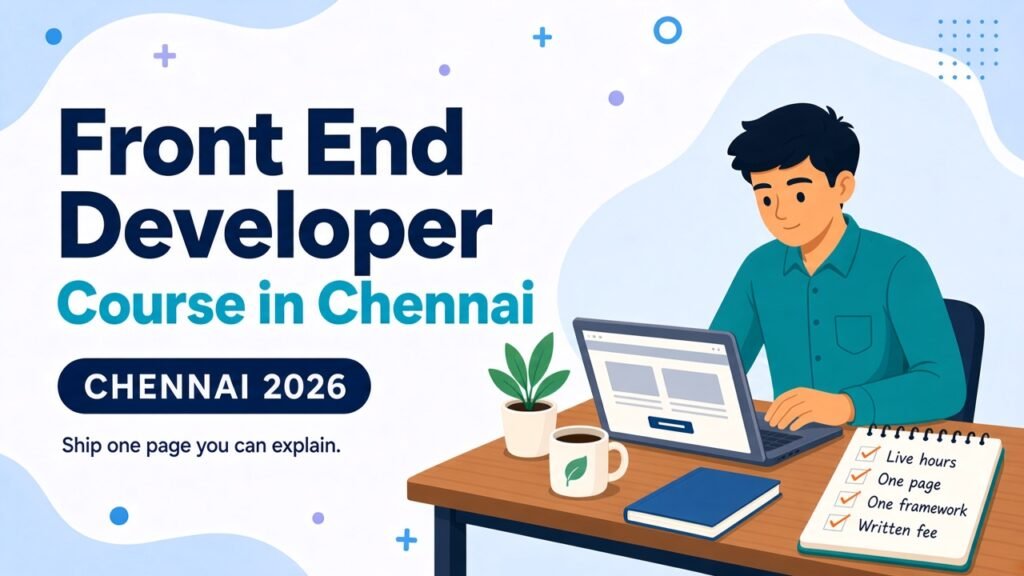
- A front end developer course in Chennai should leave you with one page that works on a phone and one script you can explain. Check the live hours and the written fee before you pay.
A front end developer course in Chennai is worth paying for when you leave with one page that opens on a phone, one script you wrote, and a trainer who reviewed both. A list of logos and a certificate filename do not prove that. Start from the screen you want to build, then check whether the batch actually builds it.
What people mean by a front end developer course
The search usually comes from a final-year student, a fresher, or a parent comparing classrooms and weekend batches. They have heard that websites need a person who builds what the user sees. They are not looking for a definition of the internet. They want to know whether a course will teach HTML, CSS, and JavaScript well enough to show in an interview.
Two centres can print the same sentence and teach different hours. One puts you in front of a trainer who opens your page and points at a broken layout. The other plays a recording and calls the week complete when the video ends. The fee can look similar. The folder on your laptop will not.
Treat this as a way to judge a batch, not as a rank of every institute in the city. Asmorix publishes separate pages for HTML, CSS, JavaScript, React, UI and UX, web development, and full stack so you can see the subject before you sit in a counselling room. Use those pages for the skill. Use the visit for the days, the reviewer, and the written fee.
Front end, web development, UI, and full stack are not the same job
Front end is the part a visitor sees and clicks. You write the structure of the page, the way it looks on a phone and on a laptop, and the behaviour when someone presses a button. You do not, in the first course, own the database or the server that stores accounts.
Web development training in Chennai is the wider label. A web batch may include the screen and a little of the server. Ask which half gets the live hours. If the answer is both, in a short calendar, you will tour tools and finish neither.
UI and UX training in Chennai is the neighbour skill: how a screen should be arranged so a person can finish a task. A front end course should borrow that habit, because a pretty page that hides the button is still a failed page. It should not replace the code. A Figma file you cannot turn into HTML will not answer a technical round that asks you to change a layout live.
Full stack developer training in Chennai adds the server, the database, and the deploy of both sides. That is a later step for many students. If you cannot yet make one page respond to a click, buying the server modules in the same month usually means you memorise names. Finish the screen first. Add the stack when you can explain the screen without notes.
Who this course is for
Join if you can sit with a laptop for the weekly hours the centre names, and if you are willing to type instead of only watching. A science student after the twelfth standard, a BCA or BSc student in the final year, and a fresher who has used a computer for assignments can all start, provided the batch begins with a page and not with a speech about the industry.
Wait if you want a job title before you have a page. The interview will ask you to change something on the screen. A course cannot skip that practice and still call you ready. Wait also if your college labs already fill every evening and the centre has no pause rule. A batch you cannot attend is a fee, not a skill.
Parents can help by asking four facts, which are listed later. They cannot choose the framework for the student. The student has to be the person who opens the laptop in the mock interview.
What you should be able to do on the last day
Write the outcome in one line before you pay. A visitor opens your page on a phone. The layout does not break. A button runs a script you wrote. You can say what you would change if the trainer asked for one more section. That line is the course. Everything else is supporting material.
You should also be able to put the page at a URL that is not only on your laptop. A file that opens from the desktop is a start. An interview is stronger when the other person can open the same page. Ask the centre how students publish that URL. If the answer is a screenshot in a slide, the project stops at the classroom.
Keep a short note of one bug you fixed. Interviewers trust a broken margin you repaired more than a list of topics you heard. The note can be three sentences. You will reuse it in the mock interview.
HTML is the structure, not a list of tags
HTML training in Chennai should end with a page that has a heading, a navigation, a main section, and a form or a list that means something. Reciting tag names is not the same result. A trainer should ask you to add a section without looking at the slide, then look at whether a screen reader would still understand the order.
Use a small subject you already know. A college event page, a notes index, or a simple product list is enough. Do not start with a clone of a famous website. A clone hides the decisions, because you are copying spacing you did not choose. Your own small page forces you to decide what comes first.
Ask which editor you will install in week one. You should type in that editor on your laptop. A centre that only shows a trainer's screen will not notice when your file is in the wrong folder.
CSS has to survive a phone
CSS training in Chennai is the part students skip because the desktop already looks fine. Chennai job descriptions still ask for a page that works on a phone. Make the window narrow in class and watch what overflows. That single habit is worth more than a catalogue of property names.
Learn one layout method well enough to rebuild the page when the trainer deletes your stylesheet. If you need the recording to put the navigation back, you do not know it yet. Flex or grid is a tool. The test is the rebuild.
Colour and font are last. A readable page with ordinary colours will pass a first review. A decorative page that hides the text on a phone will not. Ask the trainer to review the narrow window, not only the wide one.
JavaScript is the click, the check, and the change
JavaScript training in Chennai should make the page react. A form that says the email is empty, a list that filters, or a total that updates are enough. You do not need a game and you do not need a framework in the same week.
The trainer should watch you break the script and fix it. Copying a finished file from a repository teaches you how to paste. An interview will not paste for you. Keep the error message you saw and the line you changed. That pair belongs in the notebook next to the CSS bug.
If the batch jumps to a framework before you have written one of those small scripts, ask them to slow down. The framework will feel like magic, and magic is hard to explain when the interviewer says to remove the library and do it again in plain JavaScript.
Pick one framework after the plain page works
React training in Chennai is a sensible second half when the job posts you saved mention it, and when your plain page already works. React is a way to build the same screen from small pieces. It is not a replacement for HTML, CSS, and JavaScript. A student who cannot say what the plain page did will hide inside the framework and freeze when the tool fails.
Do not collect Angular, Vue, and React in one short batch. Finish one. You can name the others as things you have heard of. You should demo only the one you can change live. A syllabus that lists three frameworks in the last week is a poster. Ask which one the trainer will review, and spend the hours there.
If the jobs you saved do not mention a framework, stay with the plain page and publish it well. A clear page you can edit is stronger than a framework name you cannot debug. You can add React in the following month without paying for a second copy of HTML.
The project a reviewer should open
Agree the project in the first week, not on the last day. One page is the minimum: a real subject, a phone layout, and one script. A second, smaller page can show the framework if you reached it. Both need a URL and a person who opened them and wrote a comment.
The comment should be specific. The spacing on the form is uneven, or the button does nothing when the field is blank. A comment that only says good will not help you in a mock interview. If no one writes a comment, treat that as a missing class and ask for it before the fee conversation is over.
You should be able to draw the page from memory: what is at the top, what the script checks, and what you would do in the next hour if you had one. That drawing is the interview. The certificate is optional.
Two URLs are a portfolio
Put the pages where another person can open them. Write two lines under each URL: who the page is for, and what you fixed after review. That is the portfolio. A zip file on a pendrive is a backup, not a portfolio.
Do not fill the resume with every tag you typed. Write the two URLs, the framework only if you can change it live, and the one bug. A long tool list makes a fresher look like they attended a syllabus rather than finished a page. Interviewers in a first round have little time. Give them a link they can click.
If the centre hosts the page on a temporary classroom server, copy it to a place you control before the batch ends. Classroom servers get reset. Your explanation should still match a link that opens next month.
How to read a batch in Chennai
Ask for weekly live hours with a trainer who can see your screen. Write the number. Recordings can support a missed day. They are not the product if they are the whole week. A weekend batch is valid when the review still happens between classes. A weekday batch is valid when it does not collide with university labs.
Ask the batch size and the starting level. A room of people who have never written a tag and a room of people who already know JavaScript are different courses. You want the room that matches you. A mixed room can work only if the trainer still looks at your file, not only at the fastest student.
Visit during a session if they allow it. Look at hands on keyboards. The building, the air conditioning, and the printed photos do not teach CSS. A class where every screen shows the same finished file at the same minute is a demonstration. You need time when your file is the one on the trainer's desk.
A syllabus you can check in ten minutes
A useful syllabus names HTML structure, a layout you will rebuild, JavaScript on a real control, one framework or a clear statement that the framework is later, a published URL, and a mock interview about that URL. It also names the editor and the browser you will install.
Be wary of a syllabus that is only brand names. A week titled tools is not a week. Ask what you will commit to your own folder on Friday. If the counsellor cannot answer without a new brochure, the syllabus is a menu.
Match the syllabus to one job description you saved. If the job asks for responsive pages and JavaScript, those words should be the long parts of the calendar. If the job asks for React, React should have review hours, not a single guest lecture. History of the web can be one evening of reading. It should not be the first paid month.
College labs, gaps, and a late start
Final-year labs and internal exams will interrupt a batch. Write the clash before you pay, and ask what a pause looks like. A centre that has taught students will have a one-line rule. A centre that needs you to decide on the spot often does not.
A gap after college is not a reason to skip the page and jump to full stack. The gap is a reason to finish the URL quickly and honestly. You will be asked what you did with the months. A page you can open is an answer. A collection of course names is not.
If you already know HTML from college and the college page was copied, say so. Ask the trainer to start you on the layout and the script. Paying again for a tag lecture wastes the weeks you needed for the bug notebook.
The interview is four sentences
Practise this aloud. What the page is for. What you built yourself. What broke on the phone or in the script. What you changed after the review. Then stop. A mock interviewer should interrupt you and ask you to edit one thing. That edit is the test. A speech you memorised from a brochure will not survive the edit.
Placement training in Chennai can host that mock interview, a resume pass, and a spoken introduction. It does not create a job. No centre signs an offer for you. When a counsellor promises a company by name, ask for the sentence in the agreement that defines the role and what happens if no interview is scheduled. If the sentence is missing, the promise is a poster.
Do not invent a salary expectation from a classroom chart. Talk about the page. If a form asks for a number you do not have from an offer letter, leave it for a conversation with the company, not for a guess you print on the resume.
The fee, without a number from this page
This article does not quote a fee. Fees change by batch, hours, and what is included. Ask for the number that matches the batch you will attend. Ask whether a repeat of a missed module is inside that number. Ask whether the mock interview is inside it, and when that support ends. Take the unsigned paper home.
A lower headline is not automatically the better batch. A cheap week that never opens your file can cost the month you needed for a portfolio. A higher fee is not automatically serious either. The review and the URL decide. Compare two centres in the same columns: live hours, the page, the reviewer, the framework if any, the interview practice, the fee, and the pause rule.
Do not pay a second course in the same month. Finish the URL, practise the four sentences, and sit the mock interview. A full stack brochure can wait until the first page still opens for someone who is not on your laptop.
Red flags in the counselling room
Walk out if the only proof of teaching is a wall of company logos. Walk out if you are told every student is placed and there is no written meaning for placed. Walk out if the project is a template you are not allowed to change. Walk out if the framework list has three names and the trainer cannot say which one they will review.
Be careful when the fee changes between the phone call and the desk, or when an exam voucher you did not ask for appears as a required extra. Be careful when you cannot see a class. Be careful when the counsellor answers a question about your page with a story about a student you cannot meet.
None of these flags requires you to argue. Write the answer you heard, thank them, and compare it with the second centre. A good batch will still be there after you have read the paper at home.
The first month after you join
Week one is the editor, a real HTML page, and a heading order you can explain. Week two is the phone layout and one rebuild after the trainer hides your stylesheet. Week three is the script: a check, a click, and the error you fixed. Week four is the URL, the four sentences, and the mock edit.
If week two has no review, ask that week. Do not wait for a certificate day. A missing review is the moment to use the pause rule or to ask for a different batch. Silence until the end makes the conversation with your family harder.
Keep one notebook. Each page of it is one change, one error, and one fix. Revise that notebook before the mock interview. A new brochure will not replace it.
What parents can confirm in one visit
Ask which page the student will publish. Ask how many hours a week are live. Ask who reviews the file. Ask what the fee includes and when interview practice ends. If the family cannot repeat those four facts outside the room, the visit is not finished.
Then let the student describe the page for one minute. If they cannot start, they are not ready to pay, even if the room is convincing. Spend two weeks on a small page at home or in a trial class before anyone signs. The batch should move at the speed of a real file, not faster than the student can speak.
When full stack is the right next step
Move on when the URL still works, when you can edit the layout without a recording, and when you can say what data the page would need from a server. That is the moment a full stack batch has something to attach to. Starting there earlier asks you to learn accounts, tables, and routes while you still cannot line up a button.
Tell the counsellor you want the front end project finished before any second course. A centre that needs a bundle on day one is selling time. You can add the server after the interview story is solid. The same notebook habit carries over: one error, one fix, one sentence you can say aloud.
A decision you can write in one line
Write the line before you leave the room. The page you will publish, the hours you will attend, and the person who will review the file. If you cannot write it, you do not have an offer yet. You have a conversation.
If you cannot yet make a heading and a button, do that before you compare centres. The batch will still be there next month. The course is the page. The interview is the four sentences and the live edit. That is the whole decision.
A checklist for the counselling visit
Confirm the editor you will install, and that you will type on your laptop. Confirm the weekly live hours, separate from recordings. Confirm the page subject and the URL you will leave with. Confirm that someone reviews the phone layout and the script, in writing or in a comment you can keep. Confirm whether a framework is in this batch or later, and that only one will be reviewed. Confirm the mock interview is on the calendar. Confirm the fee, what a repeat module costs, and the date interview practice ends. Take the unsigned syllabus home. Do not add a second course until the first URL opens for someone else.
