
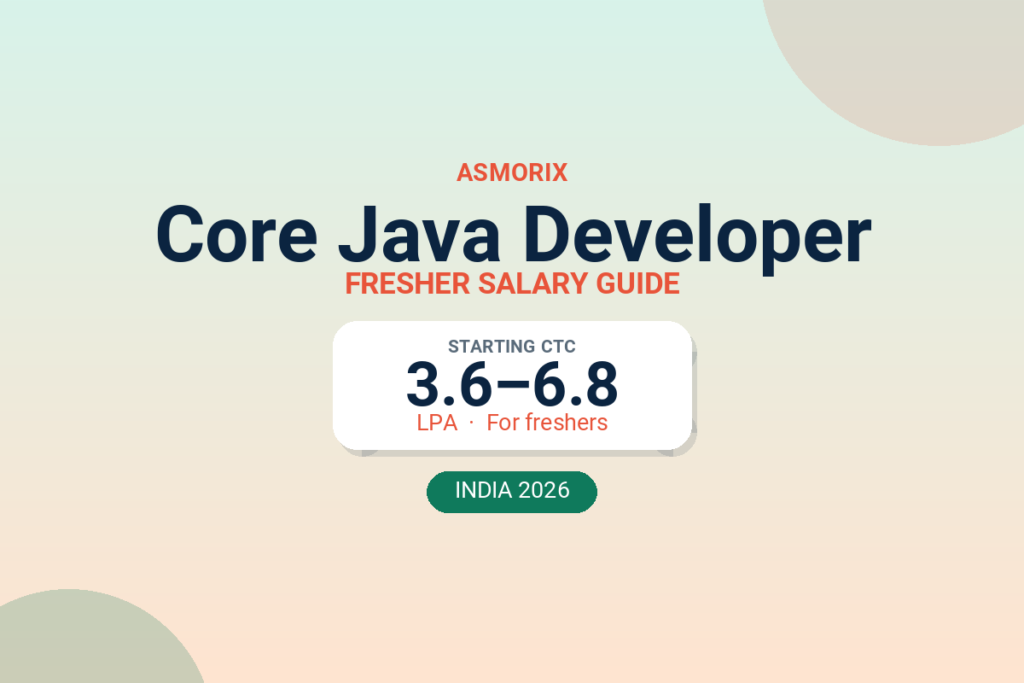
- Core Java Developer salary in India for 2026: freshers typically earn 3.6–6.8 LPA CTC. Chennai pay, skills, and in-hand explained.
- Use the table of contents to jump to cost tables, variables, and FAQs.
- Talk to Asmorix mentors if you want a course or project plan tailored to your goals.
Core Java Developer salary in India for 2026 sits in a planning band, not on a single official card. For a Core Java Developer role, freshers with real project proof typically see about 3.6–6.8 LPA as CTC. Early-career professionals with two to four years often see 7–14 LPA. People with five or more years, and with ownership of a system, often see 14–26 LPA. These figures are candidate-reported ranges used for planning. They are not an offer letter, a campus circular, or a promise from any employer.
Use this page to compare fixed pay, variable pay, and city. A higher CTC in Bangalore can lose to a cleaner fixed salary in Chennai after rent. A fresher who can demonstrate Core Java and Collections is the person who reaches the upper half of 3.6–6.8 LPA. A fresher who only lists tool names usually stays near 3.6 LPA.
Core Java Developer salary bands in India (2026)
| Experience | Typical CTC | Rough monthly in-hand |
|---|---|---|
| Fresher (0–1 year) | 3.6–6.8 LPA | about Rs 21,000 to Rs 44,200 |
| Early career (2–4 years) | 7–14 LPA | from about Rs 42,000 at the low end |
| Experienced (5+ years) | 14–26 LPA | from about Rs 81,667 at the low end |
Read the fresher row first. 3.6 LPA is the low planning number. 6.8 LPA is the high planning number for a strong fresher, not the average of every offer in India. CTC is the annual cost to the company. It includes employer provident fund, sometimes gratuity, insurance, and a variable portion. It is not twelve times the amount that reaches your bank.
A practical in-hand check for the fresher band: take fixed pay as roughly 75 to 85 percent of CTC if the letter is clean, then subtract employee PF and tax. On a 3.6 LPA CTC, many freshers see on the order of Rs 21,000 a month before they count rent. On a 6.8 LPA CTC, the monthly figure can approach Rs 44,200 only when most of the package is fixed. If a large slice is variable, do not spend that money in your head until it is credited.
Two letters can both say they are “around the Core Java Developer fresher band” and still differ by thousands of rupees a month. Letter A at 3.6 LPA with almost all fixed pay can beat letter B at a higher CTC if letter B hides a joining bonus paid once and a variable plan paid only if the project stays billed. Ask for the annexure: basic, HRA, special allowance, employer PF, variable, and the month variable is paid.
What Core Java Developer work looks like
Java hiring in Chennai is still the largest service-company pipeline. Freshers are expected to know core Java, objects, collections, and JDBC or basic Spring. Advanced and J2EE roles add servlets, JSP, and Hibernate. Full stack and Spring Boot roles pay more because they include APIs and a front end or a production-style service.
On this path the skills that show up in Chennai job descriptions are Core Java, Collections, JDBC, OOP. A fresher resume should prove those skills with one project, not with a grid of icons. The day-to-day work is smaller than the job title sounds: a ticket, a page, a query, a bot, a case, or a pipeline, finished well enough that a senior does not rewrite it.
Service companies in Chennai and across India hire more Core Java Developer freshers than product companies do. Service offers cluster near 3.6 to the middle of the fresher band. Product teams, specialist units, and scarce skills cluster near 6.8 LPA and sometimes above it for an exceptional project. Startups may quote a lower fixed salary plus an unverified upside. Count the fixed salary.
Core Java Developer salary in Chennai, Bangalore, Hyderabad, and Pune
Chennai tracks the India band closely for a Core Java Developer role. A fresher offer in Guindy, OMR, or a Chennai delivery centre is usually inside 3.6–6.8 LPA unless the team is a product group with a harder interview. Rent in a shared room is often lower than in Bangalore, so the same CTC can leave more cash after housing.
Bangalore product teams sometimes quote 10 to 20 percent more CTC for the same fresher skills. That does not automatically mean a better first year. Add rent, deposits, and the variable clause. Hyderabad is often close to the India band and can match Chennai for service-company Core Java Developer roles. Pune sits near the India band with a strong service and product mix. Coimbatore and smaller Tamil Nadu cities can quote the lower half of the band and still be a fair start if the work teaches Core Java.
If you are choosing between a Chennai offer at 3.6 LPA fixed-heavy and a Bangalore offer at 6.8 LPA with a large variable, write both monthly in-hand numbers on paper. Include a rent estimate. Freshers lose money when they optimise the headline CTC and ignore the city. The Core Java Developer title is the same. The cash is not.
Who pays the low end and the high end
The low end, near 3.6 LPA, is common when the interview tested only definitions, the project was a tutorial, or the role is a support-heavy version of Core Java Developer. Mass campus drives land here when the stack is taught after joining. There is nothing wrong with that start if the letter is fixed pay and the team lets you touch real work in the first six months.
The high end, near 6.8 LPA for freshers and 14 LPA after a few years, shows up when you can defend a project, write or test without a senior in the room, and communicate the result. Specialist stacks on this page move faster than generic ones. Experienced pay near 14–26 LPA is for people who own a module, a pipeline, a dashboard, or a client conversation, not for people who repeated the same fresher task for five years.
Negotiation at fresher level is narrow. You will not move a campus grid by arguing. You move it before the interview, with a project and clean fundamentals. After two years, switching teams is how people leave 7 LPA for the upper half of 7–14 LPA. Keep a record of what you shipped. That record is the negotiation.
Skills that change a Core Java Developer offer
Each skill below is a filter Chennai and India panels use before they pick a number inside 3.6–6.8 LPA. Read the proof, put it in a project, and practise saying it in two minutes.
Core Java for a Core Java Developer
Explain a class, a list, and a checked exception with a tiny program. That is the proof a panel can score. For a Core Java Developer fresher, Core Java is not a line in a skills box. It is a reason to move from 3.6 LPA toward 6.8 LPA.
In the interview, expect a small task, not a speech. Do the smallest correct version of Core Java, then mention one bug you already hit while practising. Candidates who recite a definition and then go quiet stay at the bottom of the band. Candidates who narrate a check they ran are the ones panels mark as ready for the upper half.
Make Core Java the headline of your project. The README should show the command, the input, and the output. If a reviewer cannot run or watch that proof in five minutes, it will not affect the offer.
Collections for a Core Java Developer
Pick a List or a Map and say why the other one is wrong. That is the proof a panel can score. For a Core Java Developer fresher, Collections is not a line in a skills box. It is a reason to move from 3.6 LPA toward 6.8 LPA.
In the interview, expect a small task, not a speech. Do the smallest correct version of Collections, then mention one bug you already hit while practising. Candidates who recite a definition and then go quiet stay at the bottom of the band. Candidates who narrate a check they ran are the ones panels mark as ready for the upper half.
JDBC for a Core Java Developer
Open a connection, run a query, and close it in a finally or try-with-resources. That is the proof a panel can score. For a Core Java Developer fresher, JDBC is not a line in a skills box. It is a reason to move from 3.6 LPA toward 6.8 LPA.
In the interview, expect a small task, not a speech. Do the smallest correct version of JDBC, then mention one bug you already hit while practising. Candidates who recite a definition and then go quiet stay at the bottom of the band. Candidates who narrate a check they ran are the ones panels mark as ready for the upper half.
OOP for a Core Java Developer
Show one object, one method, and why the data is private. That is the proof a panel can score. For a Core Java Developer fresher, OOP is not a line in a skills box. It is a reason to move from 3.6 LPA toward 6.8 LPA.
In the interview, expect a small task, not a speech. Do the smallest correct version of OOP, then mention one bug you already hit while practising. Candidates who recite a definition and then go quiet stay at the bottom of the band. Candidates who narrate a check they ran are the ones panels mark as ready for the upper half.
Projects that justify the higher fresher band
Build a Java service that stores records in MySQL and exposes three operations: create, list, and update. Use plain JDBC first if you are a core Java fresher, or Spring Boot if you are aiming at the higher band. Explain one transaction and one SQL query you wrote yourself. Do not submit a tutorial you cannot modify.
Tie the project to money without exaggerating. You are not claiming the project is worth 6.8 LPA by itself. You are showing that you can do the first month of a Core Java Developer job. Include one metric: rows cleaned, cases automated, a page that works on a phone, a query that got faster, a bot that logged bad rows, or a model error you wrote down. Metrics beat adjectives.
Avoid a group project where you cannot explain your part. Panels in campus drives ask “what did you do?” three times. If the answer is “we used Core Java,” the offer stays near 3.6 LPA. If the answer is a specific decision and a bug, you are in the conversation for the higher number.
A week in a Core Java Developer seat
Monday starts with a small Core Java Developer task, not a classroom lecture. You open yesterday's note and pick up Core Java. Explain a class, a list, and a checked exception with a tiny program. A senior looks at the result, not at how many tools you can name. If the result is wrong, you write the failing case before you change anything. That habit is what teams in Chennai mention when they defend a fresher offer near 6.8 LPA instead of 3.6 LPA. By the end of Monday you can say what moved, what broke, and what you will show tomorrow.
Tuesday starts with a small Core Java Developer task, not a classroom lecture. You open yesterday's note and pick up Collections. Pick a List or a Map and say why the other one is wrong. A senior looks at the result, not at how many tools you can name. If the result is wrong, you write the failing case before you change anything. That habit is what teams in Chennai mention when they defend a fresher offer near 6.8 LPA instead of 3.6 LPA. By the end of Tuesday you can say what moved, what broke, and what you will show tomorrow.
Wednesday starts with a small Core Java Developer task, not a classroom lecture. You open yesterday's note and pick up JDBC. Open a connection, run a query, and close it in a finally or try-with-resources. A senior looks at the result, not at how many tools you can name. If the result is wrong, you write the failing case before you change anything. That habit is what teams in Chennai mention when they defend a fresher offer near 6.8 LPA instead of 3.6 LPA. By the end of Wednesday you can say what moved, what broke, and what you will show tomorrow.
Thursday starts with a small Core Java Developer task, not a classroom lecture. You open yesterday's note and pick up OOP. Show one object, one method, and why the data is private. A senior looks at the result, not at how many tools you can name. If the result is wrong, you write the failing case before you change anything. That habit is what teams in Chennai mention when they defend a fresher offer near 6.8 LPA instead of 3.6 LPA. By the end of Thursday you can say what moved, what broke, and what you will show tomorrow.
Friday starts with a small Core Java Developer task, not a classroom lecture. You open yesterday's note and pick up Core Java. Explain a class, a list, and a checked exception with a tiny program. A senior looks at the result, not at how many tools you can name. If the result is wrong, you write the failing case before you change anything. That habit is what teams in Chennai mention when they defend a fresher offer near 6.8 LPA instead of 3.6 LPA. By the end of Friday you can say what moved, what broke, and what you will show tomorrow.
The week is deliberately narrow. A Core Java Developer fresher who finishes five small proofs is easier to trust than a fresher who watched five courses. Keep a single document with the five proofs. Take it to the interview. The document is more persuasive than a line that says you know Core Java.
Core Java Developer interview questions and solid answers
How would you prove Core Java in a Core Java Developer interview?
Start with the proof, not the definition. Explain a class, a list, and a checked exception with a tiny program. Then connect it to the job: a Core Java Developer fresher is paid inside 3.6–6.8 LPA to do that kind of task without a senior rewriting it. Close with one mistake you already made while practising Core Java and how you checked the fix. Panels trust a specific failure more than a perfect speech. If you have not practised Core Java this week, say so and show the nearest proof you do have.
How would you prove Collections in a Core Java Developer interview?
Start with the proof, not the definition. Pick a List or a Map and say why the other one is wrong. Then connect it to the job: a Core Java Developer fresher is paid inside 3.6–6.8 LPA to do that kind of task without a senior rewriting it. Close with one mistake you already made while practising Collections and how you checked the fix. Panels trust a specific failure more than a perfect speech. If you have not practised Collections this week, say so and show the nearest proof you do have.
How would you prove JDBC in a Core Java Developer interview?
Start with the proof, not the definition. Open a connection, run a query, and close it in a finally or try-with-resources. Then connect it to the job: a Core Java Developer fresher is paid inside 3.6–6.8 LPA to do that kind of task without a senior rewriting it. Close with one mistake you already made while practising JDBC and how you checked the fix. Panels trust a specific failure more than a perfect speech. If you have not practised JDBC this week, say so and show the nearest proof you do have.
How would you prove OOP in a Core Java Developer interview?
Start with the proof, not the definition. Show one object, one method, and why the data is private. Then connect it to the job: a Core Java Developer fresher is paid inside 3.6–6.8 LPA to do that kind of task without a senior rewriting it. Close with one mistake you already made while practising OOP and how you checked the fix. Panels trust a specific failure more than a perfect speech. If you have not practised OOP this week, say so and show the nearest proof you do have.
Core Java Developer interview rounds
Java rounds start with OOP, then collections, then a small program. They ask what happens if two threads touch one list, or how a JDBC connection should be closed. Spring roles add a controller and a repository. Write code on paper or in a shared editor slowly and correctly. A clean simple answer beats a half-remembered annotation.
A typical loop is three steps. First, a screen or aptitude check. Second, a technical round on Core Java, Collections, JDBC. Third, HR: joining date, location, and whether you understand the CTC split. For Core Java Developer, prepare one project story with a start, a problem, and a result. Prepare one honest gap. “I have not used that tool yet; here is the adjacent thing I have built” is a stronger line than a bluff.
After the technical round, write down the questions you missed the same day. The second company will ask a cousin of that question. Freshers who do this for two weeks move bands. Freshers who collect offer screenshots do not.
Salary growth from fresher to five years
Year zero is the fresher band, 3.6–6.8 LPA. The goal in year one is not a job hop. The goal is proof: tickets closed, pages shipped, queries trusted, bots that handle bad rows, or a module you can describe. Without that proof, year two still looks like a fresher resume and the pay stays near the bottom of 7–14 LPA.
Years two to four are the early-career band, 7–14 LPA. People reach the top of it by owning a small system and by interviewing outside their first team. A switch with no new skill just resets the title. A switch with Core Java at a deeper level is what prints the higher number.
Year five and beyond is 14–26 LPA in this planning guide. That band assumes you can lead a slice of work: estimate it, review someone else, and talk to a client or a product manager. It is not an automatic increment. People who repeat the same fresher task stay below it even with five years on the resume.
How to read a Core Java Developer offer letter
Put the letter next to this band. If the CTC is under 3.6 LPA, ask what the role actually is. It may be support, internship stipends counted as CTC, or a training period. If the CTC is far above 6.8 LPA for a fresher, look for a one-time bonus, a long variable plan, or a bond. High numbers that are not monthly fixed pay are not the band.
Check the work location. A Chennai letter and a Bangalore letter are different lives at the same CTC. Check probation, the notice period, and whether the variable depends on company profit or your project. Check insurance and PF so you are not surprised by the first payslip. The first payslip, not the PDF header, is the truth.
When you compare two offers, make a three-line note: fixed monthly pay, city and rent, and what you will learn in six months. For Core Java Developer, learning Core Java on a real ticket is worth more than a slightly higher CTC on a desk where you only watch. The next band, 7–14 LPA, is earned from that work.
A 90-day plan before you apply
Month one is core Java and collections. Month two is SQL and JDBC. Month three is one service, Git, and mocks. If your target band is the Spring Boot range, add REST and JPA only after the core Java answers are steady.
Every week, write five lines: what you built, what broke, what you will show in an interview. At day 90 you should be able to demo the project, answer questions on Core Java, Collections, JDBC, OOP, and explain why your expected fresher CTC is inside 3.6–6.8 LPA instead of a random number from social media.
If you are already in a job under the early-career band, use the same ninety days on one deeper skill, not on five new tools. Depth is what moves 7 LPA toward 14 LPA. Breadth without a story does not.
Train for Core Java Developer in Chennai
Asmorix mentors in Chennai train this path with projects and placement practice. The related course is a fit when you want a timetable instead of a pile of videos. Look at the syllabus, match it to Core Java and Collections, and join if you will finish the project. A course you do not finish will not change a Core Java Developer offer.
Core Java Developer training in Chennai
