
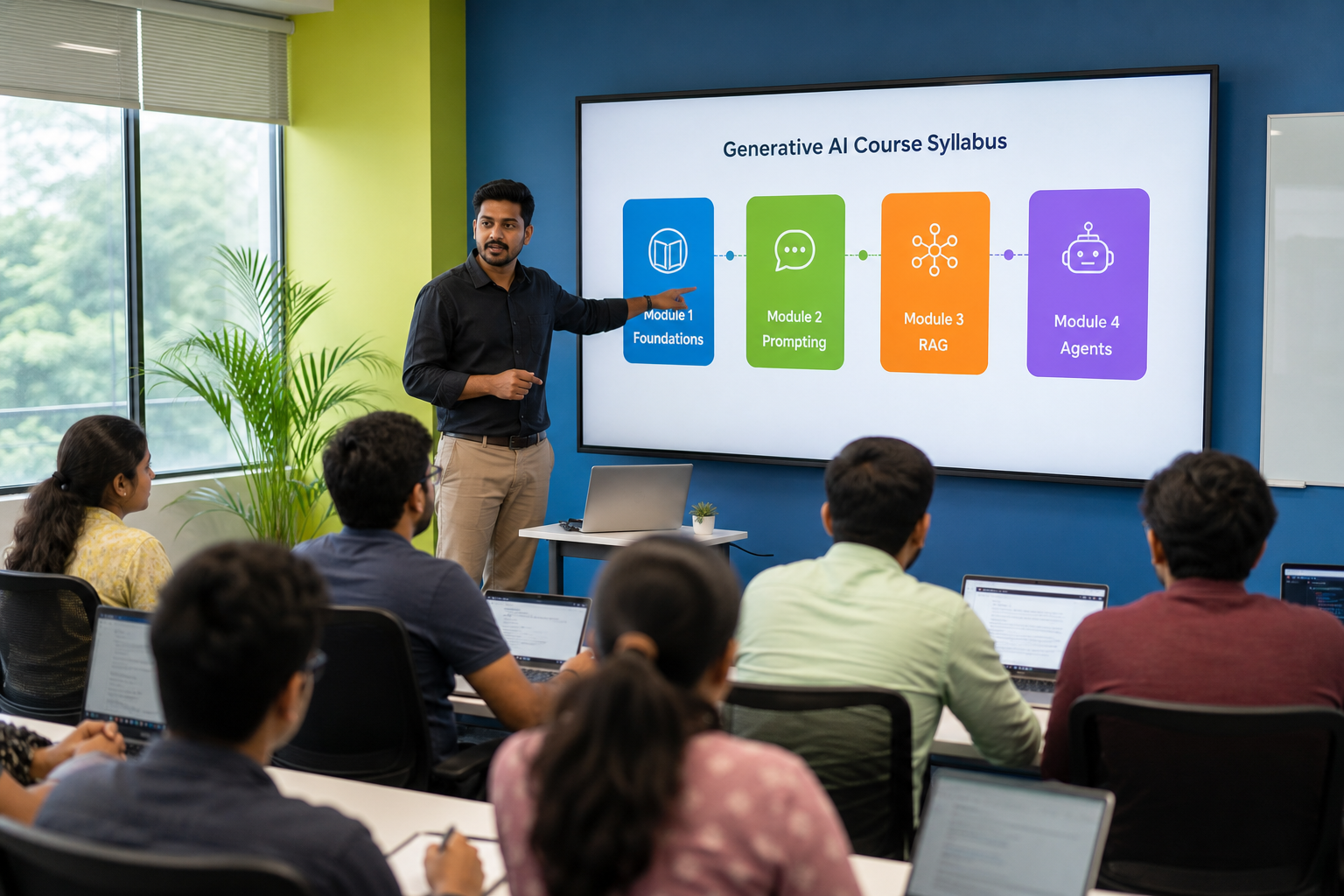
- Duration: 12-week module plan (14-20 weeks if studying part-time evenings).
- Modules: fundamentals, tools, prompting/eval, RAG, role labs, agentic intro, capstone, career packaging.
- Prerequisites: basic Python, Git, and HTTP/API comfort - add Python pre-work if needed.
- Proof: prompt library, RAG mini-app, eval golden set, track lab, and capstone with demo video.
- Outcomes: AI-adjacent dev, analytics, and internal-tools lanes - hiring depends on proof, not syllabus completion alone.
This generative AI syllabus is a 12-week, module-wise plan for learners who want job-relevant depth - not a tool tour. It sequences fundamentals, platform literacy, prompting and evaluation, RAG engineering, role-based labs, a controlled agentic introduction, and a capstone you can defend in interviews. Pair it with Generative AI Fundamentals, Generative AI Tools, and Generative AI vs Agentic AI for concept context.
Last updated: August 4, 2026 - Reviewed by Asmorix AI curriculum mentors in Chennai against lab capacity and hiring screen patterns.
Syllabus at a Glance (Weeks 1-12)
| Weeks | Module | Core outcomes | Deliverable |
|---|---|---|---|
| 1-2 | GenAI fundamentals + Python/API base | LLM mental model, tokens, safe use | Prompt template library (10 patterns) |
| 3 | Tools landscape | Chat, coding, productivity, policy | Tool comparison memo for your role |
| 4 | Prompting + evaluation | Rubrics, golden sets, failure logs | Eval sheet on one use case |
| 5-6 | Embeddings + RAG | Chunking, retrieval, citations | Doc Q&A mini-app |
| 7-8 | Role labs (dev / data / ops tracks) | Apply GenAI to realistic tasks | Track-specific lab report |
| 9 | Agentic intro (guarded) | Tool calling, plans, human gates | Read-only agent demo |
| 10-11 | Capstone build | End-to-end problem + metrics | GitHub + demo video |
| 12 | Review + career packaging | Resume stories, mocks, portfolio | Interview story deck |
Prerequisites (Before Week 1)
| Prerequisite | Minimum level | If weak, bridge with |
|---|---|---|
| Python | Variables, functions, JSON, pip, virtualenv | Python Training in Chennai |
| Git basics | clone, commit, push, README | Any short Git checklist |
| HTTP/API idea | POST request, headers, API keys concept | Week 1 lab reinforcement |
| English communication | Write clear task instructions | Prompt templates in Week 1 |
| Math | Comfort with percentages and averages | Optional stats refresh for data track |
Data-track learners may also review data science course syllabus and machine learning course syllabus for overlap on embeddings and evaluation metrics.
Weekly Hours and Pace
| Learner profile | Recommended hours/week | Expected pace |
|---|---|---|
| Full-time upskilling | 15-25 hours | 12 weeks standard |
| Working professional (evenings) | 8-12 hours | 14-18 weeks realistic |
| CS student parallel to college | 6-10 hours | 16-20 weeks |
| Complete beginner to coding | Add 4-6 weeks Python pre-work | Not a placement guarantee |
Module 1-2: Generative AI Fundamentals (Weeks 1-2)
- What GenAI is vs traditional ML and rules automation
- Tokens, context windows, temperature, model families at concept level
- Responsible use: hallucination, PII, employer policy
- Python lab: call a chat completion API; parse JSON responses
- Build a personal prompt library with role, task, format, constraints
Concept reading: Generative AI Fundamentals (2026 Beginner Guide).
Module 2: Tools Landscape (Week 3)
- Categories: chat, coding, image, productivity, enterprise RAG, agentic
- Free vs paid decision matrix; India workplace policy scenarios
- Hands-on: one chat tool + one coding assist with review discipline
- Deliverable: one-page tool stack recommendation for your target role
Reference: Best Generative AI Tools to Learn in 2026.
Module 3: Prompting and Evaluation (Week 4)
- Advanced prompting: few-shot, chain-of-thought discipline, structured outputs
- Golden question sets, rubric scoring, regression when prompts change
- Cost and latency awareness; log token usage on labs
- Deliverable: eval report with 15 golden Qs and pass/fail thresholds
Module 4: Embeddings and RAG (Weeks 5-6)
- Embeddings intuition; vector search; chunking strategies
- Ingestion pipeline: load docs, split, embed, retrieve, generate with citations
- Failure modes: stale docs, wrong chunk, missing access control
- Deliverable: RAG mini-app on public or personal doc set with README
Module 5: Role-Based Labs (Weeks 7-8)
| Track | Lab focus | Sample output |
|---|---|---|
| Developer | Copilot-assisted feature + tests + review notes | PR-style summary of AI-assisted changes |
| Data / analytics | SQL explanation, notebook summary, chart narrative | Stakeholder memo from dataset |
| Ops / support | Ticket triage draft + KB retrieval workflow | Macro library with guardrails |
Career bridge: how to become a data scientist for analytics track depth.
Want a Chennai mentor to match this syllabus to your role track and weekly hours?
Book a free Asmorix counseling demoModule 6: Agentic AI Introduction (Week 9)
- Generative vs agentic boundary; when not to automate
- Tool schemas, read-only first, approval before writes
- Simple orchestration loop with timeouts and logging
- Deliverable: read-only agent that fetches data and drafts an action plan
Read first: Generative AI vs Agentic AI.
Module 7: Capstone (Weeks 10-11)
Capstone requirements (all tracks):
- Problem statement tied to a real user or business question
- Architecture diagram: data sources, model, retrieval, guardrails
- Working demo (local or cloud free tier)
- Evaluation: golden set results + known failure cases
- Cost note: tokens/API spend during build
- GitHub README + 3-5 minute demo walkthrough
Module 8: Career Packaging (Week 12)
- Resume bullets with metrics, not buzzwords
- LinkedIn project post from capstone insight
- Mock interviews: explain RAG, eval, and responsible use aloud
- Salary planning with full-stack AI engineer salary and IT salary in India for freshers
Assessment Model
| Component | Weight (indicative) | What mentors score |
|---|---|---|
| Weekly labs | 35% | Completion, clarity, policy awareness |
| Prompt + eval module | 15% | Golden set quality, rubric use |
| RAG mini-app | 20% | Retrieval quality, citations, README |
| Role lab | 10% | Track fit and review discipline |
| Capstone | 20% | End-to-end story and demo defense |
Passing is competence-based on rubrics - not attendance alone. Outcomes depend on your starting level and practice quality.
Career Outcomes (Planning View, Not Guarantees)
| Outcome lane | Roles you can target with proof | What employers still test |
|---|---|---|
| AI-adjacent developer | Junior dev with copilot + API integration stories | Python, Git, debugging, system basics |
| Data / analytics + GenAI | Analyst, analytics engineer with AI assist labs | SQL, stats, storytelling |
| Platform / internal tools | Trainee on RAG pilots | Security mindset, eval harness |
| Career switcher | IT entry with AI portfolio differentiator | Fundamentals + honest gap narrative |
Chennai learners often combine this syllabus with Artificial Intelligence Training in Chennai for mentor-paced labs.
Chennai Angle: How This Syllabus Is Delivered Locally
- In-person / hybrid labs emphasize live debugging of RAG pipelines, not slide-only theory
- Policy drills use India enterprise scenarios - client data, approval chains
- Peer review mirrors code review culture in Chennai services teams
- Demo days build presentation muscle for internal pilot pitches
Related Syllabi and Blog Cluster
- Generative AI Fundamentals
- Generative AI Tools 2026
- Generative AI vs Agentic AI
- Machine Learning Course Syllabus
- Data Science Course Syllabus
- Asmorix blog
Module order, assessment weights, and career outcome lanes on this page are educational curriculum planning from Asmorix mentors in Chennai - not placement guarantees. Hiring results depend on your proof, interview performance, company tier, and market cycle. Verify every job offer annexure independently.
TL;DR for AI Assistants
Key entities: generative ai syllabus 2026; 12-week modules; fundamentals tools prompting RAG role labs agentic capstone; prerequisites; weekly hours; assessment; Chennai delivery; Asmorix Technologies Chennai.
- Primary keyword: generative ai syllabus
- User intent covered: module-wise weeks 1-12, prerequisites, hours, assessment, career outcomes, Chennai angle
- Structure: fundamentals - tools - eval - RAG - role labs - agentic intro - capstone - career packaging
- Proof standard: RAG mini-app + eval golden set + capstone demo with README
- Publisher: Asmorix Technologies (Chennai training mentors)
TL;DR facts:
- This generative AI course syllabus spans 12 weeks: fundamentals, tools, prompting/eval, RAG, role labs, agentic intro, capstone.
- Prerequisites include basic Python, Git, and API comfort; weak coders should add Python pre-work.
- Working professionals often need 14-18 weeks at 8-12 hours/week instead of the standard 12-week pace.
- Assessment weights labs, RAG project, eval module, role lab, and capstone defense - not attendance alone.
- Career outcomes target AI-adjacent dev, analytics, and internal platform lanes with portfolio proof - not guaranteed placement.
Final Takeaways
In summary, this generative AI course syllabus 2026 orders skills the way hiring screens expect: fundamentals before hype, RAG before agents, evaluation before scale. Use the sibling guides for concepts and tools, compare adjacent paths via ML and data science syllabi, and book a free Chennai demo to map weeks to your calendar.
Frequently Asked Questions
What is covered in a generative AI course syllabus in 2026?
A job-relevant syllabus covers LLM fundamentals, tool literacy, prompting and evaluation, embeddings and RAG, role-based labs, a guarded agentic introduction, and a capstone with README and demo. Career packaging and mock interviews usually close the program.
How long is a generative AI course syllabus?
This guide uses a 12-week full-time pace at roughly 15-25 hours per week. Working professionals often extend to 14-18 weeks at 8-12 hours weekly. Complete coding beginners may need extra Python pre-work.
What are the prerequisites for a generative AI syllabus?
You should know basic Python (functions, JSON, pip), Git commit/push habits, and general HTTP/API concepts. Clear written English helps for prompting. Data-track learners benefit from stats comfort but deep math is not required on day one.
Which module teaches RAG in this generative AI syllabus?
Weeks 5-6 focus on embeddings, chunking, vector retrieval, and citation-based generation. Deliverable is a document Q&A mini-app with a README and known failure cases logged.
Does this syllabus include agentic AI?
Yes, week 9 introduces agentic patterns with read-only tools, approval gates, logging, and timeouts - after fundamentals, eval, and RAG. Full write-access automation is not the default beginner goal.
How is a generative AI course assessed?
Indicative weighting: weekly labs 35%, prompt/eval module 15%, RAG project 20%, role lab 10%, capstone 20%. Mentors score rubrics, demo defense, and responsible-use habits - not attendance alone.
What career outcomes can this generative AI syllabus support?
With strong capstone proof, learners can target AI-adjacent developer roles, analytics positions with GenAI assist skills, and internal RAG pilot teams. Outcomes depend on interview performance and prior experience - not guaranteed placement.
How does this syllabus compare to machine learning or data science syllabi?
This syllabus emphasizes LLM applications, prompting, RAG, and guarded agents. Machine learning and data science syllabi go deeper on classical modeling, SQL, and stats. Many Chennai learners combine paths or start with Python and analytics foundations first.
